Girls' Night
Out Special!
|
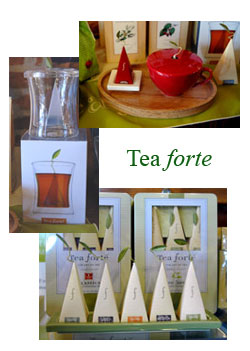
15% Off all
Tea forte
items
beginning at 5:00 pm on
Thursday, May
7th
through
Saturday, May 9th
Includes teas, cups, teapots and
accessories!
You'll love their new summer items designed for
the best summer iced teas. Check out the new "cocktail
infusions!"
|
JUST IN!
|
New
arrivals to the store happen each day! Here are just a few of
the items we think you'll want to know
about!
 Have a Happier Hour!
-- New glasses have just arrived that have a unique
shape that's just fun to hold in your hand! The glass has an
oval shape that twists ninety degrees from top to
bottom. Have a Happier Hour!
-- New glasses have just arrived that have a unique
shape that's just fun to hold in your hand! The glass has an
oval shape that twists ninety degrees from top to
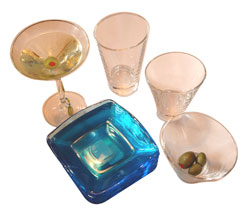
bottom. 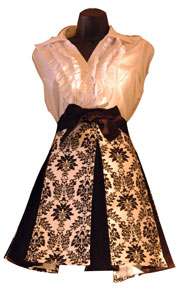 The
glasses are featured in a stemless martini glass, a taller
old-fashioned glass, and a highball glass. Pair your new
drinkware with some new appetizer plates and let the evening
begin! The
glasses are featured in a stemless martini glass, a taller
old-fashioned glass, and a highball glass. Pair your new
drinkware with some new appetizer plates and let the evening
begin!
Fashion in the
Kitchen! -- Aprons have made a comeback! Not
only do aprons serve a functional role by catching cooking spills
and splatters, but they add a bit of panache to your time in the
kitchen. The newest arrivals in our apron line-up are some box pleat
aprons that you'll love!
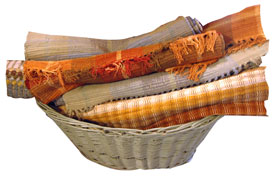
Laydown Rugs! -- These
cotton rugs have just arrived with a splash of sumptuous
color. These throw rugs are perfect in the kitchen, by the
back door, or in the breezeway. Washable and available in three
sizes, you'll find that adding these rugs will give your space an
instant
makeover!
|
Essential
Cake Techniques
|
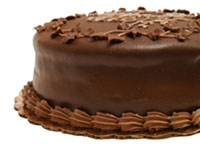 Some
manufacturers of boxed cake mixes would have you believe that making
a cake is difficult. Not so! With a few key techniques your baking
repertoire can be expanded and the possibilities unleashed - there's
a large world outside of the box! Baking a cake turns you into
a bit of a kitchen chemist; combining ingredients in a certain
sequence and manner takes advantage of natural chemical reactions.
Understanding a little about what's going on will help you bake your
best cake ever! Some
manufacturers of boxed cake mixes would have you believe that making
a cake is difficult. Not so! With a few key techniques your baking
repertoire can be expanded and the possibilities unleashed - there's
a large world outside of the box! Baking a cake turns you into
a bit of a kitchen chemist; combining ingredients in a certain
sequence and manner takes advantage of natural chemical reactions.
Understanding a little about what's going on will help you bake your
best cake ever!
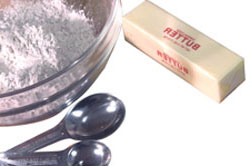 Measuring the Ingredients -
Improvisation in the kitchen is where the fun happens. However, when
baking there are certain rules and ratios to be followed so that the
chemistry of the recipe works well. Measuring ingredients
accurately is one of those rules that produces the desired results.
Use dry measuring cups for dry ingredients, and liquid measuring
cups for liquid ingredients. Choose high-quality measuring spoons
that are accurate; equipment testers report finding up to 25%
inaccuracy with some kitchen tools. Fluff your flour with a fork,
then spoon it into your measuring cup. Never pack flour, nor tap the
cup so that it settles. The only dry ingredient that is packed when
measured is brown sugar. Measuring the Ingredients -
Improvisation in the kitchen is where the fun happens. However, when
baking there are certain rules and ratios to be followed so that the
chemistry of the recipe works well. Measuring ingredients
accurately is one of those rules that produces the desired results.
Use dry measuring cups for dry ingredients, and liquid measuring
cups for liquid ingredients. Choose high-quality measuring spoons
that are accurate; equipment testers report finding up to 25%
inaccuracy with some kitchen tools. Fluff your flour with a fork,
then spoon it into your measuring cup. Never pack flour, nor tap the
cup so that it settles. The only dry ingredient that is packed when
measured is brown sugar.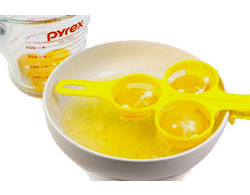
Egg Power - Eggs are the golden
not-so-secret ingredient for cakes. Eggs provide protein
strands that create the cake's structure when baked. Whipped
eggs expertly hold air bubbles that give the cake its airy texture.
Always use room temperature eggs when baking; the temperature
relaxes the protein strands making them more available when
constructing the batter. Some cake batters call for whole eggs,
others call for separating the yolks and whites. When separating
eggs, take care; the smallest bit of egg yolk will keep egg whites
from whipping up to their full potential.
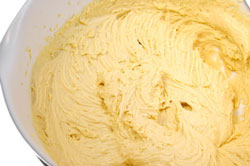 Batter
Up - Cake batters vary in composition. Generally,
liquid ingredients are assembled, and dry ingredients added
gradually. Stir all dry ingredients together well unless otherwise
instructed. Dry ingredients may be sifted through a sieve as they
are being added to the liquid to avoid clumps in the batter. Unlike
muffins or pie crust where we're urged to keep mixing to a minimum,
cake batters like to be mixed. A good cake recipe will specify how
long to beat the batter at the various sta Batter
Up - Cake batters vary in composition. Generally,
liquid ingredients are assembled, and dry ingredients added
gradually. Stir all dry ingredients together well unless otherwise
instructed. Dry ingredients may be sifted through a sieve as they
are being added to the liquid to avoid clumps in the batter. Unlike
muffins or pie crust where we're urged to keep mixing to a minimum,
cake batters like to be mixed. A good cake recipe will specify how
long to beat the batter at the various sta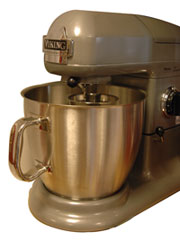 ges. Don't
shortcut the mixing times - a lot is happening. The necessary
chemical reactions take time, and the all-important air is being
incorporated during those minutes of mixing. We love our mixer that
has the elapsed mixing time noted right on the
appliance. ges. Don't
shortcut the mixing times - a lot is happening. The necessary
chemical reactions take time, and the all-important air is being
incorporated during those minutes of mixing. We love our mixer that
has the elapsed mixing time noted right on the
appliance.
Adding
Air - Incorporating air into the batter and trapping it in
the baking process creates the cake's texture. A fine, even texture
of tiny, trapped bubbles is the goal when cake-making. Recipes that
use baking powder generate some of the bubbles through a chemical
reaction that releases air as the powder meets the liquid. Air is
also mechanically incorporated into the batter during the beating
process. Once the beating is completed, pour the batter into waiting
pans and bake immediately. Do not allow the batter to stand in
the mixing bowl; those hard-won bubbles will disappear and you'll
have a flat cake!
Learn How to Fold - A great baking
technique to master is folding. When maximum
air is called for,egg whites are
often whipped 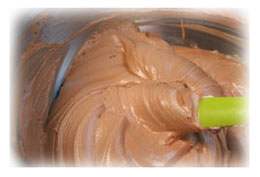 separately to a
soft peak stage. The egg whites are then added to the cake batter
very carefully. We like to take a small portion of the egg whites
and add it to the waiting batter to lighten it first. Then, adding
one third of the egg whites at a time, draw a rubber spatula through
the center of the batter all of the way to the bottom of the bowl.
Lift the spatula allowing the whites and batter to fall gently on
the top. Turn the bowl slightly and repeat the reaching down and
lifting up. Continue this gentle motion just until no white streaks
remain. Work slowly and preserve those air bubbles! separately to a
soft peak stage. The egg whites are then added to the cake batter
very carefully. We like to take a small portion of the egg whites
and add it to the waiting batter to lighten it first. Then, adding
one third of the egg whites at a time, draw a rubber spatula through
the center of the batter all of the way to the bottom of the bowl.
Lift the spatula allowing the whites and batter to fall gently on
the top. Turn the bowl slightly and repeat the reaching down and
lifting up. Continue this gentle motion just until no white streaks
remain. Work slowly and preserve those air bubbles!
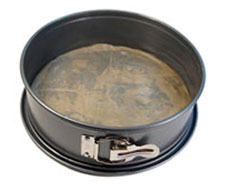 Pick
the Right Pan - Cake recipes are designed to fit a
specifically-sized pan. Matching your pan to the recipe will ensure
that all of the batter will fit, that there will be enough room for
rising, and that the baking time is accurate. Choose good quality
pans that will not warp when exposed to heat, nor dent or bend
easily when stored. Pick
the Right Pan - Cake recipes are designed to fit a
specifically-sized pan. Matching your pan to the recipe will ensure
that all of the batter will fit, that there will be enough room for
rising, and that the baking time is accurate. Choose good quality
pans that will not warp when exposed to heat, nor dent or bend
easily when stored.
Pan
Prep - Some proper preparation of the pan will save cursing
later when removing the baked cake. Again, a good recipe will
recommend the best pan prep. Instructions will vary from buttering
or greasing the pan, to greasing with a light dusting of flour, to
inserting a layer of parchment paper.
Baking Temperatures - The chemistry
of cake-making all comes together during the baking process. Air
expands when heated amplifying the power of the tiny batter bubbles.
The proteins in the batter are immortalized trapping the air and
forming the texture. Most cake baking is done in a medium oven
between 325°-350° F. Make sure your oven and racks are level.
If your oven has "hot spots" you may need to compensate by rotating
pans during baking. Ideally, to preserve consistency, the oven
door stays closed until it's time to test for
doneness.
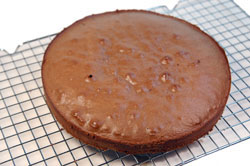
Testing for Doneness - It seems
like most cakes are dry and over-baked. We like to set our timer for
five minutes less than the recipe calls for and begin our testing at
that stage. A toothpick, cake tester, or thin-bladed knife
placed in the center of the cake should come out clean. Sometimes
it's ready at the early stage, sometimes precisely on the mark, and
sometimes 5-10 minutes later. If your pan differs from the recipe's
recommendation, the time of doneness will be impacted.
Unmolding - If your pan has been
prepped well, removing the cake from the pan is no problem. If
necessary, run the back of a thin-bladed knife around the sides of
the pan. Place a cooling rack on top of the slightly cooled cake pan
and invert the two together. The cake pan may be lifted off leaving
the cake safely on the cooling rack. Use a second cooling rack to
re-invert if necessary. If your cake sticks to the bottom of the
pan, pay closer attention to the pan preparation step the next time
around. |
Cupcake
Crazy
|
Petite,
portable, and portion-controlled, cupcakes are enjoying a
well-deserved renaissance. There's a buzz about cupcakes that's
generated a rash of bakeries in larger cities that specialize in
just cupcakes.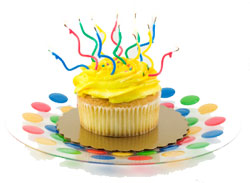 No longer just
a "kid-thing," cupcakes appeal to all generations just because of
their size and portability. Cupcakes hold just the right of amount
of self-indulgence without breaking the bank or the buttons, and
they don't require any utensils for serving or eating. No longer just
a "kid-thing," cupcakes appeal to all generations just because of
their size and portability. Cupcakes hold just the right of amount
of self-indulgence without breaking the bank or the buttons, and
they don't require any utensils for serving or eating.
The
term "cupcake" originated from the early baking traditions that used
small cups made of pottery to bake the sweet confections. These
baking molds predate muffin tins and were reported to be about the
size of a teacup. We love the whimsical British term for cupcakes,
"fairy cakes."
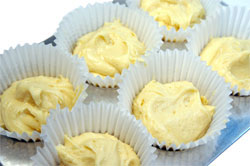 Cupcakes
come in all sizes. Have some fun experimenting with different pans
that yield perfectly portioned pieces: Cupcakes
come in all sizes. Have some fun experimenting with different pans
that yield perfectly portioned pieces:
Cupcakes often
suffer from over-baking and dryness. To solve this, choose the right
recipe and monitor doneness diligently. Bake cupcakes up to a month
in advance and freeze until ready for icing and
decorating.
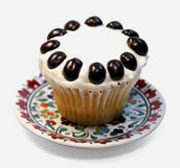 Paper liners
for baking cupcakes eliminate any pan prep while keeping the petite
cakes from drying out afterwards. Some fun silicone cupcake holders
make for a lot of added fun. Paper liners
for baking cupcakes eliminate any pan prep while keeping the petite
cakes from drying out afterwards. Some fun silicone cupcake holders
make for a lot of added fun.
Decorating cupcakes is a great
way to spend time with little chefs and to express your own
creativity. Begin with a base layer of frosting applied with the
help of an offset spatula, a tool that is quite handy for this task.
Any icing
appropriate for a cake is appropriate for
cupcakes with the exception of 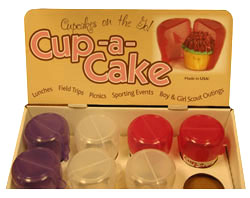 icings that are
primarily whipped cream. Designs and
flourishes may be piped on with a simple decorator's kit, or fun
shapes molded from ready-made fondant. Sometimes simple toppings are
all that's needed: toasted nuts, coconut, fruit, colored sugars,
nonpareils, little candies, or chocolate shavings. icings that are
primarily whipped cream. Designs and
flourishes may be piped on with a simple decorator's kit, or fun
shapes molded from ready-made fondant. Sometimes simple toppings are
all that's needed: toasted nuts, coconut, fruit, colored sugars,
nonpareils, little candies, or chocolate shavings.
The
cupcake itself is just the beginning of the fun! We've seen
cupcakes arranged in tiers in lieu of wedding cakes, cupcake
decorating contests, cupcake haiku, cupcake blogs; it's endless and
timeless! |
Sculptures
in Cake
|
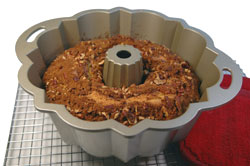 Most of us are
familiar with the classic Bundt cake pan. Originating from a
German tradition of kugelhopf, (coffeecakes baked in a
fluted ring pan), the modern day Bundt pan was developed in the
1950's by H. David Dahlquist in Minneapolis, MN. Mr. Dahlquist's
company became the Nordic Ware company that is well-known today for
its quality bakeware. More than 50 million of the trademarked Bundt
pans are reported to have been sold. And, should you find yourself
in a food trivia contest, National Bundt Pan Day is November
15th! Most of us are
familiar with the classic Bundt cake pan. Originating from a
German tradition of kugelhopf, (coffeecakes baked in a
fluted ring pan), the modern day Bundt pan was developed in the
1950's by H. David Dahlquist in Minneapolis, MN. Mr. Dahlquist's
company became the Nordic Ware company that is well-known today for
its quality bakeware. More than 50 million of the trademarked Bundt
pans are reported to have been sold. And, should you find yourself
in a food trivia contest, National Bundt Pan Day is November
15th!
Nordic Ware cake pans are constructed from heavy
aluminum that promotes even baking. The special surface provides
great detail and easy unmolding. Bundt bakeware features large,
single cake pans and molds for individual cakes. 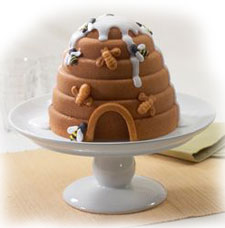 Each Bundt pan
is sized by volume for easy matching to an appropriate recipe.
At their
website, Nordic Ware provides some great tips for "How-To Bake the Perfect Bundt
Cake." Each Bundt pan
is sized by volume for easy matching to an appropriate recipe.
At their
website, Nordic Ware provides some great tips for "How-To Bake the Perfect Bundt
Cake."
Also, with the
pan and on the Nordic Ware website you'll find great cake recipes
that "match the pan." The recipes have been tested thoroughly and
yield a cake that holds its shape and carries the detail of the pan
well. Oh, and the Nordic Ware recipes taste great!
From
their classic beginnings, the Nordic Ware people have unleashed
their creativity in the 21st century into a whole line of sculpted
cake pans. You can find a variety of molds that turn a simple cake
into a celebration. We like to think of these pans as
"traditions in the making." The sturdy pans last a lifetime
and will be one of those items that get passed on to future
generations. Choose from different seasonal motifs such as a bunny,
a pumpkin, holiday trees, floral designs, hearts, or even a beehive,
and start your own family cake
tradition. |
Smart
Cake-Making Tips
|
Tip #1:
Did you forget
to take the butter out of the refrigerator to soften? Set the sticks
upright on the kitchen counter for maximum air circulation for about
30 minutes. Meanwhile, you can prepare your baking pans, measure
other ingredients, etc. If you're very careful, a stick of
butter can be softened on the defrost cycle of your microwave in a
mere five seconds.
 Tip #2:
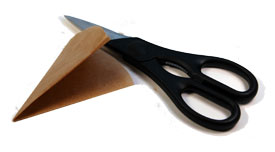
Use a technique
from grade school to prepare parchment paper for your baking pans.
For a round pan, fold a square of parchment paper in half, half
again, and once more - 8 layers of paper. With your kitchen
shears, (handily stored in your knife block), freehand cut an arc
with a radius equidistant from the folded point. Trim as necessary
for a final fit. Tip #2:
Use a technique
from grade school to prepare parchment paper for your baking pans.
For a round pan, fold a square of parchment paper in half, half
again, and once more - 8 layers of paper. With your kitchen
shears, (handily stored in your knife block), freehand cut an arc
with a radius equidistant from the folded point. Trim as necessary
for a final fit.
Tip #3:
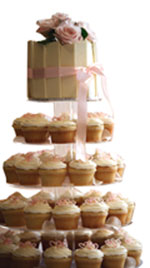
To create a
visually appealing presentation, display cakes and cupcakes at
different heights. A cake stand is the perfect pedestal for your
lovely baked creation. It not only elevates the cake, but the
occasion as well. A tiered serving plate is perfect for
displaying and serving a set of cupcakes.
Tip #4:
Transporting
cakes and other baked goods can be a challenge. Give yourself
a fighting chance of getting your creation to its destination by
using specialized cake or cupcake transporters. The covered design
of transporters will keep your decorations safe and the cake moist
and fresh.
Tip #5:
Decorate a
batch of cupcakes in such way that when served together create a
presentation design, similar to pieces of a
puzzle.
|
Q
& A's
|
 Q:
My baking pans have a greasy residue on them. What is it and
why can't I clean it off? Q:
My baking pans have a greasy residue on them. What is it and
why can't I clean it off?
A: Many popular cooking
sprays will leave a residue on your baking pans that is nearly
impossible to remove. To keep your pans looking like new and baking
well, we recommend using butter or oil to grease your pans. For many
applications, parchment paper or silicone mats will create a
non-stick baking surface. The only spray recommended by Nordic Ware
for use with their Bundt pans is Baker's Joy Non-Stick Spray which
supplies both flour and oil in the spray.
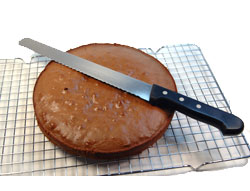
Q: What's the best way to cut one cake
layer into two layers?
A: Some layered cake recipes
call for thin layers of cake where one baked layer is cut in half.
To obtain two equally thick layers, use a long-bladed, serrated
knife such as a bread knife. Score the outer edge with the
knife cutting no more than one half-inch deep. Once scored all
around, begin cutting deeper with the serrated knife turning the
layer gradually and using the scored line as a guide. Alternatively,
use a cake layer slicer that has wires that evenly cut into
pre-measured layers.
Q: What's the origin of the phrase
"Let them eat cake!"
A: This common phrase
is most often attributed to Marie Antoinette from the mid-18th
century. When told that the French people had no bread to eat due to
a flour shortage and a complex pricing policy, she uttered the
remark. To our modern ear, the remark seems rather callous. However,
the French phrase is "Qu'ils
mangent de la brioche," refers to a baked good that relied
more on eggs and less on flour, and would have been more available
and nutritious to the peasantry.
Q: How do I keep crumbs from
gathering during frosting?
A: Tops of cakes have just a
bit of crust that holds the cake surface intact. The sides and
bottoms, however, do not. Freeze the cake layers just slightly
before frosting. The outer frozen surface will make spreading
the frosting easy with less crumbling during frosting.
Q: What are "butterfly
cakes?"
A:
This fanciful term comes from a 1950's tradition with cupcakes. To
make your own butterfly cakes, trim off the top of the cupcake, cut
in half and set aside. Scoop out some of the crumb from the cupcake
base and fill with fruit compote, whipped cream, or pudding. Place
the two halves in the filling at an angle to simulate butterfly
wings.
|
Q
& A's
|
The Modern
Baker, Time-Saving Techniques for Breads, Tarts, Pies, Cakes, and
Cookies by Nick Malgieri. Copyright 2008. Published by DK
Publishing, New York, NY.
A
2009 Nominee for the prestigious IACP Cookbook
Awards.
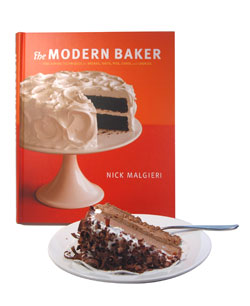 If
you're inspired to develop your "inner baker," this book is for you!
Mr. Malgieri has assembled the new primer for making baked goods at
home. The hefty book covers breads, tarts, pies, cakes, and cookies.
He's constructed his recipes in a step-by-step fashion that brings
the novice along, while retraining the expert baker in new
techniques that save time without compromising the ingredients or
the results. As Malgieri states, "this whole book is very technique
oriented, with explanations about the hows and whys . . . . " It's
hard to beat fresh-baked food, and nothing is fresher than those
items made in your own kitchen. Mr. Malgieri promotes taking a
Zen-like attitude toward baking - something to be enjoyed, the
process savored, and the results relished. Expertly photographed by
Charles Schiller, the luscious pictures are pure inspiration by
themselves. We love a well put-together book, and this one qualifies
in content, design, and published quality; it's obvious why this
book has risen to the top tier of the cookbook
world. If
you're inspired to develop your "inner baker," this book is for you!
Mr. Malgieri has assembled the new primer for making baked goods at
home. The hefty book covers breads, tarts, pies, cakes, and cookies.
He's constructed his recipes in a step-by-step fashion that brings
the novice along, while retraining the expert baker in new
techniques that save time without compromising the ingredients or
the results. As Malgieri states, "this whole book is very technique
oriented, with explanations about the hows and whys . . . . " It's
hard to beat fresh-baked food, and nothing is fresher than those
items made in your own kitchen. Mr. Malgieri promotes taking a
Zen-like attitude toward baking - something to be enjoyed, the
process savored, and the results relished. Expertly photographed by
Charles Schiller, the luscious pictures are pure inspiration by
themselves. We love a well put-together book, and this one qualifies
in content, design, and published quality; it's obvious why this
book has risen to the top tier of the cookbook
world.
|
Fancy Cake Recipes
|
Recipes excerpted from The Modern
Baker by Nick Malgieri. Copyright 2008. Used by permission of
DK Publishing, New York, NY. Used
with permission. All rights
reserved.
Sour Cream
Coffeecake
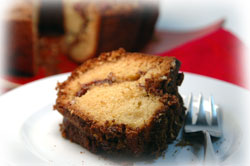 While baking,
the kitchen was redolent with the aromas of cinnamon and sugar - we
could hardly stand it! The result was a moist slice of coffeecake
that lived up to all of the anticipation. The cake unmolded without
any error - the sign of a good pan matched with a good recipe! Each
bite melted in our mouths. This recipe is quick, easy, and
definitely in the "keeper" file. While baking,
the kitchen was redolent with the aromas of cinnamon and sugar - we
could hardly stand it! The result was a moist slice of coffeecake
that lived up to all of the anticipation. The cake unmolded without
any error - the sign of a good pan matched with a good recipe! Each
bite melted in our mouths. This recipe is quick, easy, and
definitely in the "keeper" file.
Click here to view the
recipe.
Click here for a printable version of
the recipe.
Golden
Cupcakes
These
cupcakes had substance, not anything like the inferior cupcakes of
questionable character that we've become accustomed to. It's like
biting into a real peach! Moist from the sour cream, the petite
cakes domed perfectly providing a proper canvas for frosting and
decorating. They made several people instantly happy!
Click here to view the
recipe.
Click here for a printable version of
the recipe.
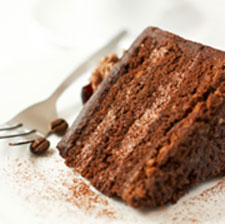
Milk Chocolate
Mousse Cake
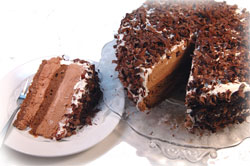 Ok,
this one is a little more complex, but oh, sooo worth it! It's
really two recipes combined into multiple layers of pure dessert
nirvana. A triple chocolate experience, two layers of cocoa génoise
(cake) provide the structure, two layers of chocolate mousse are
interleaved, and the entire masterpiece is slathered with whipped
cream and generously topped with chocolate curls. Thankfully, the
process can be staged over a couple of sessions in the kitchen and
then completed well ahead of any guests arriving. Ok,
this one is a little more complex, but oh, sooo worth it! It's
really two recipes combined into multiple layers of pure dessert
nirvana. A triple chocolate experience, two layers of cocoa génoise
(cake) provide the structure, two layers of chocolate mousse are
interleaved, and the entire masterpiece is slathered with whipped
cream and generously topped with chocolate curls. Thankfully, the
process can be staged over a couple of sessions in the kitchen and
then completed well ahead of any guests arriving.
.
Click here to view the
recipe.
Click here for a printable version of
the
recipe.
| |


 Songs
must be sung, flames must be lit, cutting carefully choreographed,
and photos flashed all the while to memorialize the moment. So is
the converse true? Does the presence of a cake mean the occasion is
special? We say, "Yes!" Making your own cake is easier than you
think and the results are so much more rewarding than the
alternative. In this issue we'll present some essential techniques
for making delicious cakes that live up to the expected standard,
and riff on some fun variations in the cake family - cupcakes and
molded cakes. We finish with a review of a brand-new cookbook
that will inspire your "inner baker," and three recipes from that
book that will have you craving an occasion just for the
cake!
Songs
must be sung, flames must be lit, cutting carefully choreographed,
and photos flashed all the while to memorialize the moment. So is
the converse true? Does the presence of a cake mean the occasion is
special? We say, "Yes!" Making your own cake is easier than you
think and the results are so much more rewarding than the
alternative. In this issue we'll present some essential techniques
for making delicious cakes that live up to the expected standard,
and riff on some fun variations in the cake family - cupcakes and
molded cakes. We finish with a review of a brand-new cookbook
that will inspire your "inner baker," and three recipes from that
book that will have you craving an occasion just for the
cake!