 The Olive Harvest – Olives command a labor-intensive harvest. Harvesters spread nets on the ground and shake the olives from the tree. Or, they scrape branches by hand or mechanically and catch the olives as they fall. Fortunately, the trees rarely reach heights above 15 meters, and the nets separate undesirable ground fall olives from the usable, harvested fruit. Olives are picked when full-sized, but may be either unripe and green, or fully ripened and black. Olives destined for oil production are picked just before they’re fully ripe. Freshly picked, the olives are unpalatable due to the presence of phenolic compounds and the bitter, naturally occurring oleuropein. The subsequent processing converts the olive from inedible to prized.
Olive Processing – Once picked, the olives are subjected to a variety of fermentation and curing routines, depending on the desired outcome. Cured green olives have a firmer texture than their ripe, black counterparts.

Brine curing – The olives are washed, then placed in a brine of salt, water, and vinegar to ferment. Within two to four weeks, the olives are considered edible.
Oil cured – Washed olives are placed in oil and left to set for several months.
Dry cured – After washing, the olives are packed in salt for a month or more.
Water cured – Olives are soaked in a water bath where the water is exchanged regularly.
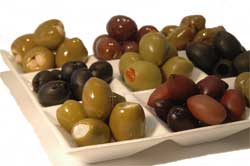
Olive Flavors – Once basic curing has occurred additional flavors are infused. Popular additions include hot chilies, garlic, lemon, oregano and other herbs. Today, we find olives stuffed with small pearl onions, whole garlic cloves, hot peppers, whole almonds, fine blue cheese, and nearly anything else that will fit neatly.
Types of Olives – The list of olive types would exhaust this discussion, but it’s worth noting a few of the more common types and characteristics. With the increase in popularity of bulk olives, it’s easy to experiment with the different olives available.
Manzanillo – This variety of olive is grown worldwide, and is one of the more common types available. Its fruit is a large, rounded oval shape with a rich, thick pulp surrounding the seed.
Mission – These olives are grown in California and found primarily as canned, black versions. The processing of canned mission olives involves a lye treatment that hastens the curing process of unripe green olives and simultaneously turns them black.
Arbequina – Grown in Catalonia, Spain, these small brown olives are admired as a table olive and for their oil.
Cerignola – Noted for their giant size and bright green color, these olives are harvested in Cerignola, Italy. Large and meaty, they’re a natural for stuffing, or for taking center stage on the antipasto plate.
Kalamata – From Greece, these olives have a narrower shape with pointed ends. These black olives are cured in brine that uses red wine vinegar. Similar to Champagne, or Parmigiano-Reggiano, Kalamata olives enjoy the status of Controlled Designation of Origin. Only Kalamata olives grown in Greece may be called “Kalamata.”
Niçoise – These tree-ripened olives are tiny and pulpy and are native to Nice, France.
Frantoio – Found in Italy’s Tuscan region, and prized as a source of olive oil, these olives have a strong, fruity taste.
Leccino – Also from Tuscany, this sweet, mild-flavored olive is another common source of olive oil.
The branches of the olive tree have a reputation as a symbol for peace. The tradition of offering an olive branch, or planting an olive tree, was an act of faith that implied the beginning of a long, peaceful future as the tree matured to fruition.