Special
Event - June 6th
|
Join us on
June
6th from 11:00 am - 3:00 pm as we celebrate our 9th
anniversary at Kitchen Collage! First of all, we'd like to
thank you, our loyal customers, for making these past nine years a
fantastic experience! You have provided us with the enjoyment
of your friendship, and the motivation and stimulation for bringing
the finest products to your home!
Join us on Friday, June
6th, as we celebrate with hourly giveaways and
demonstrations. We'll be baking cookies with Heartland
Bakeware, chopping and dicing with knives from Wusthof-Trident,
grilling panini with Cuisinart, and making smoothies and garnishes
with Harold Imports. No party would be complete without food
-- we'll have many treats and drinks to sample. We look
forward to seeing you!
|
| At the
Collage |
COOKING
EVENTS: Call (515) 270-8202 to
register!
Friday, June 6th -
11:00 - 3:00 pm
Anniversary
Celebration - Join us as we celebrate the 9th anniversary of
Kitchen Collage! We'll have several
experts on hand to answer your questions and show
you the latest and greatest! (See above announcement for more
details).
Saturday, June 7th -
9:00 am - 1:00 pm
Knife
Sharpening Event - Expert: Clark Stone, Wusthof
Trident. Get your edge back on your knives! Our Wusthof
Trident representative will be at the Collage to expertly sharpen
your knives. Each knife will be reconditioned to perfect
sharpness for a $3/knife donation. Donations will be matched
by Kitchen Collage and given to the Food Pantry.
Wednesday, June 11th
- 5:30 - 7:30 pm
Blue
Ribbon Fruit Pies - Instructor: Lana Ross, Blue Ribbon
Pie Maker. Join us as Lana teaches us the essentials to the
quintessential spring pair found in Strawberry-Rhubarb Pie.
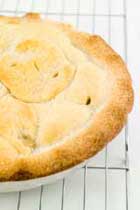 She will also share her
version of a Luscious Lemon Blueberry Pie. From the perfect
pie crust to the proper thickeners, you'll take away information
suitable for all types of summer fruit pies. $50. Just
a few seats left; call to reserve a place! She will also share her
version of a Luscious Lemon Blueberry Pie. From the perfect
pie crust to the proper thickeners, you'll take away information
suitable for all types of summer fruit pies. $50. Just
a few seats left; call to reserve a place!
Thursday, June 19th -
5:00 - 7:00 pm TWO
SESSIONS!
Friday, June 20th - 12:00 - 1:30
pm
Healthy,
Fresh and Local - Instructor: Pete
Trusiak, Corporate Chef, Westye Group of Chicago. Pete is a
great talent who is passionate about using local produce in his
cooking. We'll use the produce from One Step at a Time
Gardens, our Community-Supported Agriculture partner, as we
plan a menu around what's in season, and what's local. Learn
how to shift your thinking about menu planning and preparing healthy
meals. $50. Waiting list only
for Thu evening session; seats available for Fri. noon. Call
to reserve a place.
Call
to reserve your place - (515)
270-8202! |
Farm Shares
- The First Deliveries Have Arrived!
|
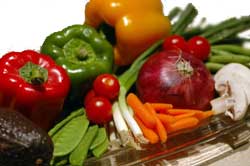 Farm Shares from One Step at a Time
Gardens Farm Shares from One Step at a Time
Gardens
Kitchen Collage
is pleased to be one of two pickup locations in Greater Des
Moines. One Step at a Time
Gardens is a Community Supported Agriculture (CSA) model of
farming where individuals and families subscribe for a season of
fresh, clean, sustainably grown produce from this local farm.
Weekly shares are dropped off at Kitchen Collage for individual
pickup by "shareholders." Weekly shares come in a variety of
sizes appropriate for any family. So that crops can be
planned, sign up now through their website form at www.ostgardens.com, or contact them at
641-495-6367. |
Marinade Magic
|
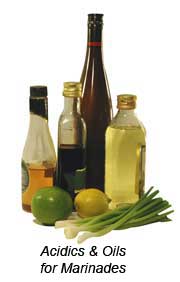 Marinades are a great method for introducing
flavor into meat, poultry, seafood, and vegetables. Liquid in
nature, marinades have an acidic component, oil, and added
spices. The acids in the marinades begin the process of
breaking down the proteins in the meat. As well, the liquid is
absorbed at the cellular level, "plumping up" the food before
grilling. Marinades are a great method for introducing
flavor into meat, poultry, seafood, and vegetables. Liquid in
nature, marinades have an acidic component, oil, and added
spices. The acids in the marinades begin the process of
breaking down the proteins in the meat. As well, the liquid is
absorbed at the cellular level, "plumping up" the food before
grilling.
Whether vinegar, citrus juice, or
wine, the marinade's acidic ingredient starts the process of
changing the food. The marinade's action, which produces a
more tender result, is particularly useful for tougher cuts of meat,
such as a skirt or flank steak.
The mild acidity
of yogurt and buttermilk create a delicate marinade particularly
suited to fish and seafood. These dairy products are known to
remove any hint of "fishy-ness" that might be present.
The marinade's oil component
keeps the marinated foods from drying out. As the acid breaks
down the proteins, the meat soaks up some of the oil helping to
preserve the food's natural moisture. Most marinades have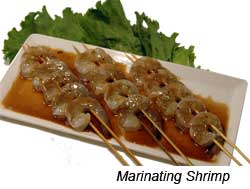 20 - 25% oil; too much oil will prevent the
absorption of the other flavors. Using an oil with a higher
smoke point, (canola, safflower, or extra virgin olive oil), will
prevent excess smoking when grilling. 20 - 25% oil; too much oil will prevent the
absorption of the other flavors. Using an oil with a higher
smoke point, (canola, safflower, or extra virgin olive oil), will
prevent excess smoking when grilling.
The size and cut
of the meat impact the marinating process. Marinade a large
cut of meat overnight, a medium cut for 8 hours, and small cuts
(steaks, chicken breasts), for 2-4 hours. Fish and other
seafood protein structures are delicate and require no more than
15-20 minutes of marinating; beyond this timeframe the fish will
become mushy and unusable. Always refrigerate foods while
marinating.
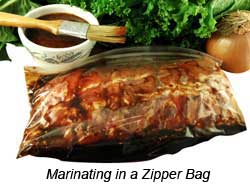
When marinating any type of food, use a
non-reactive container such as glass, or stainless steel.
Periodically turn the meat in the marinade, or baste with excess
marinade. For smaller cuts of meat, it's hard to beat a zipper-type
plastic bag; it's easy to turn the contents within the liquid,
requires less marinade, and cleans up
easily.
|
Rub It
In!
|
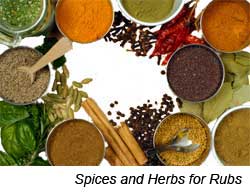 Rubs are another favored method for adding
flavor to grilled foods. A rub influences the surface of the
food by providing a flavorful, crusty complement to the food's
interior. By definition, rubs are comprised of salt, sugar,
and spices. From this basic formula, the combinations of
spices and herbs are nearly endless in generating flavors that span
the globe. Rubs are another favored method for adding
flavor to grilled foods. A rub influences the surface of the
food by providing a flavorful, crusty complement to the food's
interior. By definition, rubs are comprised of salt, sugar,
and spices. From this basic formula, the combinations of
spices and herbs are nearly endless in generating flavors that span
the globe.
A rub combination is sprinkled on the
meat, poultry or seafood, then massaged into the surfaces with
fingertips. A rub applied just before grilling adds flavor,
but a rub added several hours earlier to meat or poultry greatly
deepens the flavors and adds a bit of curing action to the
process.
Toasting the spices prior to adding the
salt and sugar will activate the spices' aromatic oils, and allow
the flavors to bloom and transfer into the meat. 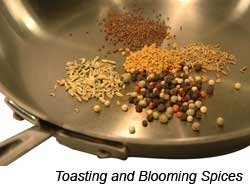 To toast spices, begin with whole spices placed
in a skillet over medium heat with no added oil or liquid. Let
the spices heat while stirring frequently or tossing often.
Once fragrant, remove from heat and immediately transfer the spices
from the skillet to a suitable bowl or plate for cooling. Take
care to only lightly toast the spices, avoiding any burnt or bitter
tastes that might result from excess heat. To toast spices, begin with whole spices placed
in a skillet over medium heat with no added oil or liquid. Let
the spices heat while stirring frequently or tossing often.
Once fragrant, remove from heat and immediately transfer the spices
from the skillet to a suitable bowl or plate for cooling. Take
care to only lightly toast the spices, avoiding any burnt or bitter
tastes that might result from excess heat.
Grind the
toasted, whole spices in a spice mill, impact grinder, or with a
mortar and pestle. Once mixed, most rubs may be stored in an
airtight container for several months.
While rubs are
generally thought of as a combination of dry ingredients, wet rubs
incorporate small amounts of liquid or wet ingredients, such as
vinegar, mustards, or lemon juice. 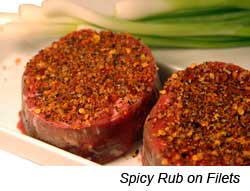 Paste-like in consistency, a wet rub differs
from a marinade in the quantity of liquid used. To try another
form of wet rub, apply a very light coating of oil or mustard on the
meat just prior to applying a dry rub mixture. Paste-like in consistency, a wet rub differs
from a marinade in the quantity of liquid used. To try another
form of wet rub, apply a very light coating of oil or mustard on the
meat just prior to applying a dry rub mixture.
The
spices in a rub impart a huge amount of intense flavor to the
finished food. The salt inspires a taste intensity, and the
sugar's caramelization brings a flavor complexity and a delicious
brown crust.
|
Grilling
Gear
|
 If there's one
thing that grilling inspires, its innovation! The aficionado
in all of us motivates a perpetual quest to perfect our technique
and a continual pursuit of our outdoor cooking enjoyment. Our
fellow experts have been busy perfecting their craft and bringing
their ideas to the rest of us. Here are a few of our favorite
additions to grilling gear: If there's one
thing that grilling inspires, its innovation! The aficionado
in all of us motivates a perpetual quest to perfect our technique
and a continual pursuit of our outdoor cooking enjoyment. Our
fellow experts have been busy perfecting their craft and bringing
their ideas to the rest of us. Here are a few of our favorite
additions to grilling gear:
Wood - This sounds rather obvious,
but as the saying goes, "what's old is new again!" Flavoring your
grilled foods with different wood flavors can be your secret
ingredient. Aromatic wood
chips, paper-thin cedar wraps, and cedar planks are some of the
easiest ways to add classic wood flavor to your charcoal or gas
grill.
 Thermometers - The most common
grilling error is overcooking meat. A thermometer provides
confidence that the proper temperatures have been reached - no need
to give it an extra minute. Instant-read, remote, digital read
- there's a solution for everyone. One of our favorites this
season is the four-pack of individual thermometers for custom
grilling of your steaks. Thermometers - The most common
grilling error is overcooking meat. A thermometer provides
confidence that the proper temperatures have been reached - no need
to give it an extra minute. Instant-read, remote, digital read
- there's a solution for everyone. One of our favorites this
season is the four-pack of individual thermometers for custom
grilling of your steaks.
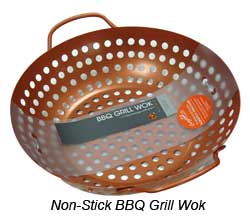 Baskets - Variations on grilling
baskets only get better and better! Baskets and grill mats
allow for the grilling of delicate foods with all of the smoky
pleasures imbued, but without the loss of any food between the
grates. An interesting variation on the grill basket is the
grill wok - stir-fry meets the outdoors! Baskets - Variations on grilling
baskets only get better and better! Baskets and grill mats
allow for the grilling of delicate foods with all of the smoky
pleasures imbued, but without the loss of any food between the
grates. An interesting variation on the grill basket is the
grill wok - stir-fry meets the outdoors!
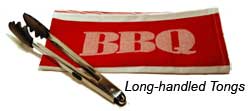
 Tongs - If you're not adept at
using tongs in your cooking routine, grilling is a great time to
start the habit. Tongs allow a firm grip of the food for
turning, moving, and removing foods without the piercing and
subsequent moisture loss that a fork might cause. Tongs with
covered "claws" resist heat transfer, ensuring a cool grip.
Use one pair of tongs for handling raw foods, another for cooked
foods. Tongs - If you're not adept at
using tongs in your cooking routine, grilling is a great time to
start the habit. Tongs allow a firm grip of the food for
turning, moving, and removing foods without the piercing and
subsequent moisture loss that a fork might cause. Tongs with
covered "claws" resist heat transfer, ensuring a cool grip.
Use one pair of tongs for handling raw foods, another for cooked
foods.
Grill
Safety - Be safe around the grill - use long-handled forks,
spatulas, brushes and tongs for placing, turning and removing
foods. Long silicone mitts reduce the possibility of a
traditional mitt or hot pad catching fire.
 And that's not
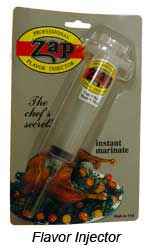
all! You'll find flavor injectors, propane tank fuel
indicators, wire brushes for cleaning, magnetic lights for
after-dark grilling, steak knives, carving boards, burger presses,
and loads of ready-to-go marinades and
rubs! And that's not
all! You'll find flavor injectors, propane tank fuel
indicators, wire brushes for cleaning, magnetic lights for
after-dark grilling, steak knives, carving boards, burger presses,
and loads of ready-to-go marinades and
rubs! |
| Smart
Cooking Tips |
|
 Tip #1: Assemble skewers
with one type of food on a skewer. The like foods
can cook evenly instead of a mixed skewer where some foods overcook,
and others are undercooked. Disassemble cooked
skewers on a single platter and mix before serving. Tip #1: Assemble skewers
with one type of food on a skewer. The like foods
can cook evenly instead of a mixed skewer where some foods overcook,
and others are undercooked. Disassemble cooked
skewers on a single platter and mix before serving.
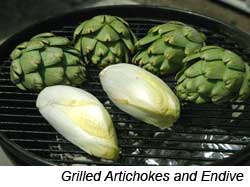
Tip
#2:
Halve artichokes or endive and grill to tenderness with a
basting of olive oil.
Tip
#3: Use
a smoked salt in your rub for additional complexity.
Tip #4: Deploy an aromatic,
specialty oil, like walnut oil or truffle oil, in a light basting of
meats for extra flavor.
Tip
#5: Plan
on about one cup of marinade for every pound of meat.
 Tip
#6:
Finish a grilled steak with a modest dollop of a compound
butter - tarragon, shallot, chives, or basil. Tip
#6:
Finish a grilled steak with a modest dollop of a compound
butter - tarragon, shallot, chives, or basil.
Tip
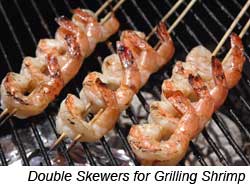
#7: To
keep foods cooperative and not "twirling" on a skewer, use a double-pronged skewer, or two traditional skewers placed in
parallel. Flat skewers will also help prevent
spinning.
Tip
#8: Plan
on about two tablespoons of rub mixture for every pound of
meat.
|
| Q & A's |
|

Q:
What's the
difference between grilling and barbecuing?
 A: Both words are
often used broadly and interchangeably to mean cooking outdoors with
a fire. However, their culinary meanings are
distinct. Grilling refers to fast, direct cooking
over medium to high heat, while barbecuing implies slow, indirect
cooking. A: Both words are
often used broadly and interchangeably to mean cooking outdoors with
a fire. However, their culinary meanings are
distinct. Grilling refers to fast, direct cooking
over medium to high heat, while barbecuing implies slow, indirect
cooking.
Q: How do I use wood chips
to flavor my grill?
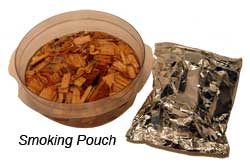
A: Aromatic wood chips add
wonderful flavor to any type of grilled food.
Choose a smoking hardwood, (pecan, cherry, cedar, hickory,
peach, apple, or several other types), and soak submerged in water
for about an hour. Place the chips in your
grill's smoke box, or on a piece of aluminum foil, wrapped and
pinched closed. Pierce a few holes in the top of
the aluminum pouch, and place in your grill directly on the charcoal
or lava rock.
 Q: Can I use the leftover marinade to baste
the meat, or as a sauce component? Q: Can I use the leftover marinade to baste
the meat, or as a sauce component?
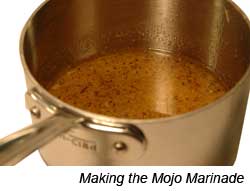
A: No. Since the leftover marinade has been in
contact with raw meat, it is unsafe to use as a basting liquid, or
as a sauce. However, if the marinade is heated to
a boil for several minutes, it may be used. (Not
all marinades handle being boiled, however). Take
care to use a clean basting brush rather than one with raw meat
contamination. |
Cookbook
Review
|
|
How to
Grill, the Complete Illustrated Book of Barbecue
Techniquesby Steven
Raichlen. Photography by Greg
Schneider. Workman Publishing, New York,
NY. Copyright 2001.
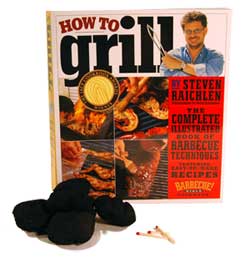 If you're looking to gain some confidence at
the grill, this book will leapfrog your knowledge and
abilities. If you're a grilling expert, you'll
expand your repertoire of skills with a season's worth of new
ideas. A winner of the coveted
International Association of Culinary Professional's Cookbook
Award, this book takes its mission of "How To"
seriously. The book is organized by type of meat,
poultry, fish or vegetable. Within each of these
major categories, individual chapters feature step-by-step
instructions on "How to Grill a T-bone Steak," How to Make Jerk
Pork," "How to Smoke Fish," "How to Grill
Oysters," "How to Grill Lettuce," or more than a hundred other
topics. Each chapter is lavishly illustrated with
full-color photos of key steps and final presentation
ideas. Informative sidebars populate nearly every
page with a host of tips, tricks and great grilling
ideas. If you're looking to gain some confidence at
the grill, this book will leapfrog your knowledge and
abilities. If you're a grilling expert, you'll
expand your repertoire of skills with a season's worth of new
ideas. A winner of the coveted
International Association of Culinary Professional's Cookbook
Award, this book takes its mission of "How To"
seriously. The book is organized by type of meat,
poultry, fish or vegetable. Within each of these
major categories, individual chapters feature step-by-step
instructions on "How to Grill a T-bone Steak," How to Make Jerk
Pork," "How to Smoke Fish," "How to Grill
Oysters," "How to Grill Lettuce," or more than a hundred other
topics. Each chapter is lavishly illustrated with
full-color photos of key steps and final presentation
ideas. Informative sidebars populate nearly every
page with a host of tips, tricks and great grilling
ideas.
|
| Grilling
Recipes |
|
Mojo-Marinated Pork
Tenderloin
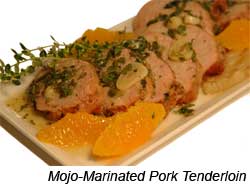 This recipe did wonders to the pork
tenderloin that we experimented on. The freshness
of the citrus and cilantro pairs perfectly with the already tender
pork. There's a lot of garlic
in this sauce, but sliced and heated in the olive oil it is nicely
tamed. Use half the marinade to marinate the
meat, reserve the other half as a sauce when served.
We thought the grilled onions with the Mojo Marinade were
particularly worthy. This marinade works equally
well on pork chops, steak, chicken breasts, fish fillets, or
shrimp. This recipe did wonders to the pork
tenderloin that we experimented on. The freshness
of the citrus and cilantro pairs perfectly with the already tender
pork. There's a lot of garlic
in this sauce, but sliced and heated in the olive oil it is nicely
tamed. Use half the marinade to marinate the
meat, reserve the other half as a sauce when served.
We thought the grilled onions with the Mojo Marinade were
particularly worthy. This marinade works equally
well on pork chops, steak, chicken breasts, fish fillets, or
shrimp.
Click here to view the full
recipe.
Click here for a printable
version of the recipe.
Java Rub
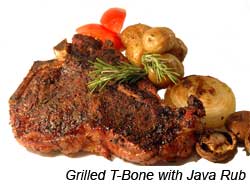 As
Steven Raichlen writes, "Coffee may seem like an odd ingredient for
a rub, but competition 'que heads use it and win big with
it. The bittersweet flavor of the coffee rub goes
great on beef (especially brisket) and pork."
He's absolutely correct! We tried it on a
couple of T-bone steaks and pronounced the rub as a
"keeper." This recipe makes enough for several
steaks, or to share with a friend. As
Steven Raichlen writes, "Coffee may seem like an odd ingredient for
a rub, but competition 'que heads use it and win big with
it. The bittersweet flavor of the coffee rub goes
great on beef (especially brisket) and pork."
He's absolutely correct! We tried it on a
couple of T-bone steaks and pronounced the rub as a
"keeper." This recipe makes enough for several
steaks, or to share with a friend.
Click here to view the full
recipe.
Click here for a printable
version of the
recipe.
| |



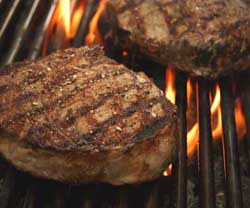 One thing is true; there is plenty of passion
when it comes to flavoring grilled foods! In this issue we'll
explore the magic of marinades and rubs, discuss the latest in
grilling gear, and offer a couple of recipes to try at your next
grilling event.
One thing is true; there is plenty of passion
when it comes to flavoring grilled foods! In this issue we'll
explore the magic of marinades and rubs, discuss the latest in
grilling gear, and offer a couple of recipes to try at your next
grilling event.