Next
Issue: May 8, 2008
|
Tea &
Scones
|
Wish List -
Gift Registry:
|

Kitchen Essentials offers Gift Registry services for any
occasion. Come into the shop to begin your registry. Let
others know that you are registered at Kitchen Essentials and that
they can shop online. |
New Trends
in Storage
|
Just when you
think storage containers have "gone about as far as they can go,"
someone makes it better! Discover the new storage products
that keep food fresher longer! We'll show you how next time
you're in the shop!
| |
|
Extreme Greens
|
|
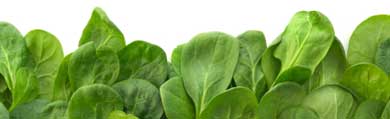
We celebrate Earth Day with a
salute to the season's color, green! Vegetable
greens, in a wide variety, are available throughout the year, but
they really shine during the early spring growing
season. Some of us grew up with the image of
"greens" as Popeye flipping open a can of life-saving
spinach. Fortified, he would conquer the current
challenge to goodness, or rescue his beloved Olive Oyl.
Popeye had it right; greens are full of powerful
nutrition! Fortunately, our choices for greens
range far beyond canned spinach. We'll explore
just a few of the available extreme greens, focus on the
quick-cooking method of sautéing, and present some options for
incorporating a new "green" habit in your food
routine.
|
April's
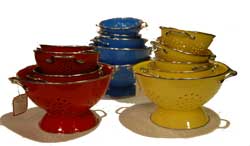
Special Feature - 15% off Selected Colanders
|
15%
off colanders by Reston-Lloyd
during
the month of April!
Colanders are indispensable
in the kitchen for all types of tasks -- draining pasta,
straining cooked vegetables, or washing fresh produce. Match
the size of your colander with the task at hand, and
have some fun with the many bright, new colors available.
|
Knife
Sharpening Event
|
Get your edge
back! Join us for a special event.
Special Knife
Sharpening
Saturday, April 26th from 10am -
1pm
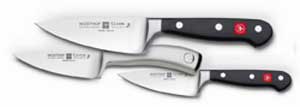
Clark Stone, of Wusthof Trident
Knives, will be in the store to professionally sharpen any brand of
knife (no serrated, however). A suggested donation of $3 per
knife will go directly to the Northeast Iowa Food
Bank.
|
Girls' Night
Out - Thursday, May 8th
|

|
Asparagus
Season
|
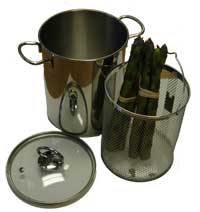 Another reason to welcome spring, as if we need
more, is the asparagus season. Asparagus is at its peak right
now. Place this wonderful vegetable at the center of your
table whether it's steamed, roasted, or sauteed. Add to the
celebration by presenting the tender spears on an asparagus plate,
and serving with asparagus tongs! Another reason to welcome spring, as if we need
more, is the asparagus season. Asparagus is at its peak right
now. Place this wonderful vegetable at the center of your
table whether it's steamed, roasted, or sauteed. Add to the
celebration by presenting the tender spears on an asparagus plate,
and serving with asparagus tongs!
| |
Locally
Grown Vegetables from Sunflower Fields
|
 Kitchen
Essentials is pleased to be a supporter of Community
Supported Agriculture (CSA) as a pick-up location for Sunflower
Fields' farm shares. Consider supporting local food systems by
participating in a Farm Share. Check out the Sunflower Fields website or
call them at 563.864.3847 in Postville, IA for more information on
how a farm share works and other options for participation! Kitchen
Essentials is pleased to be a supporter of Community
Supported Agriculture (CSA) as a pick-up location for Sunflower
Fields' farm shares. Consider supporting local food systems by
participating in a Farm Share. Check out the Sunflower Fields website or
call them at 563.864.3847 in Postville, IA for more information on
how a farm share works and other options for participation!
|
Extreme
Greens
|
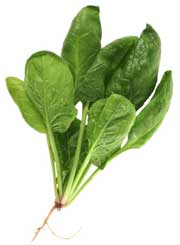
The new,
nutritional adage of "the more color, the better the nutritional
value," rings loud and clear when it comes to the world of hearty,
leafy greens; they are a fantastic biofuel for our
bodies! To the uninitiated, the greens on the
produce shelf may appear as a confusing collection of
leaves. In fact, most greens originated as a
foraged food source. Each leaf type has a
distinctive shape and flavor that drives its preparation and use in
the kitchen. To learn more about spinach, chard,
collard greens, mustard greens, kale, and even, dandelion greens, read
on!
|
|
Sautéing
Greens |
|
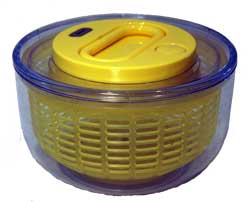 Fresh greens require washing to remove any sand
or soil hiding in the folds and crevices. A salad
spinner that handles your lettuces will also perform well on
heartier greens. Working in batches, fill the
basket with greens allowing for plenty of space in the
basket. Fill the outer bowl with water and swish
the greens in the water. Remove the basket, empty
the water from the outer bowl, and repeat until no sand or soil
appears in the bowl's bottom. Alternatively, if
you have a large amount of greens, fill up the kitchen sink with
cold water and swish the greens. Again, repeat
until no soil or sand remains in the rinse water.
Spin the greens to remove excess water. If
too much moisture is left on the greens, the sautéed results will be
too watery. Fresh greens require washing to remove any sand
or soil hiding in the folds and crevices. A salad
spinner that handles your lettuces will also perform well on
heartier greens. Working in batches, fill the
basket with greens allowing for plenty of space in the
basket. Fill the outer bowl with water and swish
the greens in the water. Remove the basket, empty
the water from the outer bowl, and repeat until no sand or soil
appears in the bowl's bottom. Alternatively, if
you have a large amount of greens, fill up the kitchen sink with
cold water and swish the greens. Again, repeat
until no soil or sand remains in the rinse water.
Spin the greens to remove excess water. If
too much moisture is left on the greens, the sautéed results will be
too watery.
Sautéing food means
cooking food at a medium high temperature, in a single layer, with
just a little oil. Sautéing is a fast cooking
method that suits meats and vegetables alike.
The word "sauté"
translates from its original French as "to jump."
 The "jumping" image of food placed in a hot
pan makes sense. As well, brisk movements of the
pan during cooking will cause the food to "jump" around. The "jumping" image of food placed in a hot
pan makes sense. As well, brisk movements of the
pan during cooking will cause the food to "jump" around.
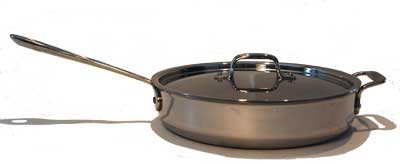
A good sauté pan
offers a broad base and relatively shallow sides.
You'll find that the height of a sauté pan is about one-third
its diameter. The wide bottom of a sauté pan
allows for efficient energy transfer from the heat source, and the
maximum amount of contact space for the food. The
shallow sides allow easy access for turning and removing the
food. If the sauté pan is large, an "assist
handle" opposite the primary handle is a great aid when moving the
pan. When sautéing greens it's important that the surface of the pan
be "non-reactive," that is, made of a material that will not react
with the acids in the food. Choose stainless
steel or non-stick surfaces, while avoiding aluminum surfaces.
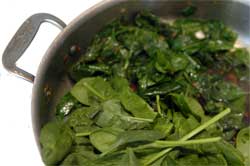 When sautéing greens, heat the pan over a
medium-high setting. Add the oil of your choice allowing it to
become hot prior to adding the greens. Add the
greens in batches, tossing or stirring quickly.
You'll find that the greens wilt quickly, providing space for
more of the fresh leaves. When the greens are
wilted and displaying a very bright green color, remove them from
the pan. Even for a large quantity of greens, the
entire process usually takes less than three or four
minutes! When sautéing greens, heat the pan over a
medium-high setting. Add the oil of your choice allowing it to
become hot prior to adding the greens. Add the
greens in batches, tossing or stirring quickly.
You'll find that the greens wilt quickly, providing space for
more of the fresh leaves. When the greens are
wilted and displaying a very bright green color, remove them from
the pan. Even for a large quantity of greens, the
entire process usually takes less than three or four
minutes!
|
Paper or
Plastic?
|
|
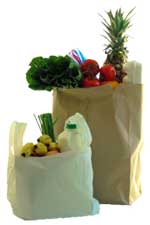 Checking out at the market, the phrase, "paper
or plastic?" is often posed to us. With our
increasingly green consciousness, we wonder what the green answer to
this question really is. The answer is
neither! As a single-use, "disposable" product,
both bag types consume material resource and energy that makes their
use a dilemma. Even when recycled, or reused, the
costs of "paper or plastic" seem to be adding up to an overall
negative impact. Four out of five grocery bags
are now plastic. According to the Wall Street
Journal, over 100 billion plastic bags are used in the U.S. each
year, requiring 12 million barrels of oil to manufacture at a cost
of $4 billion to retailers. In the U.S., only 2% of plastic bags are
recycled. Even when recycled, paper or plastic
bags require additional expense and energy resource to be
effectively repurposed. Checking out at the market, the phrase, "paper
or plastic?" is often posed to us. With our
increasingly green consciousness, we wonder what the green answer to
this question really is. The answer is
neither! As a single-use, "disposable" product,
both bag types consume material resource and energy that makes their
use a dilemma. Even when recycled, or reused, the
costs of "paper or plastic" seem to be adding up to an overall
negative impact. Four out of five grocery bags
are now plastic. According to the Wall Street
Journal, over 100 billion plastic bags are used in the U.S. each
year, requiring 12 million barrels of oil to manufacture at a cost
of $4 billion to retailers. In the U.S., only 2% of plastic bags are
recycled. Even when recycled, paper or plastic
bags require additional expense and energy resource to be
effectively repurposed.
The "no
brainer" answer to the "paper or plastic" dilemma is to use a
recyclable bag. Reusable bags: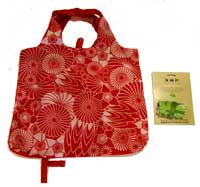
- are inexpensive
to obtain
- preserve
material resources
- protect the
environment
- improve the
neighborhood esthetic (no "urban tumbleweed")
- rarely break or
split in the middle of the driveway, and
- may be worth a 5
cent rebate with each use at many grocery stores
We offer
several styles of reusable bags that carry your groceries easily and
fashionably. The "Envirosax" reusable market bag
is made of nylon, provides large volume toting space, yet rolls up
to a tiny purse-size packet. The Envirosax may be purchased
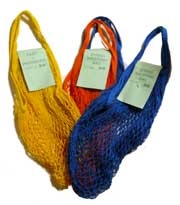
singly, or in a pack of five bags. Check out our French Market
string bags and other great styles by Red & White
Kitchen.
|
| Plan Ahead
Tip |
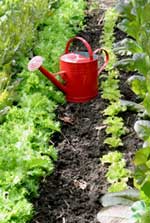 Tip #1: Plant your own crop of
spinach this spring. The time is right now for
getting the seeds in the ground. Spinach prefers
the cool weather of spring and early fall. The University of Illinois Extension provides some
simple instructions for growing your own crop of
spinach. Early hybrids will be ready to harvest
in 40 days. Remember to thin the rows of
seedlings so that the remaining plants are able to reach an
appropriate size. Tip #1: Plant your own crop of
spinach this spring. The time is right now for
getting the seeds in the ground. Spinach prefers
the cool weather of spring and early fall. The University of Illinois Extension provides some
simple instructions for growing your own crop of
spinach. Early hybrids will be ready to harvest
in 40 days. Remember to thin the rows of
seedlings so that the remaining plants are able to reach an
appropriate size.
 Tip #2: Set yourself up for
success once you resolve to incorporate reusable bags in your
shopping life. Have several bags available for
use. Keep the bags in the trunk of your car for easy access as you
head into the store. Keep a small reusable bag in
your purse for "emergency" shopping use. After
unpacking groceries, hang the bag on the doorknob of the outside
door. Throw the bag in the trunk on your next
trip out the door. Make it a game to see how
few plastic or paper bags you can accumulate in a
month. Tip #2: Set yourself up for
success once you resolve to incorporate reusable bags in your
shopping life. Have several bags available for
use. Keep the bags in the trunk of your car for easy access as you
head into the store. Keep a small reusable bag in
your purse for "emergency" shopping use. After
unpacking groceries, hang the bag on the doorknob of the outside
door. Throw the bag in the trunk on your next
trip out the door. Make it a game to see how
few plastic or paper bags you can accumulate in a
month.
|
Q
& A's
|
|

Q:
What is the
difference between sautéing, pan-searing, and
stir-frying?
A:
Each of these cooking methods uses a medium high
heat to do their work, and they all employ a relatively small amount
of oil. Sautéing results in food that is cooked
all of the way through. Pan-searing cooks the
outside of the food over a higher heat sealing in the inside
moisture and flavor. The inside of pan-seared
foods remains uncooked. 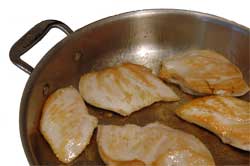 Stir-frying requires constant stirring as the
food cooks, and is usually applied to food cut into slices, or small
chunks. Stir-frying requires constant stirring as the
food cooks, and is usually applied to food cut into slices, or small
chunks.
Q:
Why is the descriptive term "Florentine"
associated with dishes containing spinach?
A: Legend has it that
Catherine de Medici, originally part of the famous and powerful de
Medici family of Florence, Italy, loved spinach.
She brought her passion for the leafy green to France when
she married into French nobility. The term was
adopted in French cuisine as a way to describe spinach dishes and
their Florentine inspiration.
Q:
How do frozen greens compare
with fresh greens?
A: The differences between
fresh and frozen greens can be quite small. Fresh
produce begins to decline in nutritional value as soon as it is
picked. 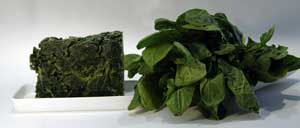 If the
fresh produce is packed, trucked and allowed to sit on a shelf for a
few days, the result may be a fresh product that is inferior to its
frozen counterpart. Frozen greens are generally
processed close to harvest time thus preserving the
nutrients. For more on the topic, check out this
article from the Colorado State Extension. All
said, use what seems to be the freshest and most appropriate to the
dish. If the
fresh produce is packed, trucked and allowed to sit on a shelf for a
few days, the result may be a fresh product that is inferior to its
frozen counterpart. Frozen greens are generally
processed close to harvest time thus preserving the
nutrients. For more on the topic, check out this
article from the Colorado State Extension. All
said, use what seems to be the freshest and most appropriate to the
dish.
Q: Both paper and some plastic bags are
biodegradable; doesn't that make their use a neutral
impact?
A: With paper or plastic
shopping bags, the decomposition process is not as straightforward
as one might think. Experts report that it still
takes many years for paper and biodegradable plastics to
decompose. Further, conditions in many landfills
lack the proper air and moisture conditions to decompose adequately,
even if they are
biodegradable. |
Cookbook
Review
|
|
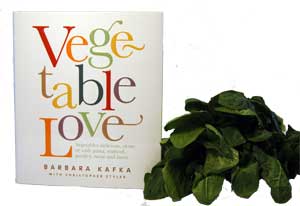
Vegetable
Love by Barbara
Kafka. Artisan, a Division of Workman Publishing,
Inc. Copyright 2005.
This 700+ page book
is truly a work of love! Ms. Kafka has compiled a
compendium of nearly every known vegetable, and put them to use in
excellent recipes ranging from simple to complex.
One might expect a
cookbook on vegetables to be organized alphabetically,
 but
Ms. Kafka has taken the unique approach of presenting vegetables by
region and origin. This makes all the sense in
the world. The vegetables of a region are
presented in their original context of climate, culinary companions,
and the peoples who have discovered and developed the flavors
surrounding the vegetable. Each vegetable is
introduced with a brief history, essential overall knowledge, and
occasionally some trivia. Each vegetable
introduction is followed by a generous selection of classic and
exotic recipes. Actually, this cookbook is
accurately described as "two books in one," the first described
above, and the second, a back section titled the "Cook's
Guide." This second section, (arranged
alphabetically), provides basic information on each vegetable for
buying, storing, washing, preparing, and cooking, and describes
differences among many individual varieties.
After reading and using this book, you'll find yourself in a
loving, long-term relationship with the world of
vegetables! but
Ms. Kafka has taken the unique approach of presenting vegetables by
region and origin. This makes all the sense in
the world. The vegetables of a region are
presented in their original context of climate, culinary companions,
and the peoples who have discovered and developed the flavors
surrounding the vegetable. Each vegetable is
introduced with a brief history, essential overall knowledge, and
occasionally some trivia. Each vegetable
introduction is followed by a generous selection of classic and
exotic recipes. Actually, this cookbook is
accurately described as "two books in one," the first described
above, and the second, a back section titled the "Cook's
Guide." This second section, (arranged
alphabetically), provides basic information on each vegetable for
buying, storing, washing, preparing, and cooking, and describes
differences among many individual varieties.
After reading and using this book, you'll find yourself in a
loving, long-term relationship with the world of
vegetables!
|
| Recipes |
|
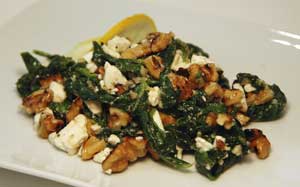 Sautéed Spinach with Feta and
Walnuts Sautéed Spinach with Feta and
Walnuts
With spinach as the
primary ingredient, this preparation, with the inclusion of cheese
and nuts, is complete enough to be a light entrée along with a slice
of crusty bread. Or, serve this recipe as a side
dish to a main course of pork tenderloin medallions.
Substitute any of the heartier greens discussed above and
you'll garner rave results.
Click here to view the full
recipe.
Click
here for a printable version
of the recipe.
Spicy Spinach and Sausage with
Pasta
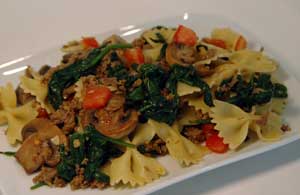 Spinach and other greens prove to be chameleons
in the kitchen as they easily take on the strong flavors of other
ingredients. Adding their own peppery quality in
response, the greens benefit the whole dish. This
recipe has all of the desired attributes of a one-dish meal: quick,
easy, and flavorful. As with most recipes, any
green may be substituted for the spinach with similar, yet subtly
different results. Spinach and other greens prove to be chameleons
in the kitchen as they easily take on the strong flavors of other
ingredients. Adding their own peppery quality in
response, the greens benefit the whole dish. This
recipe has all of the desired attributes of a one-dish meal: quick,
easy, and flavorful. As with most recipes, any
green may be substituted for the spinach with similar, yet subtly
different results.
Click here to view the full
recipe.
Click here for a printable version
of the
recipe. | |