Seafood
Specials
|
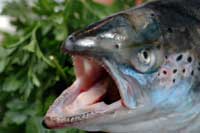
Check our website for
the latest seafood specials! We've
joined with the area's best restaurants to bring the best seafood to
the middle of the prairie! |
The Wine
Rack
|
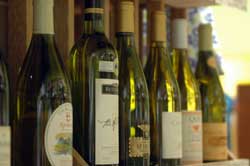
Featuring a broad
selection of fine wines, our wine racks hold the area's best
selection of Chardonnays, Chablis Blanc, Rieslings, Zinfandels,
Pinot Noirs, and Merlots. Let our wine experts help you find
just the right wine to match the
occasion!
| |
|
Apple
Time!
|
|
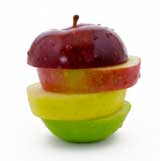 Apple
turnovers, applesauce, apple cake, apple crumble, apple tart, apple
crisp, apple Brown Betty, caramel apple, apple cobbler, apple
vinegar, apple bran muffins, baked apples, apple Waldorf salad,
apple butter, appletini, apple iPod®, apple fritter, apple savory
stuffing, drunken apples, apple bread pudding, apple cheddar scones,
apple Danish, apple crumb cake, apple oatmeal bars, apple streusel,
apple cider, apple walnut bread, red hot apples, and the best of all
. . . apple
pie! Apple
turnovers, applesauce, apple cake, apple crumble, apple tart, apple
crisp, apple Brown Betty, caramel apple, apple cobbler, apple
vinegar, apple bran muffins, baked apples, apple Waldorf salad,
apple butter, appletini, apple iPod®, apple fritter, apple savory
stuffing, drunken apples, apple bread pudding, apple cheddar scones,
apple Danish, apple crumb cake, apple oatmeal bars, apple streusel,
apple cider, apple walnut bread, red hot apples, and the best of all
. . . apple
pie!
|
What's Up in
October
|
Call 563.583.3761 to register and
reserve a place!
Thursday, Oct. 11th - 6 -
9pm
Pressure Cooking Class -
Holiday or anytime meals are made easy and quickly in a pressure
cooker.  Modern
pressure cookers are not like your Grandma's pressure cooker!
We'll make Beef Pot
Roast with Tomato and Pearl Onions, Herb
Roasted Chicken with Lemon Chicken Sauce, Quinoa with fresh herbs
and vegetables Apple Cinnamon Flan with Maple Syrup, and Creamy
Cheesecake with Fruit Glaze. $35 Modern
pressure cookers are not like your Grandma's pressure cooker!
We'll make Beef Pot
Roast with Tomato and Pearl Onions, Herb
Roasted Chicken with Lemon Chicken Sauce, Quinoa with fresh herbs
and vegetables Apple Cinnamon Flan with Maple Syrup, and Creamy
Cheesecake with Fruit Glaze. $35
Sunday, Oct. 14th - 1-4pm.
Fall Goodies -
Delight in the best of the fall harvest! The menu will
celebrate the season with Red Wine Poached Pears with Honey-Pear
Sauce and White Chocolate Mousse, White Chocolate Cheesecake with an
Orange Soup, Polish Chop Suey Cake, and Pecan and Pumpkin Pies. Mmm
. . . $20.
Tuesday, Oct. 23rd
- 6-9pm. Gluten Free Cooking -
Discover gluten-free alternatives to everyday favorites. The
menu will surprise and satisfy everyone! $35.
Thursday, Oct. 25th - 6-9pm.
DaVinci's Chef Nick
Schiesl - Join the chef of DaVinci's Restaurant
as he takes over the kitchen and demonstrates his skills!
(Read more about Nick). The
menu will include Homemade Dips and Chips, Chop Salad with Praline
Bacon, Blue Cheese and Apples, Chicken Florentine with Mashed Sweet
Potatoes and Asparagus, and Deep
Chocolate Torte with Espresso
Buttercream Frosting. $35.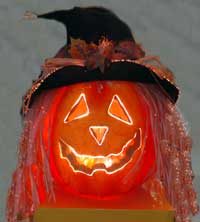 Saturday, Oct. 27th - 11am -
1:30pm. Kid's Halloween Party - Wear
your costume and learn how to make some fun treats inspired by the
season: Ghoul Juice with Eyeballs, Mud Pies with Worms,
Witch's Castle, Bug Sandwiches, Graveyard Pie, and Spider Cupcakes.
$20. Saturday, Oct. 27th - 11am -
1:30pm. Kid's Halloween Party - Wear
your costume and learn how to make some fun treats inspired by the
season: Ghoul Juice with Eyeballs, Mud Pies with Worms,
Witch's Castle, Bug Sandwiches, Graveyard Pie, and Spider Cupcakes.
$20.
| |
November
Somethings
|
|
Call 563.583.3761 to register and reserve
a place!
Thursday, Nov. 8th - 6-9pm - India Holiday DInner and Wine
Pairing - Featuring Sunil Malapati in the lead, we'll prepare
Pumpkin-Pear Soup, SPinach Salad with Soy-Ginger Dressing,
Fenugreek-Stuffed Chicken with Coconut Rice, 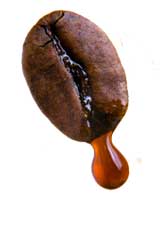 Green Beans in Lemon-Butter Sauce,
and Poached Pears in Saffron Sauce. $40. Green Beans in Lemon-Butter Sauce,
and Poached Pears in Saffron Sauce. $40.
Saturday, Nov.10th - 10am-12pm - Coffee 101 - Coffee 101 is
designed for the coffee enthusiast, (or the enthusiast wanna-be),
who wants to learn more about how coffee is source, roasted,
prepared and ready for the ideal tasting experience. Class fee
of $20 includes a Blade Grinder valued at $19.99. Can't go
wrong!
Saturday, Nov.10th -
1pm-2:30pm - The Cutting Edge Knife Skills
Classes - Learn how to hold and safely use various knives,
proper knife techniques of slicing, dicing, and chopping. Best
of all, learn how to hone your knifes for a perpetual sharp
edge. No charge.
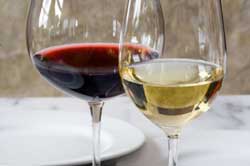 Wednesday, Nov. 14th - 5pm-7pm - Wine Down Wednesday - Wine
Tasting and Appetizers - Sample some of our favorites from the
wine racks and discover your new favorite. No
charge. Wednesday, Nov. 14th - 5pm-7pm - Wine Down Wednesday - Wine
Tasting and Appetizers - Sample some of our favorites from the
wine racks and discover your new favorite. No
charge.
Thursday, Nov. 15th -
6-9pm - Not Your Traditional Thanksgiving
Dinner - Steve Geisz, General Manager of the Grand Harbor Resort
and Waterpark, and Owner of BoarCephus Barbeque, is cookin'
something up for us again -- only this time, he's bringing his deep
fat fryer. The evening's menu includes Deep-Fried Bloomin
Onion, Mushrooms, and other Veggies, Deep-Fried Turkey, Dressing,
Yam and Pecan Casserole, and Cranberry Walnut Salad. Chef
Stephanie Gorius will be creating one of her special holiday
desserts. We'll discuss and sample the best wine pairings for
this and other holiday menus.
|
Getting to the Core of
Apples
|
|
From 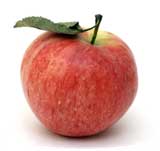 Eve's hand in
creation's garden, to the teacher's desk, and on to any number of
small electronic devices, the apple rules the fruit world as the
icon for all that is good and sustaining.
Evidence of apples extends back to 6500 B.C.E., so they've
had a while to build their stellar reputation. Eve's hand in
creation's garden, to the teacher's desk, and on to any number of
small electronic devices, the apple rules the fruit world as the
icon for all that is good and sustaining.
Evidence of apples extends back to 6500 B.C.E., so they've
had a while to build their stellar reputation.
Apples are one of
the few fruits that we buy by variety. Bananas
are bananas, but apples come as Red Delicious, Braeburn, Honeycrisp,
Granny Smith, or one of the other 7500 varieties.
From this vast diversity, about 300 varieties are grown
commercially in the U.S. Interestingly, over
time, both politics and economics have influenced the apple
varieties available to us and where they're grown.
 Until the 1990's,
U.S. orchards provided the world with apples with over half of the
apples sold being Red Delicious. Research efforts around the Red
Delicious variety, aimed toward larger apples with darker red
coloring. Ironically, those cosmetic
characteristics were delivered at the expense of great apple
taste. Other varieties, such as Granny Smith,
Gala, Honeycrisp, and Braeburn, have recently gained shelf space
pushing the Red Delicious to less than a quarter of the apple
offering. Pacific varieties, such as New Zealand's Gala and the
Japanese Fuji, grew popular in U.S. orchards primarily for exporting
purposes. In the 1990's came the "apple
crash." Between 1980-2000, spurred by newly
opened trade policies, Chinese orchards grew by 750 percent and
began to supply apples to the foreign markets previously serviced by
U.S. growers. The upside of this situation was
that the previously exported Pacific varieties were now marketed
domestically bringing more choice to the local market.
(For more on the fascinating politics and economics of apples
and other fresh produce, check out Russ Parson's book, How to Pick a Peach, the Search
for Flavor from Farm to Table). Until the 1990's,
U.S. orchards provided the world with apples with over half of the
apples sold being Red Delicious. Research efforts around the Red
Delicious variety, aimed toward larger apples with darker red
coloring. Ironically, those cosmetic
characteristics were delivered at the expense of great apple
taste. Other varieties, such as Granny Smith,
Gala, Honeycrisp, and Braeburn, have recently gained shelf space
pushing the Red Delicious to less than a quarter of the apple
offering. Pacific varieties, such as New Zealand's Gala and the
Japanese Fuji, grew popular in U.S. orchards primarily for exporting
purposes. In the 1990's came the "apple
crash." Between 1980-2000, spurred by newly
opened trade policies, Chinese orchards grew by 750 percent and
began to supply apples to the foreign markets previously serviced by
U.S. growers. The upside of this situation was
that the previously exported Pacific varieties were now marketed
domestically bringing more choice to the local market.
(For more on the fascinating politics and economics of apples
and other fresh produce, check out Russ Parson's book, How to Pick a Peach, the Search
for Flavor from Farm to Table).
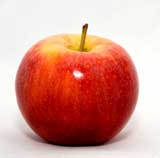
Apple
Profiles:
Experiment
with some of the common apple varieties easily available in today's
markets:
Cameo® - Small white spots on the skin
distinguish the Cameo. This sweet, yet crisp apple is used for
eating, salads, cooking and baking.
Honeycrisp - This newer variety is also crisp and
sweet. Shows red on a golden background, and
holds its shape during cooking.
Cripps
Pink (a.k.a. Pink
Lady) - Crisp, firm, with a unique tartness.
Harvested late in the fall and great for eating and
baking.
 Jonagold - A juicy apple derived from a cross
between Golden Delicious and Jonathan varieties.
Good for eating, cooking, and baking. Jonagold - A juicy apple derived from a cross
between Golden Delicious and Jonathan varieties.
Good for eating, cooking, and baking.
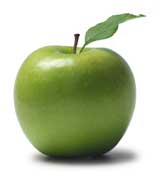
Granny
Smith - Green and tart with
a juicy crispness. Versatile for eating, salads,
and baking. With Australian origins, its roots
originate from a French crabapple and a grandmother's, (Maria Ann
Smith), tree.
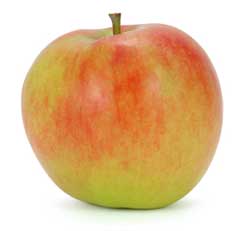
Gala - a crisp apple with stripes of yellow,
pink, orange, and red. Perfect for eating and for
use in salads. New Zealand in origin.
Fuji - Full of flavor and sweetness.
Ideal for eating, salads, and baking.
Holds its texture when cooked.
Braeburn - A firm, aromatic apple with a sweet
tartness. Ideal for eating, salads, and baking.
Red
Delicious - a classic apple
for eating out of hand. Bright red with darker
red stripes. Good in salads.
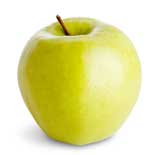
Golden
Delicious - an all purpose
apple. Great for eating, salads, and
baking. Does not brown as quickly as other
varieties.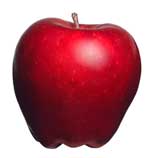
To experiment with
some local varieties, follow this link for a list of Iowa Apple Orchards. If you plan to visit,
call ahead to verify the latest orchard information.
Apple
Trivia:
-- The
Guiness Book of World Records notes the largest apple was picked
from a tree in Caro, Michigan and weighed in at three pounds, two
ounces. (An average apple weighs about 6 oz.).
-- The Red
Delicious variety was "discovered" on a Peru, Iowa farm in 1874, and
was originally named "Hawkeye."
-- Modern orchard farming uses
"high-density" planting with up to 500 trees per
acre.
--
Washington, New York, and
Michigan rank the highest in apple production.
-- Michigan is the largest supplier of apple slices
used in commercially prepared apple pie filling.
-- Apples are
still harvested by hand.
 -- One
medium apple contains 5 grams of fiber, or 20% of the recommended
daily intake of fiber. -- One
medium apple contains 5 grams of fiber, or 20% of the recommended
daily intake of fiber.
-- The type of dietary fiber in apples is
noted to have a more positive impact on health than fiber from
cereal/grain sources.
-- Apples contain the essential trace
element, boron, key for strong bones.
-- One gallon of apple
cider results from 36 apples.
-- Within 8-10 years of planting,
an apple tree will produce fruit. A dwarf tree
will produce within 3-6 years.
-- A medium apple has about 80
calories.
-- Pomology is the science of growing apples.
-- It
takes 50 leaves to support the production of one apple.
--
Americans eat 19.6 pounds of apples every year, i.e., about 47
apples per year.
-- One-quarter air by volume, the apple floats
easily bedeviling many a bobbing contest
participant.
Apple
Care:
Choose apples that
are firm, without any bruising. They are best stored in the crisper
drawer of your refrigerator, because apples will deteriorate ten
times faster if not kept cool. Apples emit
ethylene gas which when packaged with other fruits, such as bananas,
kiwis, peaches, plums and pears, will hasten their
ripening. This same gas may damage certain
vegetables including broccoli, cabbage, cucumber and leafy greens;
store apples separately from these items.
Resources: Washington Apples, Michigan Apples, New York Apples.

|
The
Perfect Pie Crust
|
|
The season's
harvest inspires the pie baker in all of us. And,
a homemade pie is always, let's say that again, always better than a
purchased pie or a prefab crust. The freshness of
the crust, your special hand in determining just the right spices,
and the abundance of mounded fruit distinguish your own pie from
lame commercial imitations.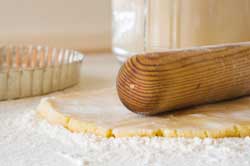
If there's an
obstacle to overcome in becoming a homemade pie baker, it's
mastering the crust. But, a few secrets and a few
simple rules will allow mastery of the common crust.
Our definition of the perfect pie crust is a tender, flaky
crust that compliments the flavor of the pie contents.
To be avoided is a tough crust that requires chiseling or
that projects an objectionable taste.
Making the
Perfect Pie Crust:
Secret #1: The ingredients for crust are
simple: flour, salt, sugar, water, and a fat
source. Most experts recommend a combination of
butter and shortening. The butter brings great
taste, while the shortening creates a desirable fine
texture. Experiment with different ratios of
butter to shortening; some recommend 1:1, others 3:2, and the recipe
below calls for 7:1.
Secret #2: Cut the butter and
shortening into half-inch cubes. Chill the
butter, but freeze the shortening pieces. (Shortenings with zero
trans fats are now readily available). Keeping
everything at a cold temperature throughout the crust-making process
is key to achieving great results.
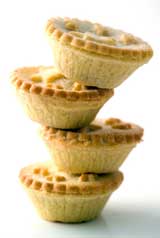 Secret
#3:
Place dry ingredients in a food processor, add the shortening
pulsing until the mixture has a sandy texture.
Then add the butter and pulse just until pea-sized pieces
form. Do not overmix. Transfer to a mixing
bowl. Secret
#3:
Place dry ingredients in a food processor, add the shortening
pulsing until the mixture has a sandy texture.
Then add the butter and pulse just until pea-sized pieces
form. Do not overmix. Transfer to a mixing
bowl.
Secret
#4: Use
water chilled with ice cubes. Add liquid one
tablespoon at a time. Mix the water in with a
folding type motion. Do not
overmix.
Secret
#5:
Gather the dough into a ball; flatten it into a disc (two
discs if a double crust). Wrap and refrigerate
for at least 60 minutes.
Secret #6: After the discs have
chilled, remove them from the refrigerator and let set at room
temperature for 5 minutes before rolling out.
Secret #7: Roll out on a cool
surface, chilled marble if you have it. Flour-dusted parchment paper
also makes a good surface for rolling. For a round result, shift the
pie crust one-quarter turn as you roll. Lift the
crust often to lightly dust the rolling surface and avoid sticking.
Don't use too much flour in the process; just enough to prevent
sticking.
Secret
#8: Roll
up or drape the crust loosely on the rolling pin to transfer it from
the flat surface to the pie dish.
Secret #9: If mixing the pie crust
manually, don't use your hands - they're too warm.
Use a pastry blender and work quickly, always maintaining a
cold temperature.
Secret
#10: For
a picture-perfect golden crust, brush heavy cream on the top crust
and edges prior to baking. A sprinkle of sugar on
top makes for a sparkly crust.
If you've mastered
a single crust, a double crust pie is half the effort.
In the "olden days," the vent holes cut into the top crust
became a personal signature of its maker. Develop
your own personal signature for your double crusts and carry on the
tradition!
Pieware:
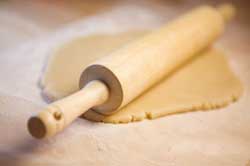 Pie plates range
from metal, to glass, or ceramic. Each one will
produce a great pie. We like plates with high
sides that leave space for plenty of filling.
When you select a pie dish, notice the shape of the rim and
how easily the slices can be removed. Pie plates range
from metal, to glass, or ceramic. Each one will
produce a great pie. We like plates with high
sides that leave space for plenty of filling.
When you select a pie dish, notice the shape of the rim and
how easily the slices can be removed.
Our favorite pie
tools include:
(1) Oven Guard - this ring holds the pie plate,
catches any spillovers, yet has a hole in the center that allows the
heat to access the bottom of the baking dish
(2) Pie Wedge - bury
this wedge underneath the crust, for flawless removal of the first
piece
(3) Shortening Measure - eliminate messy measuring
techniques with a telescoping shortening measuring tool
(4) Crust
Shield - several variations of crust protectors exist, any of which
will beat manipulating little strips of foil
(5)
Silicone Brush - delicate tendrils paint the crust with the
cream and cleaning is easy
(6) Rolling Pin - new rolling pins are
longer and often come with a series of rings when paired and placed
on the roller yield the right dough
thickness |
Apple
Pie
|
|
Endorsements don't
get much better than in the phrase, "mother and apple
pie." Apples, in pie form, place the iconic fruit
in an iconic position - the result is a slice of heaven!
Imagine juicy wedges, layered atop each other, cradled in a
delicate crust browned to golden perfection.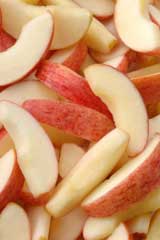 Early
fall is a great time to make an apple pie, before any competition
arises from the pumpkin and pecan pies that share the Thanksgiving
table. Early
fall is a great time to make an apple pie, before any competition
arises from the pumpkin and pecan pies that share the Thanksgiving
table.
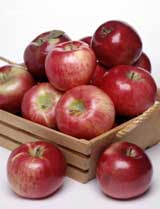
Choosing the
Apples: The best secret for a great apple pie is to use two types of
apples, one that keeps its shape, and one that becomes more
sauce-like when cooked. The less firm apple
creates a juicy context for the crunchier apple and doubles the
apple impact. Eating Well.com, in their Apple Buyer's Guide, identifies a
few apple varieties that fall into these two categories:
Saucy
Apples:
McIntosh, Cortland, Macoun, Crispin, Paula Red,
Empire
Shapely
Apples:
Granny Smith, Golden Delicious, Jonathan, Jonagold, Northern
Spy, Ida Red
Apples have
inspired a whole realm of tools designed to make coring, peeling and
slicing easier and faster. Check out our apple
peelers, apple corers, and of course, the perfect paring
knife.
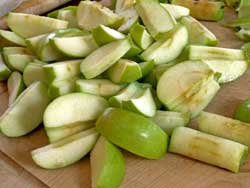 As with
all fruit pies, wonderful juices appear once mixed with sugar
(maceration), and certainly once the baking begins.
Apples have a natural thickener with their pectin content,
but still may require additional thickener.
Flour, corn starch, or quick tapioca all work their magic on
the apple juices binding the goodness around the apple
wedges. Determining the amount of thickener to
use is a bit of an art form based on the type and quantity of apples
used. As with
all fruit pies, wonderful juices appear once mixed with sugar
(maceration), and certainly once the baking begins.
Apples have a natural thickener with their pectin content,
but still may require additional thickener.
Flour, corn starch, or quick tapioca all work their magic on
the apple juices binding the goodness around the apple
wedges. Determining the amount of thickener to
use is a bit of an art form based on the type and quantity of apples
used.
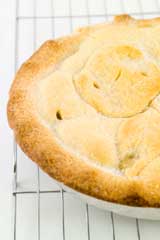
Baking the
Pie:
Parchment paper lining a jelly roll pan provides a safe
platform for baking your apple pie. Any bubbling
juices will be caught by the paper before they drip to the oven
floor. Halfway through the pie baking, be
prepared to tent the pie with a piece of foil, or a crust shield to
slow the crust browning.
 Serving Apple
Pie:
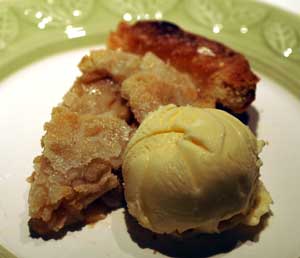
When the once-steaming pie is just two notches
above room temperature, the perfect serving moment has arrived. On
your best dessert plates, serve your masterpiece plain, with whipped
cream, vanilla ice cream, or Vermont style, with a healthy slice of
sharp cheddar cheese. Serving Apple
Pie:
When the once-steaming pie is just two notches
above room temperature, the perfect serving moment has arrived. On
your best dessert plates, serve your masterpiece plain, with whipped
cream, vanilla ice cream, or Vermont style, with a healthy slice of
sharp cheddar cheese.
Variations on
the Theme:
As if apple pie was not perfect in and of itself, a variation
might suit you one day:
Mix-ins: Add to the apples some
dried or fresh cranberries, dried apricots, maybe some walnuts, any
type of berry, or some rhubarb.
Crust Change: Substitute half of the
crust's flour with a nut flour of pecans, walnuts, or
hazelnuts. Make your own nut flour by pulsing
toasted nuts in a food processor until all nuts are very finely
chopped.
Flavor
Lift:
Add a splash of Calvados (an apple brandy), or Frangelico (a
hazelnut liquor).
Accompaniments: Serve apple pie with
your favorite coffee, or a lovely dessert
wine. |
| Plan Ahead Tips |
 Tip
#1: When
making pie crust, mix up a double batch freezing half for future
use. To freeze, form the dough into a disc about one-half inch thick
(two discs if a double crust). Seal the discs in plastic wrap,
insert into a zippered freezer-grade bag. Freeze
flat. When it's time to use, let stand at room temperature for 10-15
minutes, and roll into desired thickness. Tip
#1: When
making pie crust, mix up a double batch freezing half for future
use. To freeze, form the dough into a disc about one-half inch thick
(two discs if a double crust). Seal the discs in plastic wrap,
insert into a zippered freezer-grade bag. Freeze
flat. When it's time to use, let stand at room temperature for 10-15
minutes, and roll into desired thickness.
Tip
#2: If
the pie you are making is acidic in nature, use a glass or ceramic
pie plate. The acidic quality of the filling will
react with the metal once the pie is cut causing discoloration of
the pan and possibly an off taste in the
pie. |
Q &
A's
|
|

Q:
I know
apples begin to brown once cut, but why?
A:
Apples,
like bananas, pears, potatoes and other fruits and vegetables,
contain an enzyme and iron-containing phenols that react with oxygen
when exposed to the air producing a brown color on the
surface. 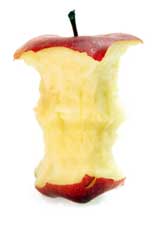 The browning can
be slowed by (1) reducing the pH with an acidic component such as
lemon juice, (2) submersing the fruit or vegetable in water reducing
the air exposure, or (3) stopping the reaction through
cooking. The browning can
be slowed by (1) reducing the pH with an acidic component such as
lemon juice, (2) submersing the fruit or vegetable in water reducing
the air exposure, or (3) stopping the reaction through
cooking.
Q:
My crust
shrinks when baked. Why and how can I stop
this?
A: The mysterious shrinking
crust is primarily the result of glutens in the flour becoming
activated when moistened adding an elastic quality to the
dough. This elasticity is preferable in bread,
but not in a pie crust! Several actions will help
to address shrinking: (1) use pastry flour
instead of all-purpose flour; it is made from soft wheat that
contains less gluten, (2) refrigerate the pie dough before rolling
or baking; the chill relaxes the gluten decreasing the elasticity,
(3) cut the butter or shortening with the flour well enough to
"moisture-proof" more of the flour; the less water the flour
absorbs, the less gluten that is formed, (4) some bakers add a bit
of cider vinegar to the pie dough retarding the formation of
glutens. If baking a pie shell without a filling,
use pie weights to hold the crust in place for the first 10-12
minutes of baking.
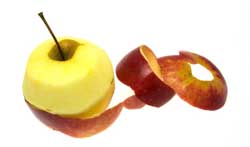 Q: What is the fastest way
to peel an apple? Q: What is the fastest way
to peel an apple?
A: Most of us learned to
cut an apple in half starting at the stem running through to the
blossom end, pivoting a knife tip around the core half, cutting
"V's" around the stem and blossom, then shaving the peel off each
half with a paring knife. This method preserves a
maximum amount of apple flesh but may be time-consuming and
awkward. Alternatively, cut the apple just to the
right and left of the core, and then either side of the remaining
core piece. Peel the chunks.
If you're competitive, try removing an apple's peel in one
strip. The record to beat for the longest
continuous apple peel is 172 feet and 4 inches!
Q: Why are apples
waxed?
A: Apples have a "natural"
wax that is partially removed in the packing process of washing and
packaging apples for shipment. The wax helps to
reduce moisture loss from the apple and improves their
appearance. The wax used is a natural
plant-based, non-petroleum coating, such as, carnauba from palm tree
leaves. The United Fresh Fruit and Vegetable
Association reports that one pound of wax will coat up to 160,000
pieces of fruit implying that very little is used on each
piece. It is rare to find wax on organic apples,
though it is possible and still be labeled organic based on the type
of wax used. For more on this, check this website. |
Cookbook
Review
|
|
Baking, From My Home to
Yours by Dorie Greenspan
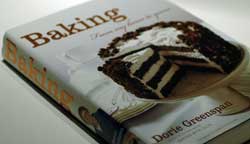 This
cookbook is a gem! Lavishly photographed, this
book could live happily on your coffee table, but its contents are
too good to be just admired; they beg to be tried, savored, and
repeated. Dorie Greenspan is the recipient of the
prestigious James Beard Award for authoring another worthy cookbook,
Baking with Julia, (as in Julia Child).
Ms. Greenspan continues her run of top-notch cookbooks in
this her ninth book. In Baking, From My Home
to Yours, Greenspan presents over 300 recipes ranging from
breakfast goods, to cookies, cakes, and pies. Her
instructions simplify the most complex desserts into something
manageable, and more importantly, reliably successful.
A beautiful gift for someone, maybe
yourself! This
cookbook is a gem! Lavishly photographed, this
book could live happily on your coffee table, but its contents are
too good to be just admired; they beg to be tried, savored, and
repeated. Dorie Greenspan is the recipient of the
prestigious James Beard Award for authoring another worthy cookbook,
Baking with Julia, (as in Julia Child).
Ms. Greenspan continues her run of top-notch cookbooks in
this her ninth book. In Baking, From My Home
to Yours, Greenspan presents over 300 recipes ranging from
breakfast goods, to cookies, cakes, and pies. Her
instructions simplify the most complex desserts into something
manageable, and more importantly, reliably successful.
A beautiful gift for someone, maybe
yourself!
|
| Recipes |
|
This pie recipe,
from Dorie Greenspan's Baking, From My Home to Yours, gets a
five-star rating in our opinion. It has just the
right amount of cinnamon and nutmeg avoiding the common sin of "too
much spice" that otherwise might overshadow the protagonist, the
apples! The lemon zest adds some brightness,
again without getting in the way of the wonderful apple flavors.
Access a printable version of the
recipe - PDF Format. 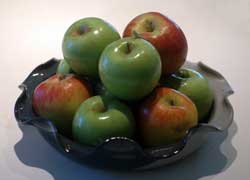
All-American,
All-Delicious Apple Pie
Good for Almost
Everything Pie Dough (see below)
4 pounds (about 6 very large)
apples
3/4 cup sugar
Grated zest of 1 lemon
2 tablespoons
quick-cooking tapioca
1/2 teaspoon ground cinnamon
1/8 - 1/4
teaspoon freshly grated nutmeg
1/4 teaspoon salt
2 tablespoons
graham cracker crumbs (or dry bread crumbs)
2 tablespoons cold
unsalted butter, cut into bits 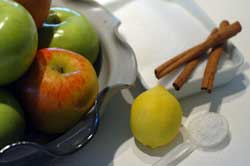
For the
Glaze:
Milk or heavy
cream
Decorating (coarse) or
granulated sugar
Instructions: (adapted for length;
Ms. Greenspan offers many more tips throughout her
instructions)
(1) Butter a 9-inch
deep-dish pie plate.
(2) Roll one portion of the pie dough into a
circle about 1/8-inch thick. Fit into the pie
plate for the bottom crust leaving 1/2-inch overhang.
Refrigerate the pie plate with fitted crust.
(3) Roll the top crust similarly; transfer
to a baking sheet and place in the refrigerator to chill for about
20 minutes while the filling is prepared and the oven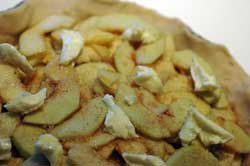 preheats.
(4) Center the
oven rack in the middle of the oven; Preheat the oven to 425
degrees.
(5) Peel, core, and
slice the apples into a large bowl.
(6) Add the sugar, lemon zest, tapioca,
cinnamon, nutmeg and salt. Toss everything
together well and let sit for 5 minutes until the juices begin to
accumulate in the bowl.
(7) Sprinkle the bottom of the crust with
the crumbs.
(8) Fill the pie shell with the apple mixture and the
juices. Pat and settle the apples into place. Dot
the top with dabs of butter.
(9) Very lightly moisten the edges
of the bottom crust. Place the top crust over the
apples. (If the crusts are too cold and begin to
crack, let sit for 5 minutes or until just pliable).
(10) Crimp
the top and bottom crusts together using fork tines, or a finger
pinch.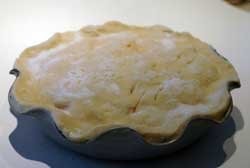
(11) With a
sharp paring knife, cut 6 slits in the top crust to vent the
steam.
(12) Brush the top
crust and edges with a little milk or cream; sprinkle it with
sugar.
(13) Bake the pie for 15 minutes. Lower
the oven temperature to 375 degrees and bake the pie for another 50
to 60 minutes (total baking time is between 65 and 75 minutes), or
until the crust is gorgeously browned and the juices bubble up
through the top crust. After about 40 minutes in the oven, if the
top crust looks as if it's browning too quickly, cover the pie
loosely with a foil tent.
(14) Transfer the pie to a rack and let
it rest until it is only just warm or until it reaches room
temperature. 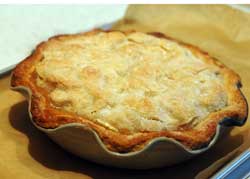
Good for Almost
Everything Pie Dough (for a
9" double crust)
3 cups all-purpose
flour
1/4 cup
sugar
1-1/2 teaspoons
salt
2-1/2 sticks (10 ounces) very cold (frozen is fine) unsalted
butter, cut into tablespoon-size pieces
1/3 cup very cold (frozen
is even better) vegetable shortening, cut into 4 pieces
About 1/2
cup ice water
Instructions: (also adapted for length)
 (1) Put
the flour, sugar and salt in a food processor fitted with a metal
blade; pulse just to combine. (1) Put
the flour, sugar and salt in a food processor fitted with a metal
blade; pulse just to combine.
(2) Drop in the shortening and
butter pulsing only until cut into the flour.
Don't overdo the mixing. The pieces will
range from pea-size to barley-size.
(3) Gradually add about 6 tablespoons of ice
water pulsing the machine on or off (or, as recommended above, add
water manually, mixing with a folding motion).
(4) Scrape the
dough from the food processor; form into two discs about 1/2-inch
thick. Cover in plastic wrap and refrigerate for
at least 1 hour.
(5) Proceed to roll out the dough and continue
with your apple pie as above!
Recipes from
Baking, From my Home to Yours by Dorie Greenspan.
Copyright (c) 2006 by Dorie Greenspan. Used by permission of
Houghton Mifflin Company. All rights
reserved. | |