Cooking
Classes
|
THE FEBRUARY - APRIL 2010 COOKING CLASS SCHEDULE
IS NOW
AVAILABLE ONLINE AND IN OUR STORES!
Invest in a Cooking Class
!
Delicious Dividends that multiply every time you cook at
home!
REGISTRATION IS NOW OPEN!
Register
Online, In-Person, or by Telephone
Harper's Point
classes - Call 513-489-6400 Settler's Walk
classes - Call 937-748-4540
www.cookswaresonline.com
Here's a peek at just a few of the classes that we're
featuring to kick-off 2010. Check out many more opportunities and
full details at our website!
Thurs, February
18 - Magnificent Mushrooms with Dan Berger
Harper's Point 6:30 - 9:00pm $45
 Mon, February 22 - Soul Soups with Jackson Rouse Mon, February 22 - Soul Soups with Jackson Rouse
Settlers' Walk
6:30 - 9:00pm $45
Tues, February 23
- A Superior Swiss Supper with Cindy Milem
Harper's Point 6:30 -
9:00pm $45
Wed, February
24 - Small Plates Big Flavor with Liliana Gebran
Harper's
Point 6:30 - 9:00pm $40
Thurs,
February 25 - 30 Minute Mom's International Adventure with
Courtney Rathweg
Harper's Point 6:30 - 9:00pm
$40
Wed,
March 3 - Bravo - Bravissimo! with Curtis Sizemore or Ben
Draughn
Settlers' Walk 6:30 - 9:00pm
$40
Thurs, March 4
- Cupcake Decorating Party with Angela Columbus
Harper's Point 6:30 - 9:00pm $40 Hands-On Limited to 16.
(Class Full; E-mail us to
be added to our waiting list. Include class, location, date, name,
phone number).
Wed, March 10 -
Pleasing Your Palate Without Punishing Your Body
with Shawn McCoy
Harper's Point6:30 -
9:00pm $45.
(Class Full; E-mail us to
be added to our waiting list. Include class, location, date, name,
phone number).
* *
* Additional Class
Added * * *
Thurs, March 10 - Classic French Bread Workshop with Kathy Lehr
Settlers'
Walk 6:00 - 9:30pm $60 Hands-On Limited to 12.
Harper's Point
classes - Call 513-489-6400
Your Cooks'Wares
Bonus:
Cooks'Wares offers a 10%
Discount on your merchandise
purchases on the day you attend
class! (excluding kitchen electrics and during Storewide
Sales) |
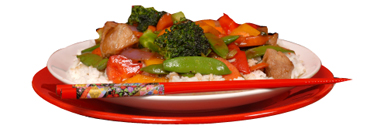
Stir-Fry
Techniques
|
With the
imminent arrival of spring, this is a great time to adopt and
develop some stir-fry cooking skills. Make it your "thing" to master
this season! Stir-fries hold
the possibility of endless variety; they're easy to 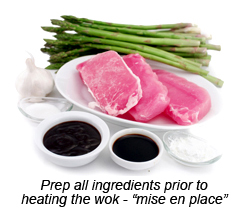 make several
times a week while producing very different meals each time. Here
are some tricks to cooking hot and fast: make several
times a week while producing very different meals each time. Here
are some tricks to cooking hot and fast:
Prep Everything First - Cooking
over high heat makes things happen quickly. Peel, chop, cut, measure
EVERYTHING in the recipe first. This is essential for good stir-fry
results and allows all of the ingredients to be at their prime in
the finished dish.
Size
Ingredients Evenly - When prepping the ingredients, dice,
cut, chop, or julienne each ingredient into bite-sized pieces of
relatively even sizes. Choose to prepare your ingredients in thin
slices or matchsticks so that the heat from the surface can quickly
get to the center of the food.
 Plan the Sequence of Events - With
all of the ingredients prepped, literally line everything up in the
order that it will go into your wok or pan. Some vegetables will
take longer to cook than others. For example, beans, peppers,
broccoli, asparagus will take longer than sprouts, zucchini,
cabbage, or bok choy. Plan the Sequence of Events - With
all of the ingredients prepped, literally line everything up in the
order that it will go into your wok or pan. Some vegetables will
take longer to cook than others. For example, beans, peppers,
broccoli, asparagus will take longer than sprouts, zucchini,
cabbage, or bok choy.
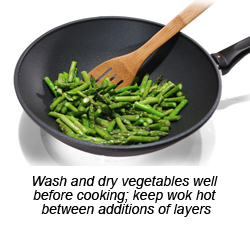
Start
Hot, Keep it Hot - Before adding any food to the pan, allow
the pan to become hot, add any oil to the pan and allow it to become
very hot - about 30 seconds. To test if the pan is ready, flick a
minute drop of water in the oil; it should sizzle vigorously. When
adding the different layers of ingredients during cooking, allow the
pan to return to full heat before adding more ingredients.
Start it hot, and always keep it hot!
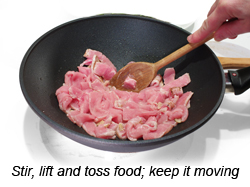 Keep it Moving - Because the pan
is very hot, it is essential to keep the food moving while cooking.
This is what's behind the technique's name "stir-fry." The surface
of the food becomes hot quickly and transfers the heat inward. Keep it Moving - Because the pan
is very hot, it is essential to keep the food moving while cooking.
This is what's behind the technique's name "stir-fry." The surface
of the food becomes hot quickly and transfers the heat inward.
Center the Action -
Beginning with the ingredients that take the longest to cook, keep
the primary cooking action in the center of the pan - that's where
it's the hottest. Move the cooked ingredients up the sides and add
the next layer to the center of the wok stirring vigorously in that
sweet spot.
Don't Overload
the Pan - A good stir-fry result depends on the food
contacting the cooking surface. 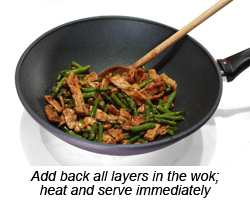 Avoid the
temptation to pile in ingredients - you will have a "steam-fry"
instead of a stir-fry! If needed, remove a layer of ingredients to a
plate while cooking the next set of ingredients. Keep in mind that
the offloaded ingredients will continue to cook, so remove just
prior to doneness, and spread in a single layer to release any
excess heat. At the end of cooking, add all layers back into the pan
to combine and reheat. Avoid the
temptation to pile in ingredients - you will have a "steam-fry"
instead of a stir-fry! If needed, remove a layer of ingredients to a
plate while cooking the next set of ingredients. Keep in mind that
the offloaded ingredients will continue to cook, so remove just
prior to doneness, and spread in a single layer to release any
excess heat. At the end of cooking, add all layers back into the pan
to combine and reheat.
Adjust
the Recipe - Many recipes prescribe cooking times for each
stage of the stir-fry. Use this information as a starting point and
adjust based on how the food is cooking. This variability arises
from the differences in food temperature, quantity of food, your
pan, and the type of heat source.
Remove Quickly - Once the stir-fry
is complete, remove from the pan, and serve immediately. Hot food
left to sit will continue to cook and challenge the desired
crisp-tenderness of the vegetables. In fact, stir-fry tradition
calls for everyone being seated at the table before the cooking
begins!
|
Wok &
Roll!
|
|
Great stir-fry results are accessible to anyone with minimal
investment! In fact, you can make a great stir-fry in any skillet or
pan, but a great wok certainly eases the process and enhances the
outcome.
The Wok
The idea behind a wok is its deep, rounded shape that provides
a lot of cooking surface without requiring a large burner or flame.
Heat transfers quickly from the concentrated source at the wok's
bottom and up its steep sides. It's the original energy efficient
pan! Besides stir-frying a wok is versatile for braising, simmering,
steaming, and deep-frying. It's truly the "all-in-one" pan that
millions of families have counted on for many
centuries.
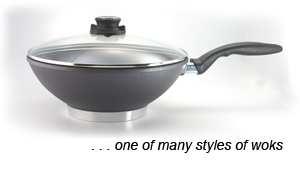 Choosing a Wok Choosing a Wok
When choosing a wok, there are a few characteristics to
consider. The first consideration is what heat source will be used
with the wok - gas or electric burners, ceramic top, or induction
stovetop. Different woks are specifically made and matched to
different heat sources.
Shape - Woks
have rounded bottoms and either set atop a ring for stability over
the burner, or on a specialized burner grate. Obtain a wok ring that
best matches your burner's configuration. Other woks have a flatter
bottom that sit like a more traditional pan on top of a burner, yet
still feature high, concave sides. Size - Choose a
size of wok that meets your most common cooking requirements. A
12-14-inch wok is usually perfect for home cooking and meals for 2-4
people. Material -Carbon Steel
and Cast Iron - Traditionally, woks have been made of carbon
steel or cast iron. This type of surface requires seasoning and
re-seasoning to prevent rust and to foster a naturally non-stick
environment. Many woks in the West go unused because of the
diligence involved in seasoning the pan and keeping it top-notch
condition. In Asian cultures, wok maintenance is not an issue - the
wok is used frequently enough that the pan becomes seasoned and
stays seasoned with no effort. Material - Nonstick
Surfaces - For many of us, a nonstick wok offers just the
right amount of practicality and purpose. However, choose a
non-stick wok wisely; some nonstick surfaces are not suitable for
high temperature cooking. Newer, safer, nonstick surfaces are now
available and have been applied in some great new wok styles. 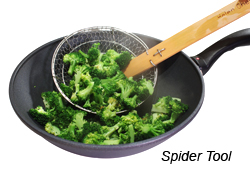 With nonstick surfaces, very little oil
is required allowing the stir-fry dish to be a healthy
preparation. Handle Style -
When cooking with high temperatures, handle considerations become an
important feature. A long handle with an opposing helper handle
works well. Stirring
SpatulasTo keep things moving while stir-frying, a good
stirring utensil is essential! A good utensil for stir-frying has a
long-handle to keep the hand a safe distance from the high
temperatures. Traditionally, bamboo or wooden spatulas have been
used in wok cookery and still prove a good choice. Many of the newer
silicone spatulas also work well at high heat, and have a bit of
flexibility allowing them to conform to the curved shape of the
pan.
 Spiders Spiders
A "spider" is a very good wok tool! The broad basket of this
long-handled utensil features an open weave resembling a spider's
web. Food scooped with a spider drains very quickly. Beyond pairing
it with a wok, a spider is versatile in scooping any food from
boiling water, or a handy strainer when draining a
pot.
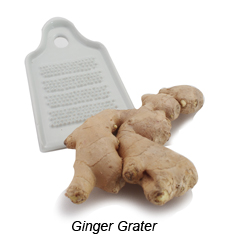
Ginger Grater
Among the aromatics in stir-fry dishes, ginger is a frequent
contributor. Working with ginger and its odd shape and coarse,
stringy pulp often poses a conundrum. A ginger grate solves the
problem by ingeniously extracting the potent pulp and liquid leaving
behind the peel and fibers. There are several styles of ginger
graters but all work similarly through a rubbing motion on top of a
bumpy surface. |
Flavor
Secrets for Chinese Stir-Fries
|
The craving for
Chinese food can be strong! What's behind these urges? We think it's
a unique combination of flavors and a few secret sauces that
characterize American Chinese dishes irresistible. With just a bit
of explanation and experimentation, you can become comfortable with
some of the basic flavor secrets in Chinese stir-fries.
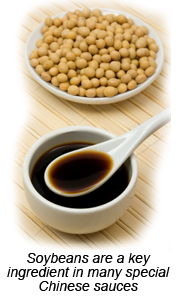 Soy sauce - Like many other foods,
special yeast and microorganism fermentation processes turn grain or
soybeans into a rich brown liquid that is salty and full of the
"fifth taste," umami. There are many variations of soy sauce
specific to different regions of the world. Soy sauce - Like many other foods,
special yeast and microorganism fermentation processes turn grain or
soybeans into a rich brown liquid that is salty and full of the
"fifth taste," umami. There are many variations of soy sauce
specific to different regions of the world.
Hoisin Sauce - While "hoisin" means
seafood, there is no fish present. This sauce includes water, sugar,
soybeans, vinegar, rice, salt, wheat flour, garlic, and chile
peppers. The sauce may be used for glazing, dipping, or as a sauce
component.
Oyster
Sauce - This sauce is made from broth leftover from cooking
oysters. The broth is greatly reduced from its original state until
it becomes a dark, viscous sauce. It does not have a fishy smell or
flavor, but is full of rich flavors that complement many
stir-fries.
Black Bean
Sauce - This sauce is also an essential condiment in many
Chinese stir-fries. It is made from fermented black beans that are
salty, bitter, and sweet all at once. Garlic and soy sauce are added
to form a thick sauce or paste. A little goes along way with this
magical ingredient.
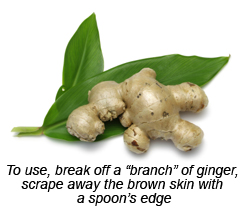 Ginger -
This aromatic provides essential flavor to many stir-fry dishes.
Peel away the thin brown skin on the nubby surface by scraping it
away with a spoon. Buy small, usable quantities. Leftover ginger may
be stored in an odor-proof bag or container in the refrigerator or
freezer. Ginger -
This aromatic provides essential flavor to many stir-fry dishes.
Peel away the thin brown skin on the nubby surface by scraping it
away with a spoon. Buy small, usable quantities. Leftover ginger may
be stored in an odor-proof bag or container in the refrigerator or
freezer.
Rice Wine -
Most stir-fries in Ms. Chen's cookbook use just a teaspoon or two of
rice wine. This mildly flavored wine serves to dissolve the
essential flavor oils found in the other ingredients. Such oils are
only dissolvable with a bit of alcohol - oil and water won't unleash
their flavors. The alcohol will evaporate away, but only after
working its extra bit of
magic.
|
Smart Stir-Fry
Tips
|
Tip #2: When serving
rice with your stir-fry, start it first before starting your prep
work. In a microwave, the rice will cook quickly and hold well as
you assemble your stir-fry.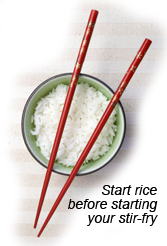
Tip #2: Check out Asian
specialty markets for unique ingredients. You'll find a wide
selection of many key ingredients and usually at a lower price than
the supermarket's specialty food aisle.
Tip #3: Use oil that can
tolerate high heat well when stir-frying. Oils with high smoke
points (the point at which they begin to burn) include these refined
oils: canola oil, safflower oil, peanut oil, soybean oil, and corn
oil. Oils with lower smoke points should be avoided in stir-frying;
they include olive oil, butter, sesame oil, and many animal
fats.
Tip #4: If
liquid is gathering in the bottom of the pan while stir-frying, this
is an indication that the pan is not hot enough or that it is
overloaded. The wok or pan should be so hot that any water in the
ingredients evaporates quickly while cooking.
Tip #5: When starting a
stir-fry, once the pan is hot, drizzle any oil being used around the
pan. This will heat the oil faster compared to pouring the oil into
one location all at once.
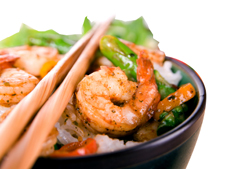
Tip
#6: After washing or cleaning any vegetables, pat them
or "spin-dry" them to remove any excess water. This will help reduce
any water accumulation during stir-frying.
Tip #7: To easily slice meats
into thin, thin sheets for stir-frying, freeze the meat for 30-45
minutes, or allow frozen meat to partially defrost. Slice the meat
across the grain to create naturally tender
pieces.
|
Q & A's
|
 Q: What is the difference between light
and dark soy sauce? Q: What is the difference between light
and dark soy sauce?
A: Light soy sauce comes from
the "first pressing" of the fermented beans. 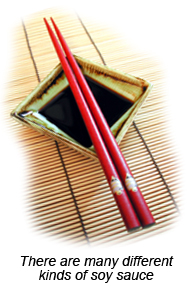 Dark soy sauce is darker, thicker, and aged
longer. Light soy sauce is saltier than dark and is used more as a
condiment or table seasoning. Dark soy is sweeter due to added
molasses and used more in cooking than at the table. Dark soy sauce is darker, thicker, and aged
longer. Light soy sauce is saltier than dark and is used more as a
condiment or table seasoning. Dark soy is sweeter due to added
molasses and used more in cooking than at the table.
Q: In the ingredients list on my soy
sauce, I see acid-hydrolyzed vegetable protein. What is
this?
A: This
is a protein form that has been broken down into components through
the introduction of water and acid. This ingredient is often used in
soy sauces that skip the fermentation step and have garnered the
nickname of "cheap man's soy sauce." The dark color in these sauces
is not natural, but added caramel coloring. Read the label before
buying.
Q: How do I season a
carbon steel wok?
A: Seasoning is easy and an
important step for setting up a new wok, or refurbishing an older
steel wok. Clean a new wok well to remove any waxy, protective
coating from the manufacturer. This will expose the bare metal. Rub
heat-tolerant oil into the surfaces of the metal. Facilitate the
bonding of the oil to the pan by heating it and rubbing on the
inside surface. Allow the pan to cool, then rub away any excess oil.
Repeat this process three or four times. Keep the wok in a seasoned
state by avoiding detergents and soap when cleaning. Simply wipe the
wok clean, rinse with plain water if necessary, and dry immediately
and thoroughly.
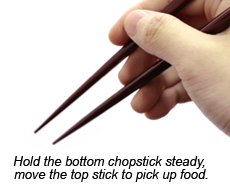
Q:
What is proper chopstick etiquette?
A: Stir-fries are a great
opportunity to practice your chopstick skills! To learn how to eat
with chopsticks, check out this link: "How to Use Chopsticks." Use the wider ends of the
chopstick to serve food from a shared bowl to your own plate or
bowl. Never place the chopsticks straight up in your bowl of food;
this is considered bad luck. Never point or gesture with your
chopsticks. It's ok to hold a bowl in your hand and bring it closer
to your mouth when eating with chopsticks; this minimizes spilling
and is considered the polite thing to do in many
instances.
|
Cookbook
Review
|
Easy Chinese
Stir-Fries by Helen Chen. Photography by Jason Wyche.
Copyright 2009. Published by John Wiley & Sons, Inc., Hoboken
NJ.
This little cookbook is a gem! With its singular focus on
Chinese Stir-Fries, it allows the Western kitchen access to the
wonderful flavors of American-Chinese cuisine. Ms. Chen comes by her
expertise honestly. As the daughter of the famed Chinese cook and
restaurateur, Joyce Chen, Ms. Chen carries forward the long-standing
family tradition of popularizing Mandarin cuisine in the 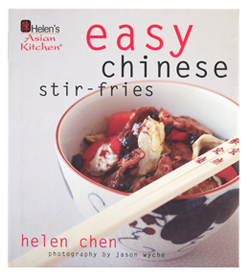 American culture. The beginning chapters
of the book focus on setting the stage with succinct and informative
discussions of stir-fry technique, equipment, and key ingredients.
The recipe chapters that follow categorize a whole host of stir-fry
inventions according to: Chicken, Pork, Beef, Seafood, Bean Curd,
and Vegetables. Each recipe is written simply and expertly. The
simplified ingredients make each of the recipes accessible for the
average cook without compromising delicious results. The
step-by-step instructions are equally clear and explanatory. The
typical American cook suddenly feels quite apt and able to tackle
their favorite Chinese dish at home! As is often the case with us,
we were especially taken by the beautiful, close-up photography that
accompanies nearly every recipe. We enjoyed experimenting with many
different Chinese stir-fries with this book as our tutor, and think
you will too! American culture. The beginning chapters
of the book focus on setting the stage with succinct and informative
discussions of stir-fry technique, equipment, and key ingredients.
The recipe chapters that follow categorize a whole host of stir-fry
inventions according to: Chicken, Pork, Beef, Seafood, Bean Curd,
and Vegetables. Each recipe is written simply and expertly. The
simplified ingredients make each of the recipes accessible for the
average cook without compromising delicious results. The
step-by-step instructions are equally clear and explanatory. The
typical American cook suddenly feels quite apt and able to tackle
their favorite Chinese dish at home! As is often the case with us,
we were especially taken by the beautiful, close-up photography that
accompanies nearly every recipe. We enjoyed experimenting with many
different Chinese stir-fries with this book as our tutor, and think
you will too!
|
Recipes for
Easy Chinese Stir-Fries
|
Recipes excerpted from Easy
Chinese Stir-Fries by Helen
Chen. Copyright 2009. Published by John Wiley & Sons, Inc.,
Hoboken NJ. Reprinted with permission of the publisher. All rights
reserved.
Stir-fried
Pork with Asparagus
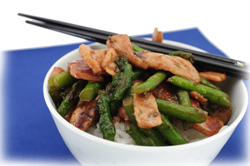 With asparagus season just around the
corner, put this stir-fry on your "must-try" list. The hoisin sauce
added just a hint of sweetness that complemented the pork perfectly.
The seared asparagus concentrated the vegetable's flavor and the
pork browned quickly over the high heat. The light covering of sauce
exceeded our expectations in taste and flavor. With asparagus season just around the
corner, put this stir-fry on your "must-try" list. The hoisin sauce
added just a hint of sweetness that complemented the pork perfectly.
The seared asparagus concentrated the vegetable's flavor and the
pork browned quickly over the high heat. The light covering of sauce
exceeded our expectations in taste and flavor.
Click here to view the full, illustrated
recipe.
Click here for a printable version of
the recipe. (PDF format)
Stir-fried
Broccoli Beef in Oyster Sauce
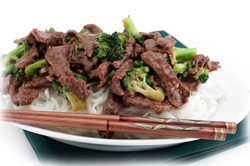 Another favorite for just about everyone, this
easy beef and broccoli dish will become a regular at your table! We
served this stir-fry over rice noodles, which made for a little
extra fun. The sauce is based on prepared oyster sauce, but lends no
fishy component whatsoever. We purchased double the beef, sliced it
all, and froze half in a thin package for a quick supper sometime in
the near future! Another favorite for just about everyone, this
easy beef and broccoli dish will become a regular at your table! We
served this stir-fry over rice noodles, which made for a little
extra fun. The sauce is based on prepared oyster sauce, but lends no
fishy component whatsoever. We purchased double the beef, sliced it
all, and froze half in a thin package for a quick supper sometime in
the near future!
Click here to view the full, illustrated
recipe.
Click here for a printable version of
the recipe. (PDF format)
Kung Pao
Chicken
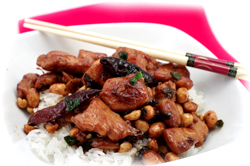 This perennial take-out favorite is now
within easy reach at home with this recipe! This stir-fry has a few
more ingredients compared to the other stir-fries, but the result is
worth the effort! We served this chicken dish over a mound of rice
and thoroughly enjoyed each chopstick-full. The recipe provides a
solid base that begs for further experimentation and
personalization. This perennial take-out favorite is now
within easy reach at home with this recipe! This stir-fry has a few
more ingredients compared to the other stir-fries, but the result is
worth the effort! We served this chicken dish over a mound of rice
and thoroughly enjoyed each chopstick-full. The recipe provides a
solid base that begs for further experimentation and
personalization.
Click here to view the full, illustrated
recipe.
Click here for a printable version of
the recipe. (PDF
format)
| |