Fall 2009
Cooking Classes
|
FALL
2009 COOKING CLASSES are OPEN for
REGISTRATION
Register Online,
In-Person, or by Telephone
Harper's Point
classes - Call 513-489-6400 Settler's Walk
classes - Call 937-748-4540
www.cookswaresonline.com
To view all of the details, visit our
website now and plan some fun this autumn!
Limited seating --
Plan early, then Register!
Added
Class! All 3 originally scheduled classes with Diane
Phillips are full! Tues, October 13 - Genuine German
CuisineSettlers'
Walk from 6:30 - 9:00pm $40 Tues, October 13 - Adult Basic Culinary Skills (also Oct 20, 27)  Harper's
Point Harper's
Point from 6:00 - 9:00pm $180/Series of 3 classes - Partial Hands On! A
few seats left -- learn the fundamental skills and techniques that
will make you a better cook!Thurs, October 15 - Chocolate Dips, Chips,
Drizzles, and Tips!
Settlers'
Walk from 6:30 - 9:00pm $40 (Wed
10/14 Class at Harper's Point is full)Sat, October 17 - Pizza, Focaccia, and
Calzones
Harper's
Point from 2:30pm - 6:00pm $60 - Hands On! - Limited to 12 Students
Added
Class! Two originally scheduled classes with Kathy Lehr are full!Tues, October 20 - Adult Basic Culinary Skills - Class 2 of 3 with
Greg GenettiHarper's Point
from 6:00 - 9:00pm $180/Series of 3 - Partial Hands On!Wed, October 21 - "OctoberFest": A German Dinner Party with Marilyn
HarrisHarper's Point from
6:30 - 9:00pm $60 Wed,
October 21 - Best of the Season Harvest Meals with Jaime
Carmody
Settlers' Walk
from 6:30 - 9:00pm $45  Thurs, October 22 - Tween Halloween Cuisine with Tricia
Jacoby Settlers' Walk Thurs, October 22 - Tween Halloween Cuisine with Tricia
Jacoby Settlers' Walk from
6:00 - 8:30pm $30 Hands On! - Ages 11-13
- Limited to 16 students Mon, October 26 - Party Appetizers á la Paul with Paul Dagenbach
Harper's Point from 6:30 - 9:00pm
$50
Harper's Point
classes - Call 513-489-6400
Your Cooks'Wares Bonus:
Cooks'Wares offers a 10% Discount
on your merchandise purchases
on the
day you attend class! (excluding kitchen electrics and during
Storewide Sales) |
Faster Bread
by Slowing Down
|
Throw all of
the assumptions you've had about making yeast bread out the window!
Instead, become acquainted with the slow-rise, no-knead bread baking
method! The emphasis on making great bread has shifted from a very
physical, labor-intensive process on the one hand, and from one-step
bread machines on the other hand, to something much simpler and
infinitely more flavorful.
 The
Science Behind Slow-Rise, No-Knead Bread - Far from
being a gimmick, the slow-rise, no-knead method of bread making
calls on the power of yeast to accomplish 99% of the work. The
Science Behind Slow-Rise, No-Knead Bread - Far from
being a gimmick, the slow-rise, no-knead method of bread making
calls on the power of yeast to accomplish 99% of the work.
Bread (and
Wine and Beer) - They're all dependent on yeast for their
existence! Baking yeast is a one-celled, live organism, Saccharomyces cerevisiae, that's
officially part of the Fungi classification. Yeast loves sugar! As
it devours the sugars present in any carbohydrate ingredient, carbon
dioxide is formed as a gas. The gas bubbles create the fizz in beer
and the texture of baked bread as the strands of dough become
immortalized around the bubbles during baking.
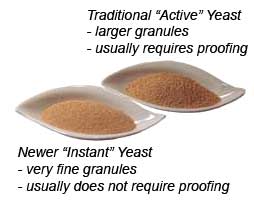
Newer,
"Instant" Yeasts - The first secret of today's artisan bread
methods is "Fast-rise," "Quick-rise", or "Instant" yeast. This yeast
does not require any proofing. (Previously, most yeast breads
required that the yeast be placed in water at just the right
temperature until it became rehydrated and bubbly, a process
sometimes termed as "blooming." This proofing step ensured
that the yeast was viable and ready for work). Instant yeast
granules are smaller in size and do not require proofing. They are
produced and packaged such that their viability is quite reliable.
In most slow-rise methods, the instant yeast is added to the dry
ingredients and dissolved as the wet ingredients are added. Instant
yeasts are also used in bread machine methods of bread
making.
 A
Cold First Rise - The second secret of new bread baking
is a cold first rise, also known as "delayed first fermentation."
Cool refrigerator temperatures surrounding the just mixed bread
control the yeast's exuberance to a very slow pace. Meanwhile, the
wet ingredients have time to work on the flour breaking it down to
simpler forms and allowing its natural enzymes to be released. The
result is incredible flavor that comes only from a cool "delayed
first fermentation." A
Cold First Rise - The second secret of new bread baking
is a cold first rise, also known as "delayed first fermentation."
Cool refrigerator temperatures surrounding the just mixed bread
control the yeast's exuberance to a very slow pace. Meanwhile, the
wet ingredients have time to work on the flour breaking it down to
simpler forms and allowing its natural enzymes to be released. The
result is incredible flavor that comes only from a cool "delayed
first fermentation."
A Cool Second
Rise - Following a vigorous, quick stir, the second rise of
the dough is accomplished in cool room temperatures for up to 18 to
24 hours. The second rise happens slowly because of the initially
cold dough. As the yeast does its work, the all-important strands of
gluten are formed, stretched, and developed. It's this second,
elongated rise that takes the place of kneading. The cookbook author
featured below calls this "micro-kneading."
 Baking
the Bread - The baking of homemade bread is perhaps the
best air freshener a home could have! About 30 minutes into the
60-75 minute bake time, the aromas begin to envelop the kitchen and
permeate throughout the house. Slow-rise, no-knead breads will
generally take longer to bake than traditional yeast breads. An
instant-read thermometer registering 210°F at the bread's center
indicates doneness. Baking
the Bread - The baking of homemade bread is perhaps the
best air freshener a home could have! About 30 minutes into the
60-75 minute bake time, the aromas begin to envelop the kitchen and
permeate throughout the house. Slow-rise, no-knead breads will
generally take longer to bake than traditional yeast breads. An
instant-read thermometer registering 210°F at the bread's center
indicates doneness.
Schedule
Elasticity - So far, hands-on time has included five minutes
for the measuring and mixing, and one minute for stirring after the
first rise - six minutes in total! However, the elapsed time has
been anywhere from 24 to 36 hours. Allowing the dough to rise slowly
in cool conditions not only yields a wonderfully tasting loaf of
bread, but a lot of elasticity in the schedule. While the
slow-cool-rise processing may seem like an exercise in delayed
gratification, it can become an easy routine to have the next loaf
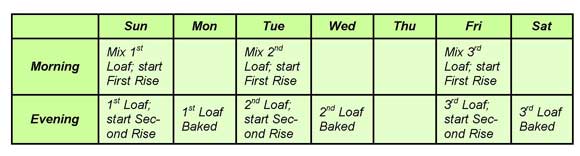
in motion at all times. Here's how we're experimenting with
the slow-rise method:
Interested
in learning and experimenting more with slow-rise, no-knead bread?
We recommend Kneadlessly
Simply by Nancy Baggett, (featured below), or Peter
Reinhart's The
Bread Baker's Apprentice, or his soon-to-be released Peter
Reinhart's Artisan Breads Every Day, or Artisan
Bread in Five Minutes a Day by Jeff Hertzberg and Zoë
François.
|
Reviving
Bread Making at Home
|
You're asking,
what's the catch? Great, fresh bread with 5-6 minutes of
hands-on work? It's just that simple - just a few common ingredients
and a couple common kitchen tools.
Tool
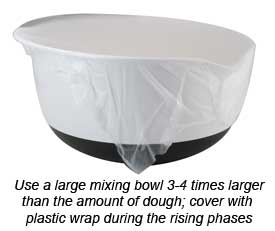
Simplicity -- The gear list for a basic, slow-rise bread
includes exactly six tools: 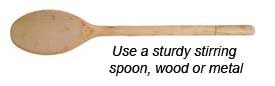
1. Large mixing
bowl
2. A sturdy mixing spoon
3.
One-cup measure
4. Teaspoon
measure
5. Baking pan or surface,
and
6. Cooling rack
That's it!
Even the simplest of equipped kitchens can become a fresh bread
baking factory! One of the stated reasons for not making yeast
breads is the mess that arises during the process. The sticky
kneading board or countertop, the fine dust of flour flown about the
kitchen during kneading, or the yeasty dough underneath one's
fingernails, etc., etc. With this method, initial clean-up is
limited to the mixing spoon, a one-cup measure and a teaspoon
measure. How much easier could it get?
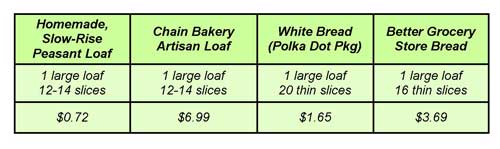
Dollars to
Pennies - It would be difficult to drive to your local
bakery, wait in line, and drive home in less than 5-6 minutes, but
if time and flavor don't convince you to try this bread making
method, perhaps cost will. We added up the cost of the
ingredients in the first recipe below and compared it to some other
bread choices:
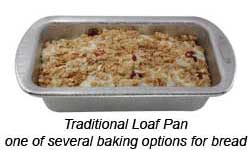
The Baking
Pan - Not all bread needs to be baked in a loaf pan, though
they certainly work quite well. Bread can be baked in a free-formed,
round loaf and baked on a cookie sheet. Many of the recipes we
explored called for using a Dutch oven or a lidded casserole dish.
The heavy cast iron or ceramic character of these pans suits bread
baking perfectly with their special heat transfer capabilities.
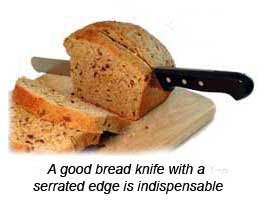
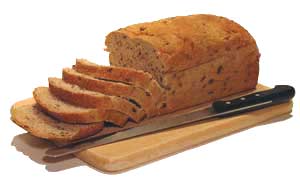
Serving
Fresh Bread - If you're a newbie to serving
fresh-from-the-oven bread, you'll find that it may be difficult to
cut when hot. It's perfectly fine to allow family or guests to tear
a piece of bread from a fresh loaf. Or, allowing the bread to set a
few minutes will make for easier cutting. A true bread knife is
invaluable for slicing fresh bread. Choose a knife that has a
serrated edge and is long-enough to match a typical loaf of peasant
bread - at least a 10-12" blade
length.
|
Mastering
Measuring
|
In a
carpenter's world the saying goes, "Measure twice, cut once." Bakers
don't quite have the chance to measure twice, so it's best to get it
right the first time! Having accurate measuring tools is the
first step. It's amazing how many measuring tools are inaccurate in
their construction. 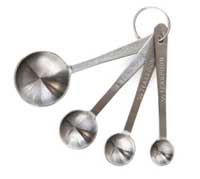 Choose
tools that are from a reputable manufacturer. We have several styles
of cups and spoons that we recommend and would be happy to point out
their different features. Choose
tools that are from a reputable manufacturer. We have several styles
of cups and spoons that we recommend and would be happy to point out
their different features.
Measuring
Liquids - To measure liquid ingredients, use a glass or
plastic cup that has accurate markings and features a spout for
pouring. When measuring make sure to "read" the liquid's level
horizontally from eye level. If the angle of your view is not level,
your measurement will be off. Use a small rubber or silicone scraper
to fully empty the measuring cup. For very viscous liquids like
honey or molasses, oil the inside of the measuring cup; the sweet
liquid will slip out easily without leaving any product
behind.
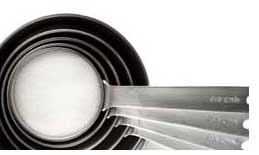 Measuring Dry
Ingredients - To measure dry ingredients, use graduated or
nested measuring cups. They may be made of plastic, ceramic or
stainless steel. We like measuring cups that have permanent markings
embossed on their handles or sides. Painted markings may disappear
in time with dishwashing and handling. With accurate tools in hand,
a correct technique is also required. Here are a few tips for
accurately measuring some common bread ingredients. Measuring Dry
Ingredients - To measure dry ingredients, use graduated or
nested measuring cups. They may be made of plastic, ceramic or
stainless steel. We like measuring cups that have permanent markings
embossed on their handles or sides. Painted markings may disappear
in time with dishwashing and handling. With accurate tools in hand,
a correct technique is also required. Here are a few tips for
accurately measuring some common bread ingredients.
- Powdery
Textures - (Flour, Baking Powder, Baking Soda,
Confectioner's Sugar) - Stir or lightly fluff the powder in its
container. Spoon the powder into the measuring cup. Fill to
overflowing, then scrape off any excess
 so
that the contents are level with the top of the cup. Do not pack,
tamp down, or allow it to settle. Also, do not scoop powdery
ingredients with the measuring tool; this has the effect of
packing the ingredients causing too much to be used. so
that the contents are level with the top of the cup. Do not pack,
tamp down, or allow it to settle. Also, do not scoop powdery
ingredients with the measuring tool; this has the effect of
packing the ingredients causing too much to be used.
- Granulated
Textures - Sugar, Salt - Simply pour or spoon into the
measure and level off.
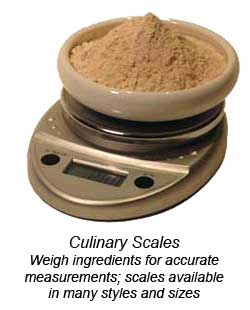
Measuring by
Weight - Measuring ingredients by weight is a well-used
method in commercial kitchens and in international cultures. We
often prefer weighing ingredients when baking because it is so easy
to add ingredients according to the scale's display without
measuring cups or spoons. Convert your favorite recipes from volume
measurements to weight measurements and simplify your life. The
density of the ingredient will affect the volume-to-weight
calculation; use the Nutrition Information table on the ingredient's
packaging where the volume-to-weight conversion for the product is
listed.
|
Cooks'Wares'
Smart Slow-Rise Bread Making Tips
|
Tip #1: Upon discovering your
new favorite bread, mix several batches of the dry ingredients and
store in a zipper bag. 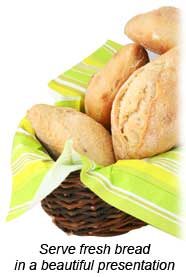 Write
a card with the remaining ingredients listed, the baking temperature
and time noted, and tape it to the bag. The next time you are ready
to mix a loaf, it will take you only two minutes and only one spoon
to wash! Write
a card with the remaining ingredients listed, the baking temperature
and time noted, and tape it to the bag. The next time you are ready
to mix a loaf, it will take you only two minutes and only one spoon
to wash!
Tip #2:
Showcase your fresh bread in a bread basket, or on a cutting board
draped with a beautiful tea towel. Baskets and fabric will allow
steam to be released while keeping your bread warm.
Tip #3: Slow-rise, no-knead
breads seem to use a smaller quantity of yeast than other yeast
bread recipes and usually less than a single envelope. Consider
buying a jar of yeast that allows you to use just what you need and
avoids a half-used packet.
Tip #4: Yeast is a dormant,
one-celled organism that "comes alive" when in contact with water.
To ensure freshness, always check the expiration date when
purchasing. Unopened yeast packages may be stored in a cupboard;
opened packets or jars should be stored tightly closed in the
refrigerator.
Tip
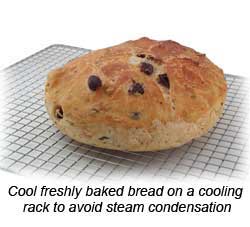
#5: Within 5 minutes of removing the bread from the
oven, turn the bread out of its pan and place on a cooling rack.
This will prevent the outside of the bread from getting wet from
steam condensation as the bread cools.
 Tip #6: Slow-rising bread asks the
yeast to work for a relatively long period of time. However, there
are limits to yeast's tolerance - at some point, the yeast can
become expended and fail to rise - call it post-party exhaustion.
Over-fermentation can be avoided by cooling the dough for more of
the rising period, and acting within the 24-36 hour window. Tip #6: Slow-rising bread asks the
yeast to work for a relatively long period of time. However, there
are limits to yeast's tolerance - at some point, the yeast can
become expended and fail to rise - call it post-party exhaustion.
Over-fermentation can be avoided by cooling the dough for more of
the rising period, and acting within the 24-36 hour window.
Tip #7: Keep extra
sets of measuring cups and measuring spoons in your utensil drawer.
This will allow you to keep baking without having to wash or rinse a
measuring cup or spoon for the next ingredient. Extras will also
allow you to avoid reaching into a dirty dishwasher during the next
recipe.
|
Q &
A's
|
Q: Why the emphasis on the feel of
the dough?
 A: Flour varies in the amount
of moisture that it can hold based on local weather conditions, the
type of flour, or the way in which flour was measured. Some say the
amount of flour used can vary up to 25%. Becoming comfortable with
the feel of the dough provides a guidepost for achieving the desired
outcome. A: Flour varies in the amount
of moisture that it can hold based on local weather conditions, the
type of flour, or the way in which flour was measured. Some say the
amount of flour used can vary up to 25%. Becoming comfortable with
the feel of the dough provides a guidepost for achieving the desired
outcome.
Q: Does
sifting affect the measurement of flour?
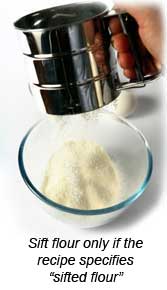
A: Yes! A cup of sifted flour
will weigh approximately 4 ounces. In contrast, one cup of unsifted
flour will weigh 4.75 ounces - a 18+% difference! If the recipe
calls for sifted flour, most definitely sift the flour. If the
recipe does not specify sifted flour, then spoon "fluffed" flour
(see above) into the measuring cup and level off. In the "olden
days" flour was routinely sifted to break up clumps of flour and to
remove hard bits. Today's flour quality does not require sifting
unless specified by the recipe.
Q: What is a dash? A
pinch? A smidgen?
A: Many baking recipes call
for a dash, pinch or a smidgen. According to most, a dash is 1/8
tsp., a pinch is 1/16 tsp., and a smidgen is 1/32 tsp. And yes,
there are measuring spoon sets available for a Dash, Pinch and
Smidgen!
Q: What is
the difference between all-purpose flour, bread flour, cake flour,
and self-rising flour?
A: All-purpose flour is for
general use in any recipe unless specified otherwise. Bread flour is
made from hard wheat which has a higher protein content and greater
percentage of gluten. Cake flour is flour with a low protein content
and only half the glutens of bread flour. 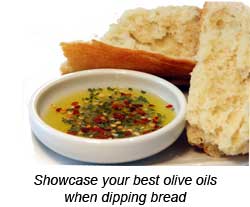 Cake
flour produces a fine, very tender product in baking, but it is not
suitable for bread making; use it for cookies and cakes. Self-rising
flour is pre-mixed flour containing baking powder and salt and is
more suitable for making quick breads, (pancakes, muffins, waffles),
than yeast breads. Cake
flour produces a fine, very tender product in baking, but it is not
suitable for bread making; use it for cookies and cakes. Self-rising
flour is pre-mixed flour containing baking powder and salt and is
more suitable for making quick breads, (pancakes, muffins, waffles),
than yeast breads.
Q:
What is the proper etiquette when dipping bread in
oil?
A:
Dipping oils are a great way to enjoy fresh bread while substituting
healthier oils for butter. Tear off a bite-sized piece of bread and
dip in oil. Do not dip an entire slice of bread in the oil, and
certainly do not "double-dip" the slice after having bitten off a
piece.
|
Cookbook
Review
|
Kneadlessly
Simple, Fabulous, Fuss-Free, No-Knead Breads by Nancy
Baggett. Copyright 2009. Photography by Alexandra Grablewski.
Published by John Wiley & Sons, Inc, Hoboken, NJ.
True to
its title, this cookbook takes us down a new pathway for making
bread. And while there are several takes on cool, slow-rise bread
baking, we found this book particularly accessible in its
instructions and breadth of adapted recipes. 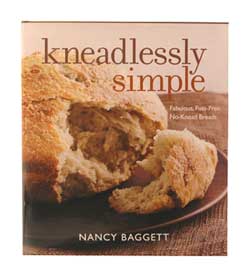 Ms.
Baggett expertly explains the chemistry behind the chilled
temperatures and the elongated rising times. We especially
appreciated the flexible schedule that she builds into each recipe;
she clearly understands real life and last minute changes to the
agenda. The cookbook starts with easy, yet delicious, recipes
designed to train the renewed bread baker in the new method. From
there the variations break out in several directions. She covers
American Favorites, Old-World Classics, Whole and Multi-Grains,
Gluten-Free Breads, and Sweet Breads. A great trouble-shooting
section provides a safety net and confidence for the experimentation
ahead. The book ends with expert guidance for converting your own
beloved bread recipes to the cool, slow-rise method. We can't wait
to try the Cinnamon Sticky Buns and the Rosemary
Focaccia! Ms.
Baggett expertly explains the chemistry behind the chilled
temperatures and the elongated rising times. We especially
appreciated the flexible schedule that she builds into each recipe;
she clearly understands real life and last minute changes to the
agenda. The cookbook starts with easy, yet delicious, recipes
designed to train the renewed bread baker in the new method. From
there the variations break out in several directions. She covers
American Favorites, Old-World Classics, Whole and Multi-Grains,
Gluten-Free Breads, and Sweet Breads. A great trouble-shooting
section provides a safety net and confidence for the experimentation
ahead. The book ends with expert guidance for converting your own
beloved bread recipes to the cool, slow-rise method. We can't wait
to try the Cinnamon Sticky Buns and the Rosemary
Focaccia!
|
Recipes for
Fresh, Better Bread
|
Recipes excerpted from Kneadlessly
Simple, Fabulous, Fuss-Free, No-Knead Breads by Nancy
Baggett. Copyright 2009. Published by John Wiley & Sons, Inc,
Hoboken, NJ. Reprinted with permission of the publisher. All rights
reserved.
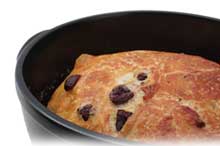
Crusty White,
Peasant-Style Pot Bread
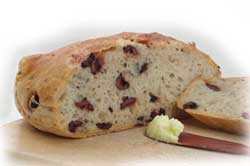 This
was our first attempt at using the cool, slow-rise method of
bread-making. We added a cup of kalamata olives as suggested in one
of the variations. It was a huge success! Not only was it
incredibly easy, the result was extremely rewarding! The
recipe produced a well-rounded loaf with a beautiful golden crust.
The taste and texture was divine! We plan to make this bread again
and again. This
was our first attempt at using the cool, slow-rise method of
bread-making. We added a cup of kalamata olives as suggested in one
of the variations. It was a huge success! Not only was it
incredibly easy, the result was extremely rewarding! The
recipe produced a well-rounded loaf with a beautiful golden crust.
The taste and texture was divine! We plan to make this bread again
and again.
Click here to view the full, illustrated
recipe.
Click here for a printable version of
the recipe.
Great Granola
Breakfast Bread
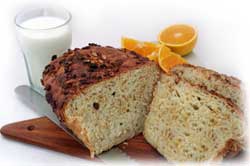 Bolstered
by our first round of success, this recipe sounded wonderful and we
were right! Easily mixed, as promised, the bread had just the
slightest hint of sweetness. The added granola provided some extra
texture. We thoroughly enjoyed it when it was warm, and possibly
even more when it was toasted. Buttered toast and a glass of milk -
breakfast nirvana! Bolstered
by our first round of success, this recipe sounded wonderful and we
were right! Easily mixed, as promised, the bread had just the
slightest hint of sweetness. The added granola provided some extra
texture. We thoroughly enjoyed it when it was warm, and possibly
even more when it was toasted. Buttered toast and a glass of milk -
breakfast nirvana!
Click here to view the full, illustrated
recipe.
Click here for a printable version of
the recipe.
Crispy Roasted
Garlic and Parmesan Pot Bread
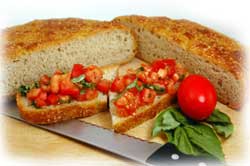 Another
winner! We roasted the garlic earlier when the oven was on and
had the garlic/cheese paste ready to mix into the dough ahead of
time. The dough took all of five minutes to make, and another minute
to tend the next day. The baked bread had a rich, yet not
overwhelming, garlic and cheese flavor that made the perfect
bruschetta base and a fantastic garlic toast. Yummm... Another
winner! We roasted the garlic earlier when the oven was on and
had the garlic/cheese paste ready to mix into the dough ahead of
time. The dough took all of five minutes to make, and another minute
to tend the next day. The baked bread had a rich, yet not
overwhelming, garlic and cheese flavor that made the perfect
bruschetta base and a fantastic garlic toast. Yummm...
Click here to view the full, illustrated
recipe.
Click here for a printable version of
the
recipe.
| |