Fall 2009
Cooking Classes
|
FALL
2009 COOKING CLASSES are OPEN for
REGISTRATION Register Online,
In-Person, or by Telephone Harper's Point
classes - Call 513-489-6400 Settler's Walk
classes - Call 937-748-4540 www.cookswaresonline.com
To view all of the details, visit our
website now and plan some fun this autumn! Limited seating --
Plan early, then Register! 
Harper's Point
classes - Call 513-489-6400
Your Cooks'Wares Bonus:
Cooks'Wares offers a 10% Discount
on your merchandise purchases on the
day you attend class! (excluding kitchen
electrics) |
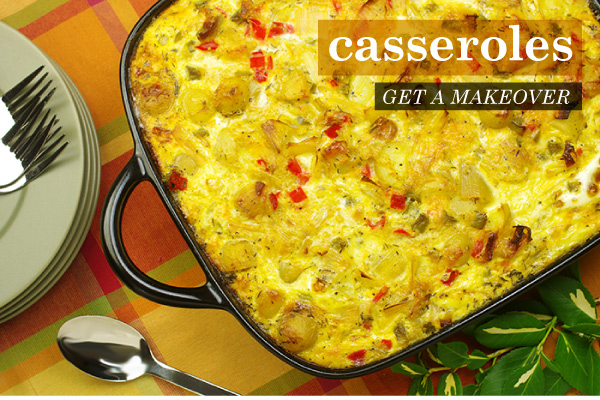
Concocting
Casseroles
|
Even when
casseroles had temporarily lost their public flair, they were always
at home in the everyday kitchen. Now back in the limelight, the
casserole graces buffets spreads, dinner parties, and elegant dining
tables in some form. Broadly defined, a casserole is a one-dish meal
baked in an oven. From there, variations abound!
Casserole
Cousins - Some claim casseroles to be a distinctly
American invention, but hundreds of baked dishes exist across many
cultures. Our persistent interest in other regional and
international cuisines has opened us up, once again, to casseroles.
We know them, perhaps, by other names: French Cassoulets, Southern
Shroups, Egg Stratas, Seafood Bakes, Pots, Pot Pies, Vegetable
Gratins, Italian Lasagnas and Baked Shells, Greek Moussakas and
Pastistos, Royales, Supremes, Minnesotan Hot Dishes, and the dessert
casseroles, Cobblers, Crisps, Crunches.
Ultimate Practicality - The
resurgence of casseroles is logical in many respects; they appeal to
a practicality that so easily trumps fussiness. Traditionally, the
casserole was the perfect venue for ready ingredients based on
seasonal availability. Variously composed, the casserole kindly
stretched ingredients to the crowd at hand. Most casseroles can be
prepared ahead of time leaving the kitchen and the cook free and
clear for other meal preparation tasks. Once ready, most casseroles
may be eaten with a fork eliminating carving, cutting and complex
serving. The casserole epitomizes "family-style
dining."
The Ties That Bind - One-dish
concoctions generally use a binder of one sort or another that
builds cohesiveness in the resulting product while adding
distinctive flavor. Classic binders include eggs, cream, sour cream,
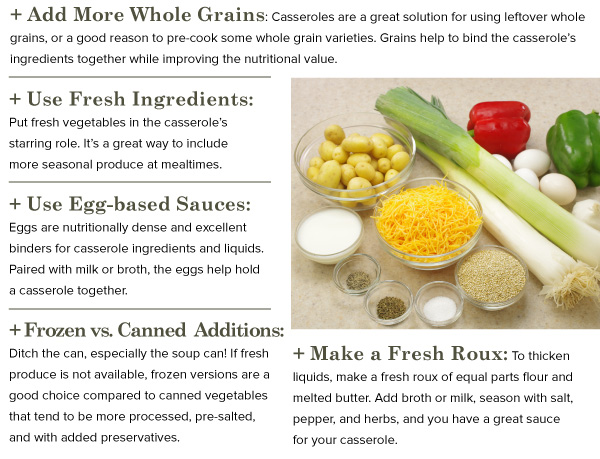
roux-based sauces and cheeses. The 50's and 60's homemaker
substituted canned condensed soups as the popular binder; it may be
this sub-par preparation that perhaps eventually led to the
casserole's temporary demise. Back to cooking from scratch,
casseroles flourish once again.
Choosing
the Right-Sized Pan - Most casserole recipes will
indicate the size of pan to be used measured by volume - most
commonly a 1.5 quart, 2 quart, 2.5 quart, or 3 quart pan. Be
aware that not all same-sized pans are shaped in the same way. Some
pans are shallow, others deep. The shape of the pan will affect the
length of baking time. Shallow pans will bake more quickly; deeper
pans will heat more slowly.
When Is It Done? - Many casserole
recipes offer timing instructions such as "bake until bubbly."
Seemingly vague, the instruction is spot on; at the point where the
casserole is bubbly throughout, the temperature is most likely above
200°F. At that temperature, eggs have coagulated, cream has
thickened, juices evaporated and the mixture begins to set up as
desired.
Friendly Follow-on
Food - Casseroles make for perfect leftovers, if there are
any.... Package leftovers in logical containers for follow-on use;
refrigerate or freeze. Reheat leftovers in the oven or microwave
oven. A sprinkling of water on top of the leftovers and a
light cover will keep the casserole from becoming too dry in the
reheating process.
|
Better
Bakeware
|
Now that
one-dish baked meals are back, the vessels for baking and serving
have been updated, tempered, and designed for the contemporary
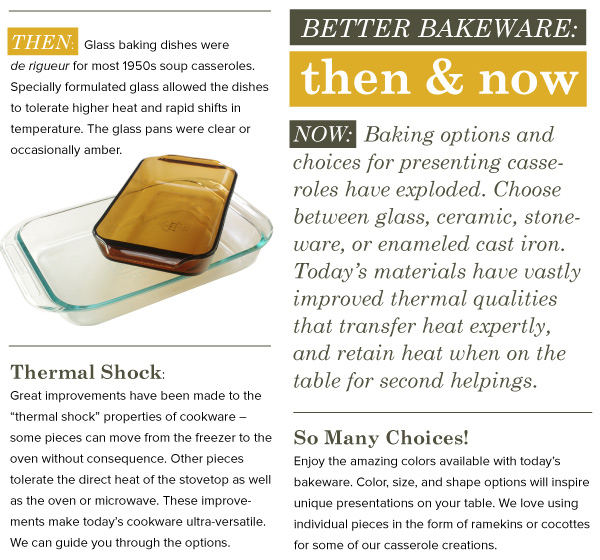
kitchen. Once was the time where the only casserole dish was a
clear, glass rectangular piece; today, the range and diversity of
bakeware is exciting and sports whole new levels of
practicality.
What
to Look For in a Baker - Updating your bakers and
casseroles will provide new inspiration for the genre. Consider the
following characteristics when choosing baking dishes:
- Material -
Casseroles as a vessel have traditionally been earthenware
vessels. Today's choices are often earthenware in the form of
specially formulated and fired ceramics. Choose bakers that are
tempered to move from freezer to oven to table.
- Durability -
Finishes with quality glazes or enameling provide easy cleaning,
resist stains and avoid odor retention.
- Shape and
Size - Equip your kitchen with a variety of sizes to make
tailoring your choice of baker and recipe as easy as possible. Too
small, or too large, and your baking will be altered in perhaps
undesirable ways.
- Lids - Many
bakers or baking pots come with lids which can be handy for
stovetop preparation, keeping food warm on the way to the table,
and covering leftovers in the refrigerator. Lids are generally not
required during the baking phase, however.
- Handles -
Practice lifting a baker with hot pads in hand to ensure that a
good grip is available. A pan without handle areas is difficult to
maneuver when full and hot.
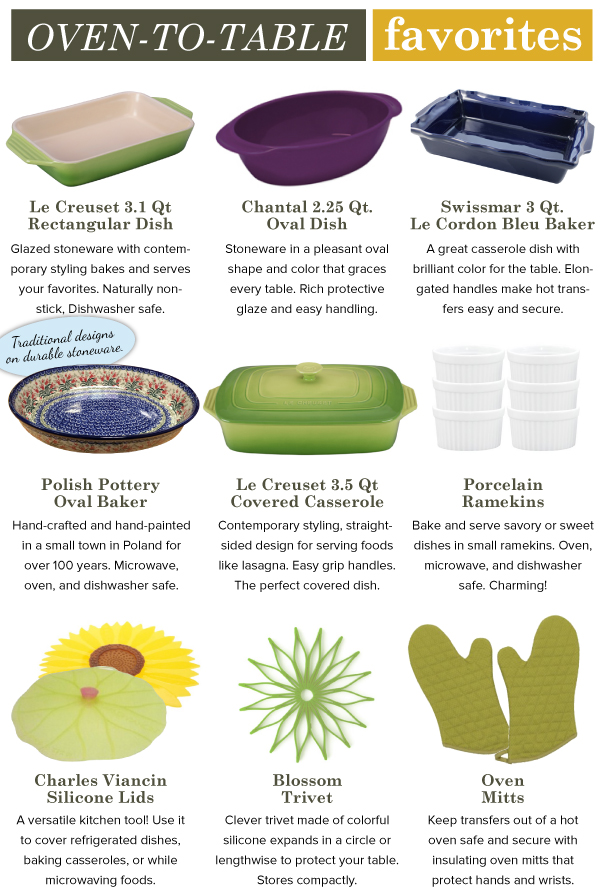
Our Favorites:
Le
Creuset - This French manufacturer of quality bakeware
offers two types of pans that are perfect for casseroles. Le Creuset's Stoneware
Bakers feature all of the sought after characteristics of a
great casserole dish. Available in many shapes - square,
rectangular, oval, loaf, and pie - the sizes range from individual
servings to crowd-sized vessels of 5+ quarts. Le Creuset stoneware
resists stains, chipping and cracking. Le Creuset Stoneware is rated
for use in situations up to 500°F. Also well-known for their
enameled cast iron, Le Creuset products come in bold, bright colors
that complement food and the table in delightful ways.
Emile
Henry - Another French-based company, Emile Henry uses
clay from the Burgundy region of France to craft its ceramic pieces.
The nature of this special ceramic slowly and evenly transfers heat
throughout dish. Once heated, the ceramic holds the heat beautifully
keeping the food hot until the second helpings are had. Possessing
extraordinary "thermal shock" properties, Emile Henry products move
directly from freezer to oven, and are at home in the microwave and
under the broiler. Emile Henry's
Flametop® series has the added ability of stovetop
functionality. These products are stain resistant, do not crack or
chip easily, and have glazes that will not craze or discolor with
use. Explore the new Emile Henry colors!
Chantal
- A U.S.-based company, Chantal is well-known for its
enamel-on-steel products, Copper Fusion™ cookware, and now, its
Make and Take®
Bakeware. Chantal bakeware features all manner of shapes and
sizes in beautiful ceramic and stoneware colors and moves easily
from oven to table. The lids of the new Make and Take® line sport a
removable silicone gasket that form a seal for safe transport and
secure refrigerator storage.
Arcelegance -
Also from France, Arcuisine manufactures clear glass ovenware, Arcelegance,
designed to withstand thermal and mechanical shock. Simple and
elegant, the glass pieces come in oval and rectangular shapes and
matching lids. Great for its see-through character.
Soufflés and
Ramekins - Available in many brands, shapes and sizes, these
classic fluted-edge baking dishes with their straight-sides are
ideal for casseroles of all types.
|
Heat Defense
Systems
|
It's a daily
threat in the kitchen - protecting oneself and one's environment
from the damages of misplaced heat. The gift of heat that allows us
to eat a greater range of foods, also has the potential to burn or
scar our skin, countertops, and dining room tables. Understanding
heat transfer and its affects on surfaces helps us avoid damage and
pain.
What is Heat? - Heat is a form of
energy, thermal energy that moves from one object to another. In the
kitchen, heat transfer occurs when objects are in contact with each
other. Nature favors equalization of temperatures between the
objects. The speed at which this equalization happens is based on
the molecular characteristics of the objects. Some materials are
great conductors of heat, (i.e., metal, liquids), others are
insulators (glass, wood).
Cloth
Protection -- In the kitchen, hot pads and oven mitts
are indispensable in providing protection particularly when moving
food out of the oven. The traditional material for hot pads and oven
mitts is cotton fabric. Cotton or cotton blends have the
characteristic of withstanding higher temperatures. Wool, also an
excellent heat resistor, is not quite as washable as cotton. Oven
mitts provide full protection in and around the oven.
Silicone
Innovation - The advent of silicone-based products
throughout the kitchen has also provided some novel application of
the materials in the heat protection arena. Silicone is very heat
resistant, exceptionally flexible, and easy to clean. Investigate
silicone oven mitts, handles, and trivets.
Other Natural Insulators - In
addition to plant-based fabrics, other plant materials, wood and
cork, prove to be excellent insulators and heat protectors. A
decorative cutting board or cork trivet will host your hot casserole
dish safely.
Countertops
and Dining Surfaces - Your kitchen countertop may be
sensitive to the heat. A laminate surface is most sensitive and can
easily be scarred from a hot casserole dish. Solid surfaces, like
Corian® or similar products, are less sensitive, but still
susceptible. Manufactured stone is also sensitive to heat.
Granite, marble, limestone, and concrete are less susceptible to
heat, though the sealers placed on these surfaces may be sensitive
to heat. Stainless steel is the least sensitive to heat though
abrupt localized changes in the metal's temperature may cause
temporary reactions. Bottom line, protect your countertop surfaces
by insulating them from heat
sources.
|
Cooks'Wares'
Smart Casserole Tips
|
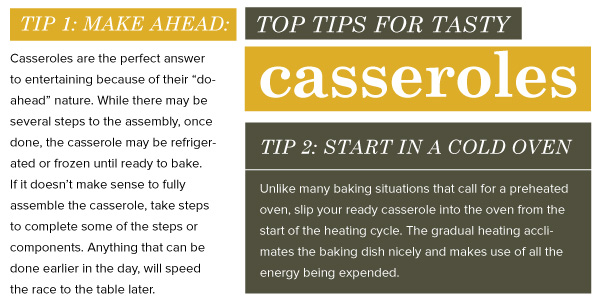
Tip #1: Use a meat
thermometer to check the temperature of your casserole. Sometimes
the edges may be bubbling away, but the center remains lukewarm and
liquefied. Checking the temperature periodically at the center
allows a progress check and timing assessment.
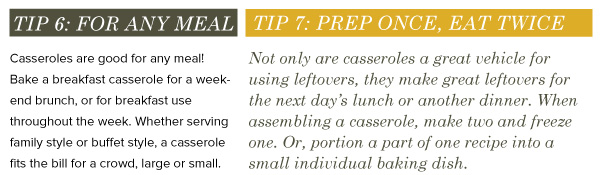
Tip
#2: Class up your table presentation of baked
dishes with individual casseroles or ramekins. Serve these single
servings on a separate plate lined with a simple doily or cloth
napkin. Check out Le Creuset's Mini-Cocottes in their iconic shade
of orange.
Tip
#3: Generally, if your baker is built for moving
directly from freezer to oven, place the frozen pan in a cold oven
and allow the pan to preheat along with the oven. The center of a
frozen casserole will take longer to bake than an unfrozen
casserole. Adjust your timing accordingly.
Tip #4: At the risk of
stating the obvious, know where you're going with the hot casserole
before opening the oven door. We've all done it; in our rush to get
the dish out of the oven, we forget to find a landing space. Clear a
safe location, protect the surface, then
transfer the casserole from the oven. Hot pads will protect your
hands for only a short time, plan to transfer quickly. Keep your hot
pads and mitts dry -- water is a very effective conductor of
heat!
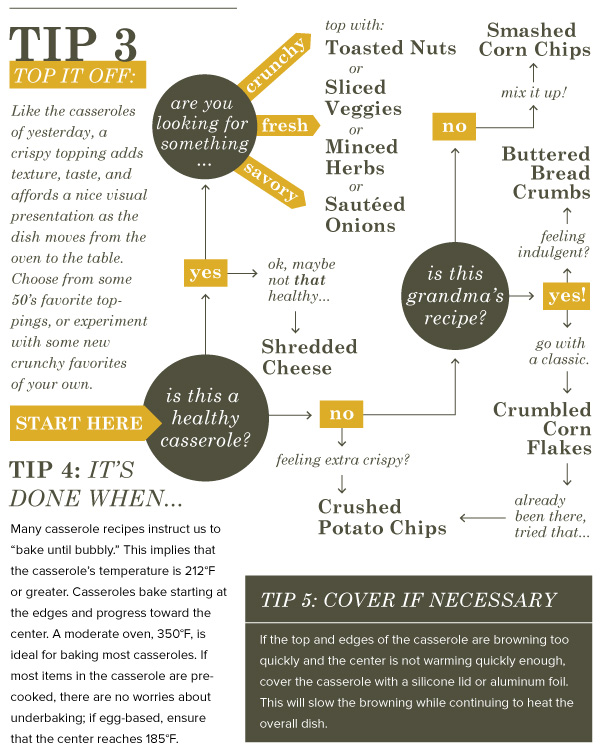
Tip #5: Casseroles are often
topped with cheese or a breaded topping. We think panko bread
crumbs are particularly good as a casserole topping. Drizzle melted
butter on the crumbs and toss until incorporated. Spread evenly on
the casserole's top.
Tip
#6: Use an old trick to track your baking dishes. On
the inside of a kitchen cupboard, tack a card listing your favorite
baking dishes and their sizes, e.g., large blue baker = 1.5 quarts,
red round = 2 quart, and so on. You'll reach for the right size more
easily while keeping track of some less used pieces.
Tip #7: These 'tween days
between air conditioners and furnaces where our homes are naturally
more open are a great time to flip on the self-cleaning mode of your
oven. The open windows will provide the necessary ventilation for
the high temperature cleaning
process.
|
Q &
A's
|
Q: How did Campbell's soups
become so associated with American casseroles?
A:
In the 1950's, marketing efforts by the soup company enticed
homemakers to buy their products by providing recipes utilizing
their prepared soups. Perhaps the most famous incarnation of this
phenomenon is the still popular Green Bean Casserole. According to
the Campbell Soup Company, the recipe was developed in their test
kitchens in 1955 by Dorcas Reilly as a combination of French cut
green beans, condensed mushroom soup, and French-fried
onions.
Q: What's the
best way to clean ceramic bakers? A: Most food remains can be
cleaned easily from well-glazed bakers. For burnt or stuck-on foods,
simply allow the baker to soak in hot, soapy water for a period. The
excess food will easily wash away after a good soak. Avoid immersing
stoneware in water for long periods of time.
Q: How can I tell what the size of
my baking dish is? A: Most U.S. recipes express
the size of the casserole in "quarts." Check the bottom of your
baking dish to see if the size is inscribed on the bottom. If it is
not, measure the volume of the dish by pouring measured water into
the baker to a height one-half inch from the rim. The
amount of water used will approximate the recipe volume that the
dish will hold.
Q: How
can I keep my casserole from bubbling over in the oven and making a
mess? A:
Choose the right size of baking dish for the recipe. Fill the dish
leaving at least an inch of space from the top of the rim. This
should contain the most exuberant of bubbling casseroles. Just in
case, oven liners can minimize the work of an oven
mess.
|
Cookbook
Review
|
Crazy for
Casseroles, 275 All-American Hot-Dish Classics by James
Villa. Copyright 2003. Published by Harvard Common Press, Boston,
MA.
A
James Beard Foundation Book Award Nominee
This
accomplished cookbook author puts it all together for us in this
hefty cookbook. Based in a love for capturing the best of regional
cooking, Mr. Villas has assembled a tome of recipes that preserves
some of the best of our cooking heritage while greatly expanding
today's possibilities for the casserole by incorporating fresh
ingredients and novel combinations. His offering is organized first
by course: appetizers, entrées, sides, breads and desserts. Within
each category, he surveys the full range of possibilities by primary
ingredient, eggs, meats, poultry, fish, pasta, vegetables and
fruits. We appreciated his chapter on "Casseroles for a Crowd" where
we were tutored through some of the nuances of large quantity
cooking. We're grateful to Mr. Villas who in this book, has
resurrected and reestablished the casserole as a rich culinary
tradition both classic and
contemporary.
|
Recipes for
Delicious Casseroles
|
Recipes excerpted from Crazy for
Casseroles by James Villa. Copyright 2003. Published by
Harvard Common Press, Boston, MA. Used with permission of the
publisher. All rights reserved.
Sunday
Sausage, Apple, and Cheese Strata
This
breakfast or brunch casserole is a nice twist on traditional egg hot
dishes. The sausage (we recommend a spicy choice), provides a
satisfying heft, the apples a slight sweetness, and the cheese
produces a melted wonderfulness. Pair this with fresh fruit cup and
call it the perfect start to a day!
Click here to view the full
recipe.
Click here for a printable version of
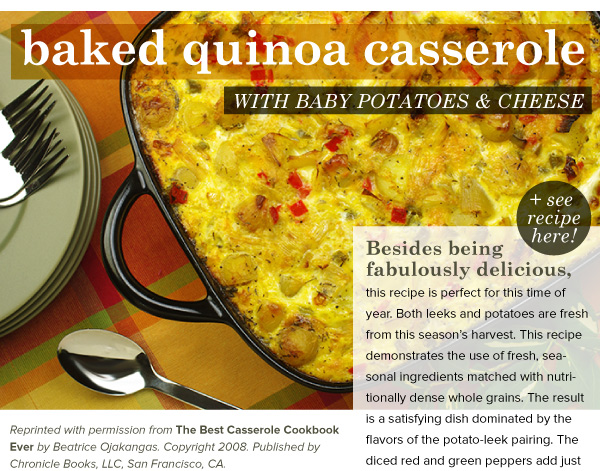
the recipe. . Potato, Wild
Mushroom, and Sorrel Gratin
Reminiscent
of scalloped potatoes, but two leaps past, this gratin exceeds
expectations on the flavor scale. The season's fresh harvest of
potatoes is perfect for this dish! We were all out of sorrel but
followed the recommendation to substitute arugula. The woodsy flavor
of the mushrooms offered distinctive flavors to the
experience.
Click here to view the full
recipe.
Click here for a printable version of
the recipe.
David's
Chicken, Ham, Artichoke, and Pasta Casserole
We
second the author's introduction of this dish as an "up-to-date. . .
sophisticated casserole." Once again, the flavors blended into a
delectable dish, just as a casserole should. The slight smokiness of
the ham, the artichokes, and the Parmesan cheese characterized the
final product that we savored bite by bite as we enjoyed our white
wine, sip by sip.
Click here to view the full
recipe.
Click here for a printable version of
the
recipe.
| |