Cooking
Classes
|
THE MARCH - APRIL 2010 COOKING CLASS SCHEDULE
IS NOW
AVAILABLE ONLINE AND IN OUR STORES!
Invest in a Cooking Class
!
Delicious Dividends that multiply every time you cook at
home!
REGISTRATION IS NOW OPEN!
Register
Online, In-Person, or by Telephone
Harper's Point
classes - Call 513-489-6400 Settler's Walk
classes - Call 937-748-4540
www.cookswaresonline.com
Harper's Point
classes - Call 513-489-6400
Your Cooks'Wares
Bonus:
Cooks'Wares offers a 10%
Discount on your merchandise
purchases on the day you attend
class! (excluding kitchen electrics and during Storewide
Sales) |
Making Perfect
Cheesecakes
|
Cheesecake has
received a reputation for being difficult to make - we're not sure
why - it's much easier than most pastries, and the results always
delight even when they don't turn out just right! We'll take things
step-by-step and guide you to perfect cheesecakes - or at least
better cheesecakes!
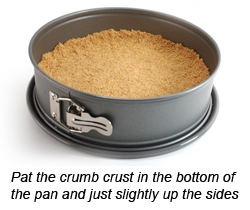 Crust -
the ideal cheesecake crust provides a complementary platform for the
cheesecake. Typically, recipes use a dry crumb moistened with a bit
of melted butter patted into the bottom of the pan. Unlike a pie, a
cheesecake crust covers just the bottom and a half-inch, or so, up
the sides. The crust helps to form a barrier between the batter and
the pan. After patting the crumbly crust into the pan, place the pan
in the freezer for 10-15 minutes while mixing the batter. This
serves to harden the crust into place and prevent any shifting of
the crust when the batter is added. Many bakers choose to prebake
the crust in the oven for 7-10 minutes prior to adding the
batter. Crust -
the ideal cheesecake crust provides a complementary platform for the
cheesecake. Typically, recipes use a dry crumb moistened with a bit
of melted butter patted into the bottom of the pan. Unlike a pie, a
cheesecake crust covers just the bottom and a half-inch, or so, up
the sides. The crust helps to form a barrier between the batter and
the pan. After patting the crumbly crust into the pan, place the pan
in the freezer for 10-15 minutes while mixing the batter. This
serves to harden the crust into place and prevent any shifting of
the crust when the batter is added. Many bakers choose to prebake
the crust in the oven for 7-10 minutes prior to adding the
batter.
Mixing the
Batter - Smoothness is the watchword when it comes to mixing
the perfect cheesecake batter. Cheesecake is primarily a cheese of
one kind or another, eggs, and sugar. In the U.S., cream cheese is
the common choice.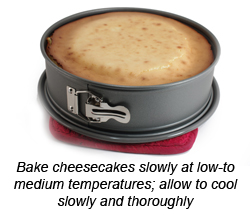 In Italy, it's ricotta cheese, and in other
regions, different forms of fresh, unripened cheese are used. Have
your ingredients at room temperature before mixing. Start with
beating the cheese on low speed into a very smooth consistency;
lumps will not disappear or dissolve during baking, so this is the
moment to achieve the desired smooth, creamy texture. Eggs serve to
thicken the batter when baking. Add them one-by-one incorporating
thoroughly into the cheese. Using a low speed while mixing will
prevent over-aerating the batter. In Italy, it's ricotta cheese, and in other
regions, different forms of fresh, unripened cheese are used. Have
your ingredients at room temperature before mixing. Start with
beating the cheese on low speed into a very smooth consistency;
lumps will not disappear or dissolve during baking, so this is the
moment to achieve the desired smooth, creamy texture. Eggs serve to
thicken the batter when baking. Add them one-by-one incorporating
thoroughly into the cheese. Using a low speed while mixing will
prevent over-aerating the batter.
Baking - Cheesecakes typically bake
between 325-350ºF, and for 1 to 1.5 hours. This low and slow
strategy allows for even baking - the outside will not be
over-baked, and the inside will not be under-baked. The first half
of baking is crucial for allowing air bubbles to expand and raise
the batter. Avoid opening the oven door to check progress; 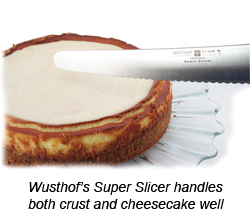 this will change the oven's temperature
and risk collapse of the forming texture. There are "no-bake"
cheesecake variations, but we tend not to think of them as "real"
cheesecakes. this will change the oven's temperature
and risk collapse of the forming texture. There are "no-bake"
cheesecake variations, but we tend not to think of them as "real"
cheesecakes.
Checking for
Doneness - A reliable, tested recipe is your best resource
for timing when baking your cheesecake. The center of the pan should
be wiggly and wobbly still; this may appear as underdone, but the
center will continue to cook and set up during the initial stages of
cooling.
Chilling -
Allow the cheesecake to cool on a wire rack until it reaches room
temperature - about 2 hours. Keeping the cheesecake in the pan, wrap
it well and refrigerate for at least 4-6 hours. The famed chef,
Dorie Greenspan, says in her book, Baking,
that the cooling and chilling process is just as important to the
finished cheesecake as the baking!
 Serving
- Cheesecake is almost synonymous with "richness." Allow the
cheesecake to set at room temperature for 30 minutes prior to
serving to remove the chill just a bit. Where a 9-inch pie might be
cut into eight wedges, a 9-inch cheesecake graciously serves twelve.
A scalloped-edged knife glides through the cheesecake while cutting
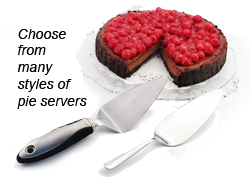
neatly through the crust. Wipe the knife clean after each cut. A pie
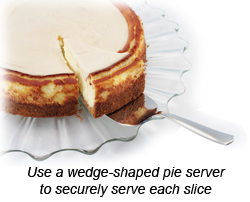
server will deftly lift the slice to the plate. A slice of
cheesecake is typically served upright for dramatic effect, but can
just as easily be laid on its side with toppings
applied. Serving
- Cheesecake is almost synonymous with "richness." Allow the
cheesecake to set at room temperature for 30 minutes prior to
serving to remove the chill just a bit. Where a 9-inch pie might be
cut into eight wedges, a 9-inch cheesecake graciously serves twelve.
A scalloped-edged knife glides through the cheesecake while cutting
neatly through the crust. Wipe the knife clean after each cut. A pie
server will deftly lift the slice to the plate. A slice of
cheesecake is typically served upright for dramatic effect, but can
just as easily be laid on its side with toppings
applied.
|
Perfect Pans for Perfect
Cheesecake
|
A finished
cheesecake is fragile at the same time that it's substantial and
heavy. For good outcomes at the point of serving, it's essential
that you start with a proper pan. There are two basic pan styles
deployed when making cheesecake; either style will ensure easy
handling at finale time.
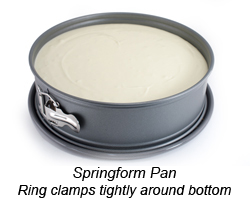
Springform Pans - This pan is the
common standard for cheesecake. The pan comes in two parts, a
bottom, and a circular band that forms its removable sides. The band
fits around the bottom and the clamp snugly tightens the ring into
place forming a leak-proof seal. Most springform pans have 3-inch
high sides that allow for lofty baking. To remove a cheesecake or
other baked good from a springform pan, run the back of a knife or a
spatula around the edge, carefully unclamp and lift away the ring.
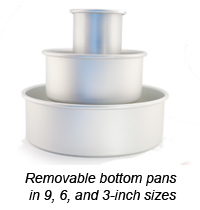
Removable Bottom Pans
- Some bakers prefer this type of pan for cheesecake. The
bottom of the pan sits on a "shelf" formed by the sides of the pan.
The weight of the batter presses the bottom and the side ring
together. When baking and chilling is complete, run a blunt knife or
spatula around the sides of the pan. 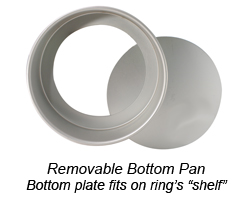 Holding the pan with one hand, push the
cheesecake up from the bottom. You may carefully transfer the
cheesecake from the pan's bottom, or keep the bottom in place for
serving. Removable bottom pans come in all shapes, sizes, and
heights and are useful far beyond the cheesecake world. Holding the pan with one hand, push the
cheesecake up from the bottom. You may carefully transfer the
cheesecake from the pan's bottom, or keep the bottom in place for
serving. Removable bottom pans come in all shapes, sizes, and
heights and are useful far beyond the cheesecake world.
Pan Surfaces - The surfaces of
baking pans vary in their finish. For cheesecake, nonstick surfaces
are a bonus since the pan is not typically prepared by greasing and
flouring as with most cakes. Alternatively, parchment paper may be
used to line the pan's bottom and sides. The paper prevents any
sticking to the pan, and is easily removed.
Pan Height - Cheesecakes love to
loft during baking and our preference seems to be "the taller the
better" when it comes to a slice of cheesecake - the soaring heights
add to the decadence! Choose a pan with a minimum of 3-inch sides.
If needed, 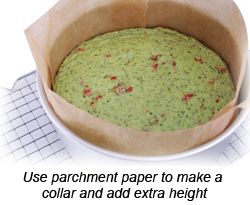 additional height can be had by forming a
collar of parchment paper while lining the sides of the
pan. additional height can be had by forming a
collar of parchment paper while lining the sides of the
pan.
Pan Diameter -
When making cheesecake, match the pan size to your recipe. This will
ensure that the baking time provided in the recipe is an accurate
estimate. For example, the volume of a 9-inch pan with 3-inch high
sides is 191 cubic inches; the volume of a 10-inch pan with 3-inch
high sides is 236 cubic inches. This is a difference of 45 cubic
inches or 24%. If you must adapt your baking to a different size of
pan, adjust the baking time
accordingly.
|
Cheesecake
Improv
|
Cheesecake's
popularity is due, in part, to its adaptability. The mild, slightly
tangy cream cheeses or ricotta cheeses accept a wide range of
flavors. It's only the imagination that is limited. Here are a few
of our favorite riffs on cheesecake:
 Savory Cheesecakes - The savory
side of cheesecake is a great discovery ahead of you if you haven't
already become familiar with this notion. A savory cheesecake may be
served as an appetizer, a spread, or as a luncheon entrée
accompanied by a green salad. (See the savory recipe
below). Savory Cheesecakes - The savory
side of cheesecake is a great discovery ahead of you if you haven't
already become familiar with this notion. A savory cheesecake may be
served as an appetizer, a spread, or as a luncheon entrée
accompanied by a green salad. (See the savory recipe
below).
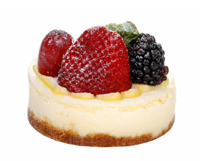
Shift the Size
- While most cheesecake dreams evoke the image of a slice, you may
shift the expectation and presentation of cheesecake by making
different sizes of cheesecake. Both springform and removable
bottom pans come in varying diameters. Choose a 3 x 3-inch pan for
an individual cheesecake, or a 6 x 3 pan for a savory appetizer
version. Ramekins are suitable for cheesecake only if they are also
the serving vessel; it is often difficult to remove a cheesecake
from a pan that does not have a removable bottom of one kind or
another.
Crust
Variations - The standard for cheesecake seems to be a graham
cracker crust. But, the world is big! Experiment with complementary
flavors: ginger snaps, vanilla wafers, shortbread cookies, nut
meals, or biscotti. For savory cheesecakes, try crusts made of
cheesy crackers, saltines, crushed pretzels, or corn
chips.
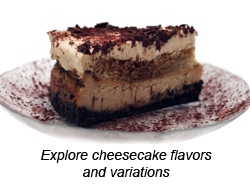 Batter
Variations - Once you've mastered a basic cheesecake, the
door to flavor variations opens wide! In the featured cookbook
below, Chef Geary offers hundreds of his personal favorites. As you
explore flavor additions think in three directions - the crust, the
batter, and any toppings. Batter
Variations - Once you've mastered a basic cheesecake, the
door to flavor variations opens wide! In the featured cookbook
below, Chef Geary offers hundreds of his personal favorites. As you
explore flavor additions think in three directions - the crust, the
batter, and any toppings.
Topping Variations - Classic
toppings of whipped cream or sweetened sour cream are almost always
appropriate with cheesecake. Fruit, fresh or sauced, is the perfect
visual complement and a tasty pairing. Other sauces, fudge, caramel,
dulce le leche, or crème anglaise are all perfect
accompaniments.
|
Smart Cheesecake
Tips
|
 Tip #1: Cracks in cheesecake can
form while baking. Several factors can lead to cracking. Bake your
cheesecake in a medium to medium-low oven so that it bakes slowly
and more evenly. Cool the cheesecake gradually; some recommend
allowing the cheesecake to cool in the oven with the door propped
open. Cracks may also form if the cheesecake has baked too long;
don't overbake. Tip #1: Cracks in cheesecake can
form while baking. Several factors can lead to cracking. Bake your
cheesecake in a medium to medium-low oven so that it bakes slowly
and more evenly. Cool the cheesecake gradually; some recommend
allowing the cheesecake to cool in the oven with the door propped
open. Cracks may also form if the cheesecake has baked too long;
don't overbake.
Tip
#2: If your cheesecake develops a crack, don't sweat it.
Repair the crack by smoothing the baked batter, or camouflaging it
with toppings.
Tip
#3: Wrap your cheesecake well when chilling; it will easily
pick up any odors present in your refrigerator.
Tip #4: Use fresh cream cheese for
your cheesecakes. Cream cheese does not freeze well, i.e., don't buy
a lot of it on sale hoping to stockpile for the future. Freezing
changes the cream cheese's texture making it unsuitable for use. Do
not substitute non-fat cream cheese or whipped cream cheese in your
recipe - they do not mix or bake the same way as regular cream
cheese.
Tip #5:
Carefully store both springform and removable bottom pans so that
they are not subject to warping or bending. We dry our springform
pan very, very well, then store in a nearly clamped position.
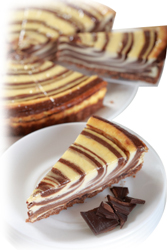 Tip #6: The pan's bottom may be
kept in place when plating and serving, but if you would like to
transfer the cheesecake from the bottom, line the bottom with
parchment paper to minimize any sticking of the crust. Use a broad
cookie spatula or circular cake spatula to manage the
transfer. Tip #6: The pan's bottom may be
kept in place when plating and serving, but if you would like to
transfer the cheesecake from the bottom, line the bottom with
parchment paper to minimize any sticking of the crust. Use a broad
cookie spatula or circular cake spatula to manage the
transfer.
Tip #7: Some
cheesecake recipes call for baking cheesecake in a water bath for
more even cooking. Place the cheesecake pan on a sheet of aluminum
foil and fold up the sides to prevent any water seepage into the
pan.
Tip #8: Baked
cheesecakes freeze very well. Remove a chilled cheesecake from its
pan; allow it to freeze well while placed on a plate or cookie
sheet. Once frozen, wrap well and freeze for up to four months. Thaw
frozen cheesecake overnight in the
refrigerator.
|
Q & A's
|
 Q: Q: 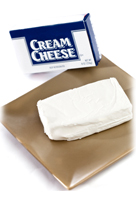 What is cream cheese? What is cream cheese?
A:
Cream cheese is a fresh, unripened, pasteurized cheese
comprised of 33% milk fat with a slightly acidic character from the
lactic acid formed by introduced bacteria. The fat content of cream
cheese is higher than most cheeses making it a common substitute for
butter. Cream cheese is often compared to the French Neufchatel
cheese that is similar in texture and acidic taste, but is ripened
unlike American cream cheese.
Q: What is a New York-style
cheesecake?
A: Different explanations exist for this
cheesecake term. Generally, the origins converge around a cheesecake
that is made with cream cheese (as opposed to ricotta), and with
just the flavors of the cheese, egg, and sugar. The popularity of
cheesecake in New York City in the 1930s, no doubt, has played a
role in the colloquial term.
Q: What is parchment
paper?
A: Parchment paper is paper with integrated
silicone. The silicone can handle heat where waxed paper cannot.
Parchment is a common baking liner that is moisture, grease, and
heat resistant. However, parchment is still paper and will burn
around the magic number of 451ºFarenheit. Avoid its use in broiling
or in toaster ovens where the heating element may be too close to
the paper.
 Q:
Many baking pans are made from "anodized aluminum." What does this
term mean? Q:
Many baking pans are made from "anodized aluminum." What does this
term mean?
A: Anodized aluminum is the result of
aluminum exposed to an acid-induced oxidation process. This chemical
process hardens aluminum in a special way that makes it especially
durable. Heat is transferred evenly through anodized aluminum. A
natural finish exists with anodized aluminum that creates an inert
surface, i.e., aluminum will not transfer from the pan to the food.
Pans may be prepared as "hard anodized" or "silver anodized." A hard
anodized pan is processed longer and has an even harder surface.
Wash all anodized aluminum pans by hand, and never in the
dishwasher.
|
Cookbook
Review
|
The Cheesecake
bible by George Geary. Copyright 2008. Published by Robert
Rose Inc., Toronto, Ontario, Canada.
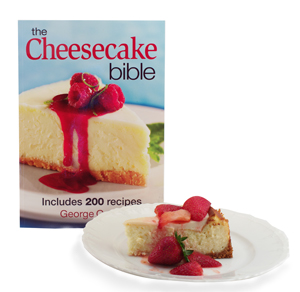 Who knew there could be so many
different kinds of cheesecake? George Geary has assembled a
compendium of hundreds of cheesecake recipes that cover some serious
culinary ground with their range of flavors and combinations. He
tutors us through the basics in the first chapter, then unleashes
the possibilities with following chapters such as "Chocolate
Cheesecakes," "Citrus Cheesecakes," "Nut Cheesecakes," and many
other chapters. We especially enjoyed the chapter on "Savory
Cheesecakes" where wonderful flavors are brought to the richness of
the cheesecake world. He helps us explore small cheesecakes, classic
and inventive toppings, and concludes with a series of "Celebration
Cheesecakes" that truly would make any occasion even more special.
Each recipe is presented succinctly and clearly with added variation
notes and presentation suggestions. This cookbook gets extra points
for offering all of the measurements in metric quantities - weighing
ingredients allows for the most accurate results and the least
amount of clean-up. From basic to exotic, you'll find a cheesecake
suitable for any occasion in this
book! Who knew there could be so many
different kinds of cheesecake? George Geary has assembled a
compendium of hundreds of cheesecake recipes that cover some serious
culinary ground with their range of flavors and combinations. He
tutors us through the basics in the first chapter, then unleashes
the possibilities with following chapters such as "Chocolate
Cheesecakes," "Citrus Cheesecakes," "Nut Cheesecakes," and many
other chapters. We especially enjoyed the chapter on "Savory
Cheesecakes" where wonderful flavors are brought to the richness of
the cheesecake world. He helps us explore small cheesecakes, classic
and inventive toppings, and concludes with a series of "Celebration
Cheesecakes" that truly would make any occasion even more special.
Each recipe is presented succinctly and clearly with added variation
notes and presentation suggestions. This cookbook gets extra points
for offering all of the measurements in metric quantities - weighing
ingredients allows for the most accurate results and the least
amount of clean-up. From basic to exotic, you'll find a cheesecake
suitable for any occasion in this
book!
|
Recipes for
Three Delicious Cheesecakes
|
Recipes excerpted from The Cheesecake
bible by George Geary. Copyright 2008. Published by Robert
Rose Inc., Toronto, Ontario, Canada. Reprinted with permission of
the publisher. All rights reserved.
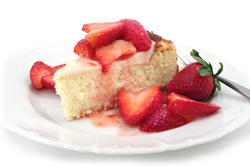 Blue Ribbon Cheesecake Blue Ribbon Cheesecake
We
know why this is called the Blue Ribbon Cheesecake - it has all of
the qualities of a winner! This basic cheesecake is a great place to
start if you're a newbie to baking your own cheesecakes. The recipe
went together quickly, lofted nicely, and tasted just how we thought
a cheesecake should taste. We agree with George's mother who likes
this recipe the best!
Click here to view the full, illustrated
recipe.
Click here
for a printable version of
the recipe. (PDF format)
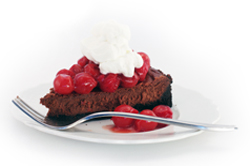 Black Forest
Cheesecake Black Forest
Cheesecake
This classic combination of chocolate
and cherries is reinvented in this cheesecake. The crust is made of
chocolate sandwich cookies with the crème filling adding a bit of
"extra" to the final result. The bittersweet chocolate combined with
the cheese, produced some kind of dessert dreamland in our mouth.
The cherries and whipped cream completed the moment.
Click
here to view the full, illustrated
recipe.
Click here for a
printable version of
the recipe. (PDF format)
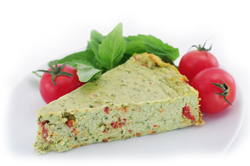 Pesto Sun-Dried Tomato
Cheesecake Pesto Sun-Dried Tomato
Cheesecake
If you're unfamiliar with savory
cheesecakes, this is a great recipe with which to experiment. The
fresh flavors of basil and garlic combine with the intensity of
sun-dried tomatoes to create a scrumptious wedge. We served it once
as a luncheon entrée, and a second time as an appetizer spread on
crackers. Tasty, rich and wonderfully different!
Click
here to view the full, illustrated
recipe.
Click here for a
printable version of
the recipe. (PDF
format)
| |