Store
Hours
|

|

Looking for a
previous
e-newsletter?
Check our E-News
Archive
|
|
|
| Just a
Little Nutty... |
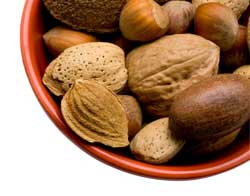 "Going
nuts" most commonly refers to a momentary mental state, but
today we take it literally with our exploration of nuts as
great food. Fresh crops are being harvested in abundance right
now by people and squirrels alike. We all have our favorite
nut preparations - pine nuts in pesto, macadamia nuts in white
chocolate chip cookies, or, perhaps, simple beer nuts with a
cold brew. Nuts are always an appropriate party food as well
as a great nutritional snack. Get ready for the season ahead
with easy nut recipes that will be a hit in your home, or in
festooned packages delivered to friends. In this issue, you'll
get better acquainted with some common culinary nuts and some
key nut preparation techniques. We conclude with three recipes
featured from the cookbook, Party Nuts, that will set you up
for some extraordinary enjoyment of nuts prepared in many
different, delicious
ways.
"Going
nuts" most commonly refers to a momentary mental state, but
today we take it literally with our exploration of nuts as
great food. Fresh crops are being harvested in abundance right
now by people and squirrels alike. We all have our favorite
nut preparations - pine nuts in pesto, macadamia nuts in white
chocolate chip cookies, or, perhaps, simple beer nuts with a
cold brew. Nuts are always an appropriate party food as well
as a great nutritional snack. Get ready for the season ahead
with easy nut recipes that will be a hit in your home, or in
festooned packages delivered to friends. In this issue, you'll
get better acquainted with some common culinary nuts and some
key nut preparation techniques. We conclude with three recipes
featured from the cookbook, Party Nuts, that will set you up
for some extraordinary enjoyment of nuts prepared in many
different, delicious
ways.
|
November Special
Event!
|

Cooks'Wares welcomes
back
Giuliano Hazan
Giuliano
Hazan had the best of all possible teachers, his
mother, Marcella Hazan, doyenne of Italian cooking, assisting
at her renowned School of Classic Italian Cooking. Now an
author, teacher, entrepreneur himself, Giuliano has become one
of the foremost authorities on Italian cooking. He is the
author of the international bestseller, The Classic
Pasta Cookbook, nominated for a prestigious James Beard
Cookbook Award; Every Night
Italian, and How to Cook
Italian.
He declares, "Italian food does not hem
and haw; it asserts itself proudly. If it were a painting, it
would not be made of varying shades of beige, but of the
vibrant colors one sees on the houses in so many Italian
towns."
Cooks'Wares
is honored to host Giuliano's exclusive engagement in the
Tri-State area, as he presents menus from his newest cookbook,
Thirty
Minute Pasta -- 100 Quick and Easy Recipes, releasing
the Fall. Giuliano's classes promise total immersion in
Italian food and life. Click here
for menu details and
registration.
|
Help
Wanted
|
|
We are currently interviewing
for part-time positions!
 Join the excitement of Cooks'Wares.
We need dependable, mature individuals who share our
enthusiasm for Fine Cooking, Quality Merchandise, and
Excellent Customer Service. We offer flexible schedules,
competitive pay and great discounts. If you like
to work with people, and enjoy selling and helping customers,
you may be the person we're seeking. Apply at
Cooks'Wares The Marketplace at Settlers Walk, 756 North Main
Street, Springboro.
| | |
Fall 2009
Cooking Classes
|
FALL
2009 COOKING CLASSES are OPEN for
REGISTRATION
Register Online,
In-Person, or by Telephone
Harper's Point
classes - Call 513-489-6400 Settler's Walk
classes - Call 937-748-4540
www.cookswaresonline.com
To view all of the details, visit our
website now and plan some fun this autumn!
Limited seating --
Plan early, then Register!
Harper's Point
classes - Call 513-489-6400
Your Cooks'Wares Bonus:
Cooks'Wares offers a 10% Discount
on your merchandise purchases
on the
day you attend class! (excluding kitchen electrics and during
Storewide Sales) |
In a
Nutshell...
|
Strictly
speaking, a nut is the seed of a tree's fruit - the tree's best hope
for passing on its genes to the next generation. The kernel is
usually surrounded by a sturdy, protective shell that frequently
challenges our access to the treasure inside!
Nuts get an ok
from nutritionists for many reasons. They have a 50-60% fat content,
but mostly the good kind, monounsaturated, and naturally free of
cholesterol. They are high in protein, fiber, and an important
source of B vitamins, Vitamin E, magnesium, and copper.
Nutritionally dense, the key to enjoying nuts is
moderation.
Appreciate each type of nut for what it is and
the distinct flavors each one offers. Not really tree nuts, but
treated like a nut in the kitchen, we've included peanuts, pumpkin
seeds, and sesame seeds in our review.
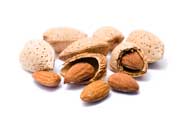
Almonds
Related to peach and
plum trees, almonds are one of the most popular culinary
nuts. Sweet almonds are used for eating in all their
forms, while bitter almonds are used for almond oil and
liqueur flavorings. We understand that a stroll through
a blooming almond orchard is enchanting. |
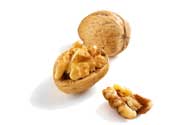
Walnuts
Broadly used in many
cuisines in various forms, walnuts are commonly
available as English Walnuts or Black Walnuts. Rich in
manganese and copper, walnuts rate a "Heart Healthy®"
designation when eaten in moderation.
|
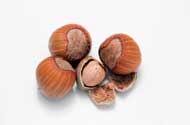
Hazelnuts/Filbert
From very similar
trees, these two nuts are used interchangeably.
Hazelnuts are very popular in European pastries and
confections. Oregon is the only domestic source of these
nuts. Hazelnuts are rich in thiamine and Vitamin
B6.
|
|
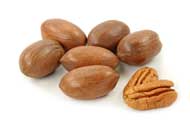
Pecans
Pecans are the only
tree nut originating in North America and come from a
specific species of hickory tree. They are native to the
Midwest and South. Pecans rate in many American regional
dishes while providing a great dose of manganese and
favorable omega-6 fatty acids.
|
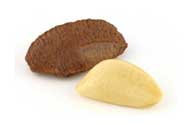
Brazil
Nut
An Amazon rain
forest nut, 20+ nuts reside in their own shell inside a
larger coconut-like pod. Grown by centuries-old, tall
trees, the flower is pollinated by a specific species of
bee. The large nut is rich with a creamy texture and
high in magnesium and selenium.
|
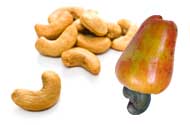
Cashews
Indigenous to
Brazil, the cashew now grows in similar tropical
regions. The seed resides singly in a shell and dangles
as an appendage to a rather large fruit. Cashews are a
popular snack nut and common in Asian
cuisines.
|
|
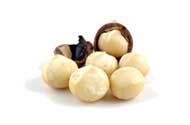
Macadamias
Originating in
Australia and now native to the South Pacific region,
macadamias possess one of the highest fat contents among
nuts -- up to 75%. Macadamias, salted and roasted, are a
popular snack and have a natural affinity to
chocolate.
|
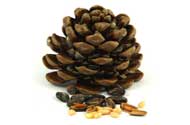
Pine
Nuts
Tucked into pine
cones of several pine tree species are tiny, succulent
pine nuts. Once shelled, the pine nuts' oils deteriorate
quickly and become rancid. Also known as pignoli nuts,
pine nuts are an equal partner in pestos, used as a
pastry garnish, and featured in many distinctive
dishes.
|
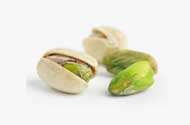
Pistachios
Native to the
mountainous areas of the Near East, pistachios have a
long culinary history (baklava, spumoni . . .). The nut
is green in color and has a naturally open shell when
mature that allows it to be roasted and salted without
shelling. Pistachios have a "Heart Healthy®" designation
- in moderation.
|
|
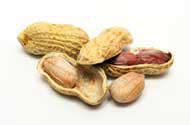
Peanuts
Really a legume,
peanuts are seeds retrieved from a pod like other beans.
Huge quantities of this nut are consumed every year.
China produces 37% of the peanut crop followed by India,
Nigeria, and then the U.S.
|
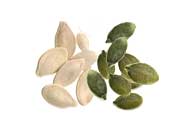
Pumpkin
Seeds
Known also as
pepitas, the seeds are easily harvested from our
favorite fall squash and pack a nutritional punch.
Pepitas are a popular ingredient in Mexican
cooking.
|
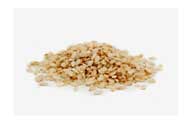
Sesame
Seeds
Really a grain seed,
sesame seeds are handled much like a nut in the kitchen.
Sesame plants thrive in tropical regions and flourish in
Middle Eastern cuisines. Sesame oil is indispensible in
Far Eastern
kitchens. | |
|
Roasty,
Toasty Nuts
|
Why roast nuts?
If you're eating nuts out of hand, roasting is an essential step for
bringing out their flavor. Roasting nuts make a nut "nuttier!"
The difference is remarkable. You might rationalize that the nuts
are going to bake anyway; not roasting will save some time.
Well, it's not the same thing. If you want flavor, and that's what
it's all about, take the extra step to roast or toast nuts prior to
adding them to your recipe.
Choosing Nuts - Choose your nuts
from a respected source or buy a reputable brand. The high fat
content of nuts means that they are susceptible to oil rancidity.
Oils that have become rancid will not hurt you, in general, but do
have a greater quantity of free radicals which may be harmful.
Eventually, rancid oils will not smell or taste good. Choose your
nuts from an inventory that has a frequent turnover.
 Storing Raw Nuts - Store raw nuts
in the refrigerator or freezer in an airtight container for up to a
year. Nuts purchased in tightly closed shells may be kept at cool
room temperatures for up to a year. Raw nuts are certainly fine, but
many have developed a dislike of nuts because they've experienced
nuts in their raw form instead of toasted. Storing Raw Nuts - Store raw nuts
in the refrigerator or freezer in an airtight container for up to a
year. Nuts purchased in tightly closed shells may be kept at cool
room temperatures for up to a year. Raw nuts are certainly fine, but
many have developed a dislike of nuts because they've experienced
nuts in their raw form instead of toasted.
Roast nuts in one
of two ways, dry roasting or wet roasting. With either method, a low
temperature and 10-20 minutes of careful oversight will yield the
best results. The higher the fat content of the nut, the faster the
roasting will occur.
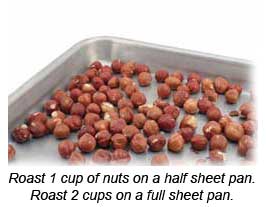
 Oven
Roasting - This method of roasting uses low oven
temperatures (180°F - 250°F) over a period of time ranging from
10-20 minutes depending on the nut. To dry roast, place the nuts on
a sheet pan in a single layer in the warm oven. Stir the nuts every
10 minutes. The nuts are roasted when their color has deepened
several shades and the kitchen is pleasantly fragrant. To wet roast,
drizzle a small amount of oil over raw nuts in a bowl and toss until
evenly coated and proceed similarly. The oil will add additional
flavor, but also adds additional calories and oily
handling. Oven
Roasting - This method of roasting uses low oven
temperatures (180°F - 250°F) over a period of time ranging from
10-20 minutes depending on the nut. To dry roast, place the nuts on
a sheet pan in a single layer in the warm oven. Stir the nuts every
10 minutes. The nuts are roasted when their color has deepened
several shades and the kitchen is pleasantly fragrant. To wet roast,
drizzle a small amount of oil over raw nuts in a bowl and toss until
evenly coated and proceed similarly. The oil will add additional
flavor, but also adds additional calories and oily
handling.
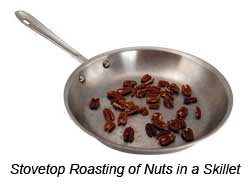
Stovetop Roasting - Nuts may be
roasted, wet or dry, in a skillet on the stovetop. Use medium-low
heat, with or without oil, and focused attention. Nuts with their
high fat content burn easily. Stir the nuts regularly during the
roasting process. Using a skillet or pan that has sloped sides will
facilitate a frequent quick toss. The nuts are just right when
slightly browned and deliciously fragrant.
Removing the Skins - Many shelled
nuts have a paper-thin skin encasing the meaty nut inside. The brown
skin is perfectly edible, but may be bitter in some nuts such as
hazelnuts. 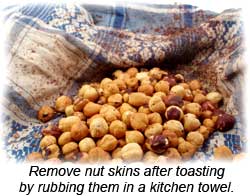 To remove the skins of hazelnuts, for example, dry oven roast the
nuts in a single layer. When golden and fragrant, remove from the
oven and cool slightly. Transfer the nuts to a kitchen towel and rub
the nuts together. The toasted skins will peel away with the
commotion and leave a golden, sweet nut behind.
To remove the skins of hazelnuts, for example, dry oven roast the
nuts in a single layer. When golden and fragrant, remove from the
oven and cool slightly. Transfer the nuts to a kitchen towel and rub
the nuts together. The toasted skins will peel away with the
commotion and leave a golden, sweet nut behind.
Storing Roasted Nuts - Just as with
raw nuts, store toasted nuts in an airtight container in the
refrigerator or freezer. Toasted nuts can be freshened with a light
warming in the oven or in a skillet. However, freshly roasted nuts
are preferable to stored roasted
nuts.
|
Right-sizing
Nuts
|
Roasty and
toasty, the nuts are ready to enjoy out of hand, embellished or as a
key ingredient in favorite recipes. Depending on the intended use,
nuts may need to be cut down to size. (Always roast the nuts whole
prior to chopping).
 Whole Nuts - These are the perfect,
bite-sized snack food at a party, public or private. Spiced and/or
glazed nuts are the perfect do-ahead dish, simple, delicious and
satisfying. Enjoy a single type of nut, or mix several types of nuts
for a complementary mix. (See the three recipes below). Use whole
nuts as a garnish Whole Nuts - These are the perfect,
bite-sized snack food at a party, public or private. Spiced and/or
glazed nuts are the perfect do-ahead dish, simple, delicious and
satisfying. Enjoy a single type of nut, or mix several types of nuts
for a complementary mix. (See the three recipes below). Use whole
nuts as a garnish
 Chunks - Use a sharp chef's knife
to cut whole nuts into large chunks. We find it helpful to position
the cutting board in a corner location where any ricocheting nuts
can be easily corralled. Chunks - Use a sharp chef's knife
to cut whole nuts into large chunks. We find it helpful to position
the cutting board in a corner location where any ricocheting nuts
can be easily corralled.
Coarse to Fine Chop - Nut pieces,
large or small, can be had with a knife and cutting board, a manual
chopper, or a food processor. Manual choppers use multiple blades in
a confined area - the longer the chop, the smaller the result. A
food processor is also perfect for accomplishing a coarse chop or a
fine grind. Use the "pulse" function on 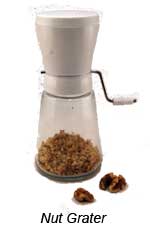 the
processor to manage your nuts to just the right size.
Processing happens quickly with nuts, so use a light hand in
pulsing, evaluating the result often. the
processor to manage your nuts to just the right size.
Processing happens quickly with nuts, so use a light hand in
pulsing, evaluating the result often.
Nut Meal - Many baking recipes
substitute finely ground nuts, (nut meal), instead of flour. A nut
grinder or a food processor is essential for making consistently
sized nut meal. Take care as you process nuts into nut meal, it may
turn into nut butter more quickly than you think!
Nut Butters - Nuts ground into a
smooth texture are favorite preparations. Peanut butter sandwiches
are the most common sandwich in the U.S. A gourmet alternative to PB
is almond butter or cashew butter. Nut butters can be made in a food
processor by processing toasted nuts until a 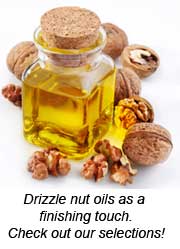 smooth
paste is formed. Nut butters, homemade or commercially prepared, may
be stored in the cupboard for three months, or in the refrigerator
or freezer for up to a year. Oils may separate in the butter as the
nut butter stands; simply stir or process back into the butter.
(Commercial peanut butter does not separate because of the addition
of hydrogenated oils). smooth
paste is formed. Nut butters, homemade or commercially prepared, may
be stored in the cupboard for three months, or in the refrigerator
or freezer for up to a year. Oils may separate in the butter as the
nut butter stands; simply stir or process back into the butter.
(Commercial peanut butter does not separate because of the addition
of hydrogenated oils).
Nut
Pastes - Sweetened nut butters offer additional uses in the
kitchen - almonds become marzipan; chestnut paste, sweetened or
unsweetened, becomes a key ingredient in many seasonal dishes.
Nut Oils and Extracts
- As half the content of a nut, extracted nut oils are a natural -
peanut, walnut, and pecan are a few of the more common oils that
lend their strength and flavor to cooks everywhere. Nut oils and
extracts are great flavorings for coffee and a plethora of
pastries.
|
Cooks'Wares'
Smart Nut Tips
|
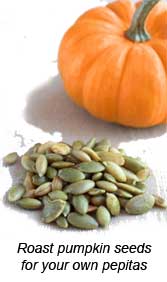 Tip #1: As you make use of
the season's pumpkins, harvest the seeds for a delightful treat.
Wash the seeds in a water bath removing any pumpkin flesh or strings
by rubbing the seeds between your hands. Strain and let dry. For
every two cups of seeds, toss with 2 tablespoons of oil and 1
teaspoon of salt. Roast the seeds in a single layer on a baking pan
in an oven set at 275°F for 10-20 minutes or until barely browned. Tip #1: As you make use of
the season's pumpkins, harvest the seeds for a delightful treat.
Wash the seeds in a water bath removing any pumpkin flesh or strings
by rubbing the seeds between your hands. Strain and let dry. For
every two cups of seeds, toss with 2 tablespoons of oil and 1
teaspoon of salt. Roast the seeds in a single layer on a baking pan
in an oven set at 275°F for 10-20 minutes or until barely browned.
Tip #2: Package
a modest serving of nuts in individual portions. Grab a bag of your
special nuts in the morning and throw it in your lunch bag or
briefcase. When the 11:00am hunger pangs hit, or the 4:00pm
cravings mount, you'll have a nutritious, satisfying answer. The
trick is pre-packaging modest portions!
Tip #3: Experiment with
different species of nuts. One of our favorite variants is the
Missouri Pecan. It is a small, petite variation of larger pecans. We
like them because they crowd nicely in our pecan pies.
Tip #4: Enjoy a classic autumn
sandwich featuring walnuts on top of an open-faced sandwich. Begin
with a slice of whole-grained bread, layer a few slices of smoked
turkey deli meat followed by thin slices of a tart apple. 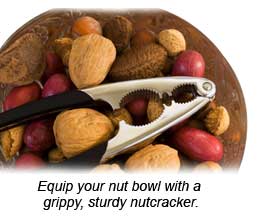 Top
with provolone cheese, then walnut halves. Broil carefully until the
cheese melts and the nuts become lightly browned. Top
with provolone cheese, then walnut halves. Broil carefully until the
cheese melts and the nuts become lightly browned.
Tip #5: Freshly harvested
nuts are a treat! Shelling them yourself also slows down the
speed of intake if that is a factor for you. A bowl of nuts in
the shell make for a beautiful presentation on a side table or on
the kitchen counter. Equip your guests with nutcrackers, nut picks,
and a bowl for shells. Each nut's shell has a fault line where the
nut will crack easily under force; some experimentation will get you
acquainted with each nut's anatomy and vulnerable point.
|
Q &
A's
|
Q: What are nut allergies?
What is proper nut etiquette with regard to nut
allergies?
A: Nut allergies are
the body's natural response to what it perceives as a foreign,
invading substance. The body mounts its defenses with a cascading
histamine response which can result in a serious situation. About 1%
of the American population has some sort of nut allergy. Peanuts,
while not nuts, can produce an allergic reaction. Individuals may
have allergies to either peanuts or tree nuts, or both. Advise your
guests which foods contain nuts.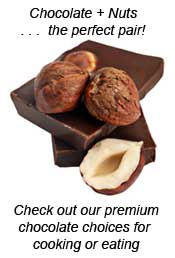
Q: What is gianduja?
A: Gianduja is a mixture of
chocolate and hazelnuts. Originating in the Piedmont region of
Italy, the name stems from a carnival character representing that
region. Similarly, Nutella® is a smooth spread made of hazelnuts,
skim milk and chocolate. It, too, hails from the Piedmont region of
Italy. Mr. Pietro Ferrero introduced the hazelnut paste as a filler
to his chocolate spread during WWII when chocolate was rationed and
in short supply. The temporary solution became a beloved tradition
everywhere. Try it on toast!
Q: What is oil
rancidity?
A:
As oils sit at room temperature they begin to break down. The
chemical degeneration produces free radicals, charged molecule parts
not connected to other molecular parts of the substance. This
chemical demise results in rancidity. Oil may be rancid before its
demise becomes detectable by taste or smell. Store oils away from
sunlight. Refrigerating oils will slow down the degenerative process
of oil rancidity.
Q:
Why were pistachios frequently dyed red in the past?
A: The shells of pistachios
are porous, fibrous and susceptible to staining. The red dye was
used to mask any stains that occurred from handpicking. Most
pistachios are now machine picked and staining is not a problem.
Pistachio shells naturally crack open when ripe, (some call it
"smiling"), allowing them to be roasted and salted without shelling.
The cracked shell gives rise to its nickname as the "Happy
Nut."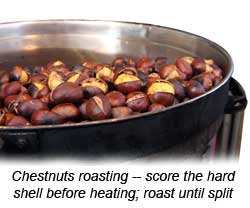
Q: How do you roast chestnuts?
A:
Romanticized in song, real "chestnuts roasting o'er an open fire"
are possible. They may also be roasted in an oven. First of all,
choose edible chestnuts, (not every chestnut tree produces edible
chestnuts). Score a small "x" in each chestnut with a sharp knife;
this will allow steam to escape when heated. Place in a baking dish
in a single layer with the "x" side up. Place in a hot oven (425°F)
for 20-30 minutes. When the skins split and the nut is becoming
golden, remove from the oven and peel while still
warm.
|
Cookbook
Review
|
Party
Nuts by Sally Sampson. Photography by Duane Winfield.
Published by Harvard Common Press, Boston, MA. Copyright 2002.
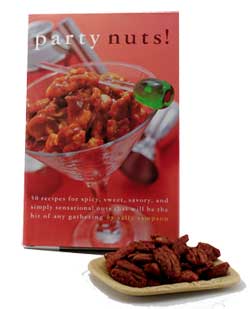 This
single-subject book is one of those little gems that will be
referred to again and again for inspiration and instruction. The
author is self-described as "a bit nuts" over nuts, and her passion
and expertise show through in each recipe. The book categorizes its
offerings into some general categories: Savory Nuts, Hot Nuts
and Sweet Nuts. She finishes her compendium of nut mixes with two
follow-on recipes, one for toffee and one for brittle using any
number of the previous recipes for a delightful kick to these
classic confections. Each recipe includes an annotation regarding
what else could be done with the specific recipe, i.e., use on
salads, or in muffins, etc., or a suggestion of what beverage would
best complement the dressed up nuts. The sumptuous photography
provides great visual inspiration. The author certainly achieves her
goal of dishing up dozens of delicious party nuts -- all for our
daily enjoyment! This
single-subject book is one of those little gems that will be
referred to again and again for inspiration and instruction. The
author is self-described as "a bit nuts" over nuts, and her passion
and expertise show through in each recipe. The book categorizes its
offerings into some general categories: Savory Nuts, Hot Nuts
and Sweet Nuts. She finishes her compendium of nut mixes with two
follow-on recipes, one for toffee and one for brittle using any
number of the previous recipes for a delightful kick to these
classic confections. Each recipe includes an annotation regarding
what else could be done with the specific recipe, i.e., use on
salads, or in muffins, etc., or a suggestion of what beverage would
best complement the dressed up nuts. The sumptuous photography
provides great visual inspiration. The author certainly achieves her
goal of dishing up dozens of delicious party nuts -- all for our
daily enjoyment!
|
Recipes for
Party Nuts
|
Recipes excerpted from Party
Nuts! by Sally Sampson. Photography by Duane Winfield.
Published by Harvard Common Press, Boston, MA. Copyright 2002.
Reprinted with permission of the publisher. All rights
reserved.
Hot Cayenne
Tabasco Almonds
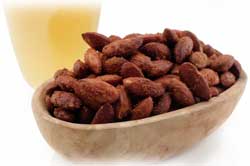 These
nuts live up to their billing of "too good to stop!" Paired, as the
author suggested, with a cold beer, we found life pretty sweet for a
while! Coming from two sources, the heat had both a front burn
and an after burn that made these nuts a complete experience. The
Tabasco's vinegar component was subtle, but just enough to start
salivating with the first bite. These nuts were the first to go
during our living room tailgating party! These
nuts live up to their billing of "too good to stop!" Paired, as the
author suggested, with a cold beer, we found life pretty sweet for a
while! Coming from two sources, the heat had both a front burn
and an after burn that made these nuts a complete experience. The
Tabasco's vinegar component was subtle, but just enough to start
salivating with the first bite. These nuts were the first to go
during our living room tailgating party!
Click here to view the full,
illustrated recipe.
Click here for a printable
version of the recipe (PDF
format).
Roasted
Southern Pecans Sweet and Piquant
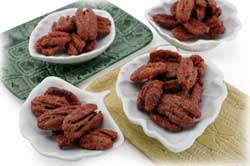 Can't decide if you want a savory flavor or a
sweet taste? No need to choose with this recipe. These pecans are
treated to a covering of both sweet and savory with the help of a
whipped egg white medium. The egg white helps to bind the flavorings
to the nuts and forms a gentle crust that adds to the appetizing,
crunchy experience. Can't decide if you want a savory flavor or a
sweet taste? No need to choose with this recipe. These pecans are
treated to a covering of both sweet and savory with the help of a
whipped egg white medium. The egg white helps to bind the flavorings
to the nuts and forms a gentle crust that adds to the appetizing,
crunchy experience.
Click here to view the full,
illustrated recipe.
Click here for a printable
version of the recipe (PDF
format).
Holy Mole
Pecans
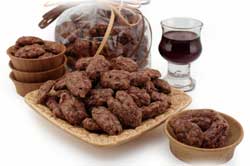 True
to their name, this nut recipe combines three familiar flavors into
a classic mole blend. This nut mix begs for a living room fire, a
warm toddy of some sort, and some good company. The blend was
neither too spicy, nor too sweet, but just right! We made a double
batch, ate one rather quickly, and used the other batch coarsely
chopped in a batch of shortbread cookies. Divine
results! True
to their name, this nut recipe combines three familiar flavors into
a classic mole blend. This nut mix begs for a living room fire, a
warm toddy of some sort, and some good company. The blend was
neither too spicy, nor too sweet, but just right! We made a double
batch, ate one rather quickly, and used the other batch coarsely
chopped in a batch of shortbread cookies. Divine
results!
Click here to view the full,
illustrated recipe.
Click here for a printable
version of the recipe (PDF
format).
| |

 Sat, November 14 -