
Next Issue:
November 18, 2010
"'Top Tips for Turkey Time"
|
Wedding Registry
| Henrietta Klarenbeek &
Michael Coveyou
November 13, 2010
Bethany Crane &
Evan Bassler May 28, 2011  
Gift Certificates
Available for all Occasions!
|
|
|
Saturday Morning Demonstrations
|  WELCOME! Cooking demos begin promptly at 10:00a.m. each Saturday. Class fee of $5. Pre-registration is not needed. Please note that seating is on a first-come basis. We suggest early arrival for best seating. WELCOME! Cooking demos begin promptly at 10:00a.m. each Saturday. Class fee of $5. Pre-registration is not needed. Please note that seating is on a first-come basis. We suggest early arrival for best seating.
Click here for our full Fall Cooking demonstration schedule.
Saturday, November 6 - Demo at 10:00am
Fall Salads with Becky Ringsby
Think that eating great salads has to end with the warm weather? Enjoy your greens all year around with these three ultimate fall salads: Roasted-Squash Salad with Maple Vinaigrette, Grilled Romaine with Bacon Dressing and Spinach Salad with Warm Citrus Vinaigrette.
Saturday, November 13 - Demo at 10:00 Cheese - Everyone's Favorite! with Robert Moore - We'll be stirring it up a bit - making a basic cheese sauce and using it for Queso for Nachos, Cheeseburger Chowder and who knows what else!
Saturday, November 20 - Demo at 10:00
Two-Tone Potato Dish with Margaret Welder. A blend of white and sweet mashed potatoes, swirled together and baked in the oven. A favorite Thanksgiving dish of my niece.
Saturday, November 27 - Demo at 10:00
Tortilla Soup with Beatriz Spalding. This classic Mexican Soup is light and tasty and can be enjoyed after the heavy meal on Thanksgiving Day. It is also quick and easy to prepare.
Saturday, December 4 - Demo at 10:00 Treacle Pudding with Custard and Mulled Wine with Marcus Johnson. A classic English pudding of Treacle Sponge served with warm custard, also learn to prepare a warming glass of mulled wine or cider whilst watching the demonstration.
Saturday, December 11 - Christmas Cookies with Margaret Welder. Every holiday season Margaret demonstrates wonderful new cookies for us to make at home for our friends and family. Be sure to stop by for this one.

Sunday, December 5th 2:00 - 5:00 pm
A Traditional English Christmas Dinner
Join instructor Fred Moore as he prepares a complete traditional English Christmas dinner for you this afternoon - prime rib roast, Yorkshire & Figgy Pudding and more. Class space is limited to 12 people. Pre-registration and pre-payment required. $40 class fee. (Only 2 places left - call now to register!)
Sunday, December 12th 1:00 - 3:00 pm
Gingerbread House Workshop
Andrea Moore and Holly Boman will assist you in assembling your very own, fresh gingerbread house with all the trimmings! Class size is limited to 12 participants. Pre-registration and pre-payment required. $15 class fee.
(Only 2 places left - call now to register!)
|
Great Buys on Great Knives!
| 
|
|
NEW at Cook's Emporium
| 
|
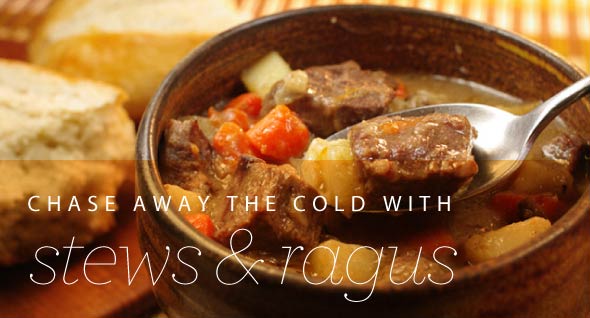
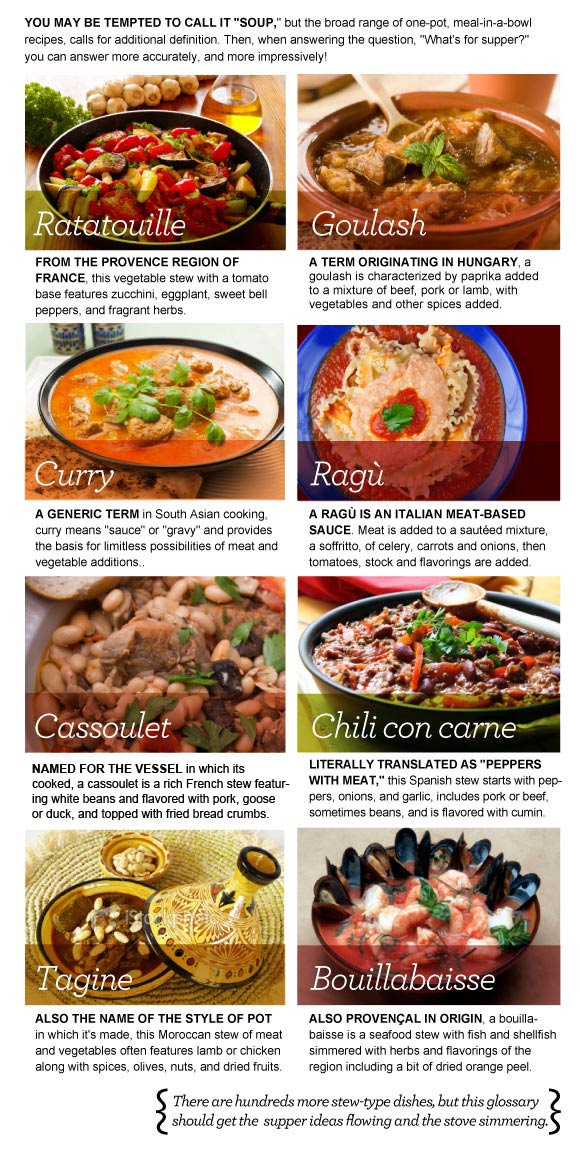
Robust, One-Pot Meals
| 
|
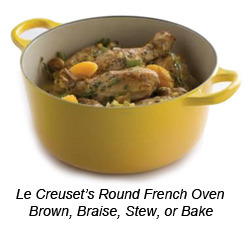
The Perfect Pot
| 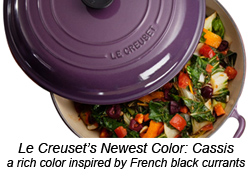 If we were limited to only one pot in our kitchen, it would be our enameled cast iron pot. Sometimes termed, "Dutch Oven," the famed cookware company, Le Creuset, uses the term "Round French Oven" for their series of enameled cast iron pots. You can fry, boil, sauté, steam and even bake in this pan for just a few people or for a crowd! Here's why this cookware is some of the best and certainly among our favorites in the kitchen. If we were limited to only one pot in our kitchen, it would be our enameled cast iron pot. Sometimes termed, "Dutch Oven," the famed cookware company, Le Creuset, uses the term "Round French Oven" for their series of enameled cast iron pots. You can fry, boil, sauté, steam and even bake in this pan for just a few people or for a crowd! Here's why this cookware is some of the best and certainly among our favorites in the kitchen.
Enameled Cast Iron - Le Creuset makes their cast iron in the northern French town of Fresnoy-Le-Grand as they have since 1925. Their foundries use standard sand casting methods where molten iron is poured into the various sized and shaped molds, cooled, then hand finished in preparation for the enameling steps. A coating of enamel is sprayed on each piece and fired at 800°F. A second coat is applied and similarly baked. The result is a beautiful glaze on top of a core of cast iron.
 Best of Both Worlds- The cast iron core evenly conducts and holds heat, while the enameled surfaces of the pot, inside and out, create a naturally non-stick surface that is easily cleaned and cared for. The enameled surface eliminates any seasoning or special care that typically accompanies cast iron cookware. Best of Both Worlds- The cast iron core evenly conducts and holds heat, while the enameled surfaces of the pot, inside and out, create a naturally non-stick surface that is easily cleaned and cared for. The enameled surface eliminates any seasoning or special care that typically accompanies cast iron cookware.
Suitable for all Cooking Surfaces- Enameled cast iron may be used on all cooking surfaces: electric, gas, ceramic, and induction stovetops. The pots, (outfitted with the black knobs), are also oven safe to 375°F making them perfect for recipes requiring stovetop browning or sautéing steps followed by a stint in the oven.
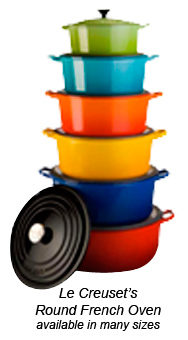
Sizes- Round French ovens are available in multiple sizes. We recommend having at least two sizes in your kitchen, a small pot for light duty and smaller quantities, and a large pot for large recipes or when cooking for a crowd.
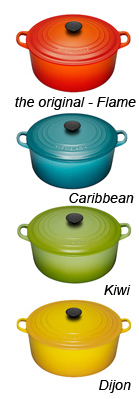
Colors - Enticing and bold, choosing the color of your Le Creuset oven is the hardest part. The colors are baked into the enamel and hold true forever. The original Le Creuset color was the classic orange known as "Flame." Recent years have brought the development of a full palette of colors, the most recent being a rich purple known as "Cassis." The beautiful glazes make the pots more than suitable for direct serving at the table.
 Care and Use- The enameled surfaces are incredibly durable, but will fare better when metal utensils are avoided. This includes metal spoons, whisks, and hand mixer beaters. Care and Use- The enameled surfaces are incredibly durable, but will fare better when metal utensils are avoided. This includes metal spoons, whisks, and hand mixer beaters.
Lifetime Warranty - Le Creuset enameled cast iron products undergo stringent quality controlled production. This, and many decades of experience with the products allow them to offer a lifetime warranty. The initial product investment definitely returns value for a lifetime and more.
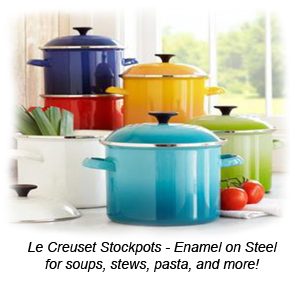
Cousins- Enameled Steel Stock Pots - Another fine Le Creuset product is their enameled steel stockpots. Thinner and lighter, the steel pots provide the necessary size and volume required to accommodate stock ingredients - stalks of celery, whole chickens, and a host of soup-making items. These pots double well as colorful pasta pots.
|
Smart Stew and Stew Pot Tips
|  Tip #1: Use an old trick of soup makers, save the rind of a wedge of Parmesan cheese, and throw it in the pot. The hard cheese rind adds a layer of flavor and builds more of the fifth taste sensation, umami. Tip #1: Use an old trick of soup makers, save the rind of a wedge of Parmesan cheese, and throw it in the pot. The hard cheese rind adds a layer of flavor and builds more of the fifth taste sensation, umami.
Tip #2: As with any cookware, take care when placing or moving enameled cast iron cookware on glass stovetops. The weight of the cookware placed forcefully on the glass may lead to damage.
 Tip #3: Avoid cutting with a knife on any enameled surface. The knife's edge may create micro-cuts on the surface of the enamel. Tip #3: Avoid cutting with a knife on any enameled surface. The knife's edge may create micro-cuts on the surface of the enamel.
Tip #4: Before washing or exposing cookware to an extreme change in temperature, allow the pan to cool for a few minutes.
Tip #5: Always match the size of the pot with the size of the burner. The heat or flame should not be allowed to "climb" the sides of the pot.
Tip #6: Use inexpensive cuts of meat such as chuck roast when stewing. Stewing, a form of slow cooking, will magically tenderize the meat and melt any tough, connective tissue. More expensive, or lean cuts of meat, will toughen during long, slow cooking.
Tip #7: Because enameled cast iron holds heat so well, take care not to overheat the pot in the early stages of cooking such as when bringing liquids to a boil. A high heat will stay with the pot long after the burner's dial has been turned down.
Tip #8: Enameled cast iron retains temperature and may be used to keep cold foods cold for a short time. Thoroughly chill the pot and lid, place salads, or other chilled foods, in the pot to serve.
Tip #9: Always use a trivet, silicone pad, or hefty potholder when placing a hot enameled cast iron pot on the table or countertop.
Tip #10: While enameled surfaces are odor and stain resistant, a periodic treatment of the pot's surfaces with Le Creuset's Cookware Cleaner will remove any gray trail marks and polish the pot back to perfection.

|
Q & A's
|  Q: Some pot lids have a pattern of bumps on their underside. What are they for? Q: Some pot lids have a pattern of bumps on their underside. What are they for?
A:
The little bumps on the inside of the lid are condensation points. As
the stew heats, steam forms and rises. The lid catches the airborne
molecules of water, and when there are enough, they condense back into
liquid form. The bumps facilitate condensation and allow the drips to
return to the pot more evenly instead of collecting at the edge of the
lid.
 Q: What is a phenolic knob? Q: What is a phenolic knob?
A:
A phenolic knob is a type of lid handle that can tolerate oven heat,
yet stay cool to the touch during stovetop cooking. Le Creuset's lid
knobs are phenolic knobs that can withstand a 375°F oven. Stainless
steel (18/10) knobs are available that can withstand any oven
temperature.
Q: Can food be stored in my French oven?
A:
Yes! The enameled surface is inert and non-reactive and can safely
store food. Allow the pot to cool well before placing in the
refrigerator.
Q: My stew is too watery. What can I do to thicken it?
A:
Stews generally have a thick quality. This can be achieved in a variety
of ways depending on the recipe. Here are a few ways to have a thick
stew: (1) Dredge the stew meats in flour and brown in oil as the first
step, (2) Use a slurry of cornstarch and cold water; add small amounts
to the stew until the desired thickness is reached, (3) Begin the stew
with a flour and butter roux, or (4) Add potatoes, rice, or pasta; their
starches will help thicken the stew. |
Cookbook Review
|
| Real Stew by Clifford A. Wright. Published by Harvard Common Press, Boston, MA. Copyright 2002.
Clifford A. Wright, Author of 12 Cookbooks
Winner of the James Beard Foundation Cookbook of the Year in 2000
| 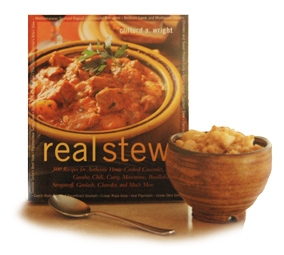 |
With this cookbook, we were treated to a culinary trip around the world. Mr. Wright has assembled over 300 recipes that fall into the broad category of stews. He includes all of the standards that we would normally conjure up as a stew, but he takes the genre leaps and bounds beyond the norm to favorites from other cultures and cuisines. While some recipes boast foreign sounding names, all are imminently accessible for the average American kitchen. The book's recipes are organized by dominant ingredient: beef, veal, lamb, pork, fowl, fish, or vegetable. The processes revealed in the recipes' instructions are designed to help us layer flavors and build delicious pots of hearty food. Peppered throughout the book are tantalizing sidebars that provide interesting tidbits of knowledge and tips for advancing our culinary skills. We're set for a winter's worth of hot and hearty meals with this book in hand.
|
|
|
|
|
Three Everyday Stew Recipes
|
|
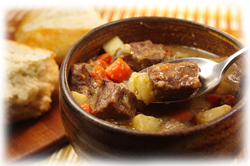
Old-Fashioned American Beef Stew
View & Print
It's hard to discuss stew without an old-fashioned beef stew coming to mind. This recipe returns the classic tastes of our grandmother's stew. It uses four types of root vegetables so abundant this time of year. The method uses a dredging of flour on the meat pieces and a browning and caramelization step that builds deep, succulent flavor. Add a crust of bread, and the meal is complete.
|  | |
Italian Sausage and Pepper Stew
View & Print
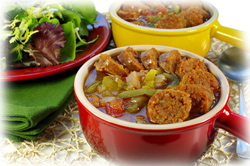
This simple stew is ready in quick order. Generous numbers of sweet bell peppers and onions are sautéed first, then joined by hot Italian sausages, tomatoes, and herbs. The spicy heat from the sausages permeates the stock and vegetables. The resulting combination of flavors lives up to the hearty "stew" moniker, and it's all accomplished in under an hour.
|  | |
White Bean, Rice, and Potato Stew
View & Print
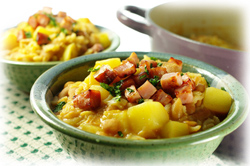
From the Aragon province of Spain, this vegetable stew is now one of our favorites! Beginning with dried beans - inexpensive and full of valuable sustenance - they are joined with their nutritional complement, rice. Potatoes, onion, and garlic lend their flavors while paprika adds a bit of color. We garnished the soup with diced Canadian bacon and a bit of chopped parsley.
|  | |
Recipes from Real Stew by Clifford A. Wright through permission of Harvard Common Press, Boston, MA. Copyright 2002. All rights reserved.
|
|
|