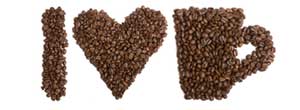
"A Good Cup of Joe"
September 24,
2009 - Vol 1, Issue 15
| |
|
Walk for the
Cure
|

|
E-News Drawing
|
If you
receive our newsletter, you will be entered into a
drawing each month for a great prize for your
kitchen. Check here each month to see if you have
won, if so, come in to collect your prize!
August's
winner:
Debbie Armuth
Debbie won a bottle of Fruits & Passion
kitchen detergent . Congrats Debbie, come by anytime to
pick up your
prize. | |
|
Morning
Therapy
|
Some
mornings it's the only thing that entices us out of bed
- the anticipation of that first great cup of coffee!
The total experience begins with a good dose of
aromatherapy, the fragrance of the beans as they're
scooped from their container into the grinder. Then it's
the vibration of the grinder as it transforms the beans
to their brew-ready stage. Next, the sound of water
pouring continues to wake our senses. The second dose of
aromatherapy floods the room as the brew is formed and
the perfume released. Finally, it's time for the first
sip - almost always followed by an "ahhh...." It's going
to be a good day! In this issue, we indulge our passion
for coffee by exploring just what it takes to make a
good cup of joe - the bean, the grind, the water, and
the brewing. And what goes better with coffee than just
a little bit of sweet? We offer three recipes from a
charming cookbook, Bite-Size
Desserts, that will complement your coffee
encounters in a most delightful
way!
|
| September Wine of the
Month |
2005 Climbing
Shiraz
Orange, Australia
 
Reg. Price:
$14.00September
Price:
$13.00
|
Elko Downtown Upcoming
Events!
|
Elko
Downtown Business Association Upcoming
Events:
6th
Annual Elko Uncorked Wine Tasting
Event
Friday, October 9th - 4pm -
7pm
Starting Point: 5th
and Railroad Streets
Music by: Gene
Russell and Southwind, Tera
Hooiman
Enjoy wine, beer, and
holiday spirits at participating
Downtown businesses. This year's Uncorked
event will be similar to the summer Wine
Walks.
$20 per person/$35 per
couple.
Streets will be closed for
event
Breast
Cancer Walk: Saturday, October
17thWalk
for the Cure! at the Elko City Park - Learn
Details! |
| Stumped Us Contest
|
September's
"Stumped Us" Question:
"What is this?"
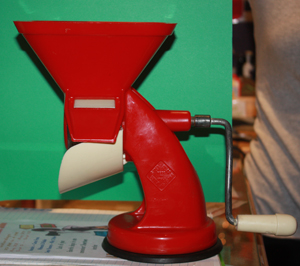
Email us with
your
answer...
August's "Stumped Us"
results . . .
"What is a Foley
Fork?"
Correct
answer....
A
"Foley Fork" (no longer manufactured) is a flexible
tined blending fork. Use for stirring, blending and
mixing. Good for incorporating dry ingredients for
baking.
August
entry winner.... Susie
Carlson
Come in anytime to pick
up your prize!
| | |
|
Cucina Fresca's Upcoming
Events!
|
|
|
The
Bean
|
 Coffee
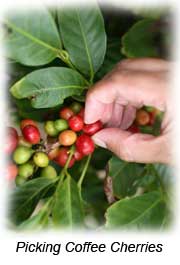
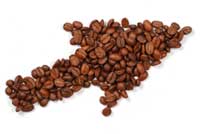
beans are the fruit of the coffee tree, actually, more of a
shrub. They grow in the tropics in a band on either side of
the equator as seeds inside red fruit known as coffee
cherries. Each fruit contains a pair of seeds, flat
sides together. A coffee cherry with only one seed inside is
known as a "peaberry"
and is highly prized and uniquely marketed. Beans and brews
are often sold by country of origin - Sumatra, Ethiopia,
Guatemala, Columbia, etc. There are two basic types of coffee
trees used for culinary purposes, those that produce arabica
beans and those producing robusta
beans. Arabica beans are the more favored fruit and produce
the better coffees that most of us are quite fond of.
Robusta beans, easier to grow for a variety of reasons,
comprise the more mass-marketed coffees. Coffee
beans are the fruit of the coffee tree, actually, more of a
shrub. They grow in the tropics in a band on either side of
the equator as seeds inside red fruit known as coffee
cherries. Each fruit contains a pair of seeds, flat
sides together. A coffee cherry with only one seed inside is
known as a "peaberry"
and is highly prized and uniquely marketed. Beans and brews
are often sold by country of origin - Sumatra, Ethiopia,
Guatemala, Columbia, etc. There are two basic types of coffee
trees used for culinary purposes, those that produce arabica
beans and those producing robusta
beans. Arabica beans are the more favored fruit and produce
the better coffees that most of us are quite fond of.
Robusta beans, easier to grow for a variety of reasons,
comprise the more mass-marketed coffees.
Recently,
coffee growing practices have received a fair amount of
attention. Agricultural systems in the uniquely tropical
coffee regions are growing rapidly to meet global demand.
Here's a glossary of a few common terms associated with coffee
bean choices:
 Fair Trade - Fair trade
certifications were established to provide a standard for
ethical coffee growing. Beans with the fair trade designation
are grown in working conditions that are safe and fair for the
employees, produced through environmentally sound growing
practices, and where the farmers are guaranteed a minimum
price for their coffee. The fair trade label is determined by
a third-party organization that inspects and certifies coffee
growing operations. Fair Trade - Fair trade
certifications were established to provide a standard for
ethical coffee growing. Beans with the fair trade designation
are grown in working conditions that are safe and fair for the
employees, produced through environmentally sound growing
practices, and where the farmers are guaranteed a minimum
price for their coffee. The fair trade label is determined by
a third-party organization that inspects and certifies coffee
growing operations.
Shade Grown - Naturally,
coffee shrubs prefer a shady location with dappled light.
However, some species can thrive in full sunlight. Shade grown
coffee implies that the forest's upper canopy have been left
intact and that the environment remains in its more natural
state with minimal use of fertilizers and mass-farming
techniques. Shade grown coffee may not produce in the
quantities that full sun coffee growing conditions might, but
does not reward commercial deforestation, and, therefore, is
considered to be more friendly to the environment and
protective of wildlife habitats.
 Organic
- The "organic" designation for coffee beans also defines
"how" the beans were grown - that is, without pesticides or
chemical fertilizers. The choice for organic beans reflects
personal health concerns and general environmental concerns.
Organic beans are usually more expensive due to the increased
costs involved in organic growing, certification processes,
and the expense in providing an adequate motive for farmers to
grow organically. Organic
- The "organic" designation for coffee beans also defines
"how" the beans were grown - that is, without pesticides or
chemical fertilizers. The choice for organic beans reflects
personal health concerns and general environmental concerns.
Organic beans are usually more expensive due to the increased
costs involved in organic growing, certification processes,
and the expense in providing an adequate motive for farmers to
grow organically.
From the tree, coffee cherries are
picked as they ripen. Finer coffee beans are picked by hand.
This is due to the variable ripening of the cherries where a
look and evaluation is required for each pluck. Cherries that
are underripe, or those that are overripe, will taint the
final brew in undesirable ways. Perfectly picked coffee
cherries are then processed in one of three ways:
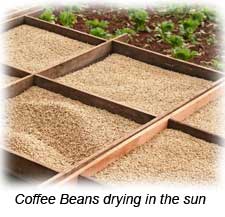
Dry processing - In this
method, cherries are placed on trays and dried in full sun for
10 - 20 days. The dried fruit pulp is removed by machine
leaving the inside seed.
Washed processing - Through
this method, the skins of the freshly harvested cherries are
removed mechanically leaving the inside pulp. The berries are
left to ferment in a tank for nearly a day, then are washed
and dried. This method is considered preferable for finer
coffees with added flavor gained from the fermentation
step.
 Semi-washed processing -
Similar to washed processing, just harvested berries are
processed with both skins and the pulp removed. The beans are
dried with no fermentation step involved. Semi-washed processing -
Similar to washed processing, just harvested berries are
processed with both skins and the pulp removed. The beans are
dried with no fermentation step involved.
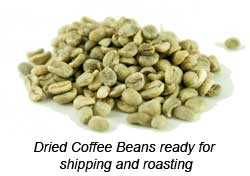
From
post-harvest processing, the beans are readied for roasting.
They are sorted and graded according to their size, density,
and color. Excellent beans are hand-sorted multiple times. As
can be seen with each of these steps, the labor intensity of
coffee is high! On to where the "green beans" go from
here!
|
The Roast and the
Grind
|
Plenty of
artistry has already gone into the coffee before it is shipped
from the farm. But the fine craft continues as the beans
proceed to the roaster. Coffee wouldn't resemble coffee if it
weren't for the roast - bitterness, smokiness, floral
overtones - it all gets built into the bean at the point of
roasting. In fact, the same batch of beans can take on
completely different characteristics when roasted differently.
A coffee roaster heats the beans and moves them constantly to
promote an even roast. During the first stage of a roast
moisture is released from the bean. As heating continues,
sugars in the bean begin to caramelize. Finally, during
extended roastings, natural oils are released. The timing and
temperatures of roasting will greatly impact the flavor and
determine the type of roast moniker applied to the
ready-for-market beans:
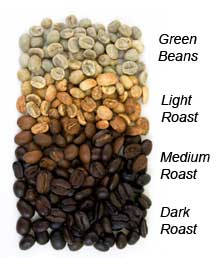 Different
Roasts: Different
Roasts:
Light
roasts - As one might guess, light roasted beans have
received the least heat and are pulled from the roaster before
sugar caramelization has occurred.
Medium
roasts - These beans have released their natural
moisture and have some sugar caramelization, but no oils
unveiled.
Dark
roasts - This roast has continued longer to the point
where the bean's natural oils have been released and the bean
roasted to a darker color. Within this designation of dark
roasts you'll find French, Italian, and espresso
roasts.
Coffee is best enjoyed from freshly
roasted beans. Choose your beans from purveyors that roast or
purchase in smaller quantities thereby providing turnover and
greater freshness.
Grinding
the Beans:
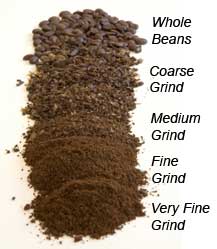
Grind whole beans just before brewing.
This allows the nuanced flavors and volatile aromas to be
retained and infused in your coffee. The fineness of the grind
is determined by how long the coffee is in contact with the
water during the brewing cycle. Finer grinds are used for drip
brewing, where a coarser grind is suitable for French press
brewing. Very fine grinds are used for espresso
brewing.
  There
are many styles of coffee grinders to choose from; they
generally fall into one of two categories: There
are many styles of coffee grinders to choose from; they
generally fall into one of two categories:
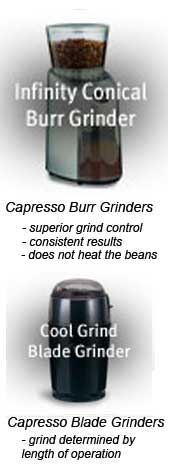
Burr
Grinders - This style of coffee grinder allows the most
control over the grinding process. The beans are crushed
between a moving wheel and a stationary surface. With a burr
grinder you can variously adjust the fineness of the grind and
achieve consistent results. Burr grinders may have either a
wheel or conical style of grinding mechanism. Conical burr
grinders are considered preferable, especially for darker,
oilier roasts which may clog other
grinders.
Blade
Grinders - Also called "impact" grinders, these
machines use a metal blade to crush the beans. The fineness of
the grind is governed by the length of operation, a
potentially imprecise science. Impact grinders will also
produce less consistency in the evenness of the grind.
When choosing a grinder, evaluate how it
operates, durability of its motor, the heat generated (avoid
burnt grounds), its capacity, and on/off safety mechanisms.
Match your need for different grinds with the grinders'
capabilities. Check Capresso's Features
Chart.
|
The
Brew
|
No
pressure, but now the artistry of the final product is all on
you! You've chosen the right bean, accomplished the right
grind, it's time to brew.
 Water
- Coffee is mostly water, so this is a critical step. Use
freshly filtered water that has had any chlorine removed. Many
simple water filtering systems are available that will yield
great water for coffee and for general consumption. Do not use
distilled water as it has no character. Softened water has too
many minerals added and can prove to have a distracting
taste. Water
- Coffee is mostly water, so this is a critical step. Use
freshly filtered water that has had any chlorine removed. Many
simple water filtering systems are available that will yield
great water for coffee and for general consumption. Do not use
distilled water as it has no character. Softened water has too
many minerals added and can prove to have a distracting
taste.
How Much
Coffee to How Much Water - This is a subjective topic
-- general guidelines call for 1-2 tablespoons of coffee
grounds for every six ounces of water. From that broad range
of instruction, the ratio is governed by the type of bean, the
grind, and personal 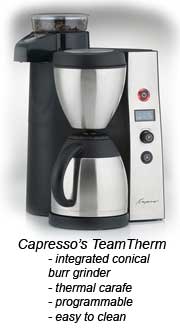 strength
and taste preferences. strength
and taste preferences.
Brewing Systems: Gone are the
percolators of the olden days that produced many a pot of
questionable product. Today, brewing systems are built
specifically to brew a better cup of
coffee.
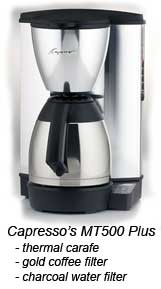
Drip
Brewers - Drip brewing produces an excellent cup of
coffee. Better machines will have good mechanisms for heating
the water to the perfect pitch of 200°F.
- Consider the filtering system deployed with each
machine. A gold-filter is inert, and will not impart any
taste to the coffee as paper filtering methods might. It's
essential that any filtering mechanism be kept impeccably
clean for the best tasting pot.
- A thermal carafe will keep the coffee at the proper
drinking temperature for about an hour. A hot plate may be
of use to warm a thermal carafe, but care should be taken to
not apply heat directly to the coffee through a
single-walled pot.
- Timing and programmability features may be important to
you; assess their ease of use.
- Many drip brewing systems offer integrated coffee
grinders - one less step.
- Single-serving brewers make coffee always available at
its freshest. If you like to vary your coffee choices, the
single serving packs are a great way to experiment with
different flavors.
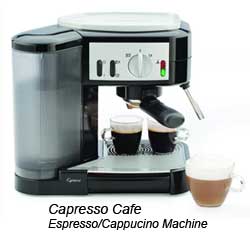 Espresso
Machines - A shot of espresso is the basis for
many, many coffee drinks. Different from brewed coffee, steam
is forced through dark-roasted, finely ground, tamped beans.
Water contact with the grounds is about 20 seconds, hence the
name "espresso." The result is an ounce of concentrated flavor
savored directly or as the basis for a latte, cappuccino,
Americano, breve, or a host of other coffee delights.
Versatility is one of the primary reasons to have your own
espresso machine. Choose a machine with durability, ease of
operation, compatible level of automation, and the Espresso
Machines - A shot of espresso is the basis for
many, many coffee drinks. Different from brewed coffee, steam
is forced through dark-roasted, finely ground, tamped beans.
Water contact with the grounds is about 20 seconds, hence the
name "espresso." The result is an ounce of concentrated flavor
savored directly or as the basis for a latte, cappuccino,
Americano, breve, or a host of other coffee delights.
Versatility is one of the primary reasons to have your own
espresso machine. Choose a machine with durability, ease of
operation, compatible level of automation, and the 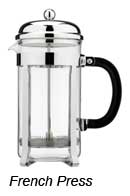 desired
accessories. desired
accessories.
French
Presses - Enjoying a recent revival, French presses are
another great tool for making a good cup of joe. Utilizing a
steeping method instead of drip brewing or forced steam, the
press allows making and serving in a single pot. French
presses are available in many sizes and styles, but all use a
spring-powered method for corralling the grounds at the bottom
of the pot prior to pouring.
Enjoy your coffee
immediately after brewing! Hot plates or warming burners will
lend a burnt flavor to the coffee. Instead, keep brewed coffee
in insulated carafes.
|
Cucina Fresca's Coffee
Tips
|
 Tip
#1: Need additional help waking up and
functioning in the morning? A programmable coffee maker
prepped the night before is the best alarm clock and a kind
way to face the day with immediate
gratification. Tip
#1: Need additional help waking up and
functioning in the morning? A programmable coffee maker
prepped the night before is the best alarm clock and a kind
way to face the day with immediate
gratification.
Tip #2: Keep your grinder and
coffee brewer immaculately clean! Coffee grounds left in the
grinder will go stale and carryover that staleness in your
next grind. Similarly, your coffee pot must be kept
exceptionally clean in order to get the best brew. Coffee gets
much of its flavor from the volatile oils released from the
beans, but it's precisely these oils that can turn rancid and
cause your next pot to be bitter and foul tasting. A good
cleaning removes any residue, and any potentially offending
oils. Clean your pot after every use and once a month brew a
cleaning solution (usually some type of citric acid) through
the system.
Tip
#3: The best coffee is made from water that is heated
to 200°F. Water boils at 212°F; the temperature should stay
below that critical point. Never allow the brewing water or
coffee to boil, nor should coffee be reheated to the boiling
point.
Tip
#4: Steam or heat milk for coffee or espresso drinks to
a temperature between 150-170°F. Milk easily gathers a
scorched taste at higher temperatures than
these.
 Tip #5: Coffee isn't just for
drinking, think of coffee as a flavor used to enhance all
types of dishes. Use whole beans as a garnish and finely
ground coffee as a seasoning to be incorporated into rubs,
infused into syrups, or sprinkled as a
topping. Tip #5: Coffee isn't just for
drinking, think of coffee as a flavor used to enhance all
types of dishes. Use whole beans as a garnish and finely
ground coffee as a seasoning to be incorporated into rubs,
infused into syrups, or sprinkled as a
topping.
Tip
#6: Like wine, coffees pair differently with different
foods. Generally, pair bold food flavors with a bold coffee,
and delicate foods with a smoother coffee.
Tip #7: If your drip coffee
is bitter, you may have ground the beans too long producing
too fine of a grind for the brewing method. If the coffee
lacks flavor, the grind of the beans may be too
coarse.
|
Q &
A's
|
 Q: What is the
cold-brewing process for coffee? Q: What is the
cold-brewing process for coffee?
A: Cold brewing
of coffee uses medium ground coffee steeped in a glass jar
with room temperature water for 3-4 hours, or up to overnight.
The grounds are strained away and the coffee is ready for use.
Some choose to use cold brewing techniques to form a
concentrated coffee. Cold brewing aficionados claim that
coffee bre wed
in this manner has a more full-bodied character and less
acidity. This is an ideal method for making iced coffee
drinks. wed
in this manner has a more full-bodied character and less
acidity. This is an ideal method for making iced coffee
drinks.
Q:
A lighter roast means a weak coffee and a dark roast
means a strong coffee, right?
A: No, the strength of
the coffee, weak or strong, has to do with the ratio of coffee
beans to brewing water, and is not associated with the type of
coffee roast.
Q:
Darker roasts have more caffeine than lighter roasts,
right?
A:
No, wrong again! The darker the roast, the less the
caffeine. Longer roasting affects the bean's caffeine
decreasing it over time. A bold flavor does not always
equate with a bold caffeine effect.
Q: What is
cupping?
A: Cupping is the
process for coffee tasting and evaluation. Using both taste
and smell, the aroma, body, acidity, flavor and finish are
evaluated. Coffee cuppings are similar in many respects to
wine tasting. There are good and bad coffees with a wide range
of subjectivity throughout the spectrum of
choices.
Q:
Is brewing coffee with a French press superior to a drip
machine?
A: Neither method is
superior to the other, but rather, it's a matter of taste. We
think there is a place for both methods in the same kitchen.
Brewing coffee for dessert using a French press is a
delightful ritual and fits the leisurely pace found at the end
of a meal. Coffee in a French press may cool more quickly than
coffee brewed into a thermal carafe. Explore the newer
double-walled French presses that address that issue.
|
Cookbook
Review
|
Bite-Size
Desserts, Creating Mini
Sweet Treats, from Cupcakes and Cobblers to Custards and
Cookies by Carole Bloom. Copyright 2009. Published by
John Wiley & Sons, Inc., Hoboken, NJ
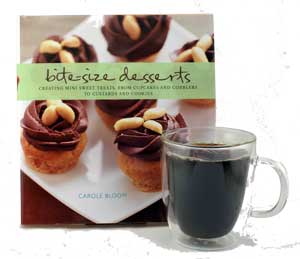 Both
the title and the cover photo compelled us to look at this
book further! We acknowledge, sometimes regrettably, that
sweets are a treat to be enjoyed in moderation, so this seemed
a perfect solution - bite-size! Ms. Bloom has assembled a
treasure chest of mini-pleasures that delight the eye, satisfy
the sweet tooth, and complement a great cup of coffee! The
book honors traditional and classic favorites only now in
miniature form, and includes some new treats that fare well in
petite sizes. Cakes, muffins, tarts, galettes, cobblers,
custards, cookies and candy - they're all there in miniature
sizes. We appreciate the consistent organization of each
recipe which begins with brief author's notes, yield
quantities, an inclusive ingredient list, and very detailed
instructions. Each recipe concludes with "keeping,"
"streamlining," and "adding style" tips that further enhance
the success built into each entry. And, if the subject matter
were not enough to entice us, the photography by Glenn Cormier
makes this book an artistic delight suitable for any, well . .
. coffee table! Both
the title and the cover photo compelled us to look at this
book further! We acknowledge, sometimes regrettably, that
sweets are a treat to be enjoyed in moderation, so this seemed
a perfect solution - bite-size! Ms. Bloom has assembled a
treasure chest of mini-pleasures that delight the eye, satisfy
the sweet tooth, and complement a great cup of coffee! The
book honors traditional and classic favorites only now in
miniature form, and includes some new treats that fare well in
petite sizes. Cakes, muffins, tarts, galettes, cobblers,
custards, cookies and candy - they're all there in miniature
sizes. We appreciate the consistent organization of each
recipe which begins with brief author's notes, yield
quantities, an inclusive ingredient list, and very detailed
instructions. Each recipe concludes with "keeping,"
"streamlining," and "adding style" tips that further enhance
the success built into each entry. And, if the subject matter
were not enough to entice us, the photography by Glenn Cormier
makes this book an artistic delight suitable for any, well . .
. coffee table!
|
Recipes for Sweet
Treats
|
Recipes excerpted from Bite-Size Desserts,
Creating Mini Sweet Treats, from Cupcakes and Cobblers to
Custards and Cookies by Carole Bloom. Copyright 2009.
Published by John Wiley & Sons, Inc., Hoboken, NJ. Used
with permission. All rights
reserved.
Bittersweet
Chocolate and Hazelnut Tartlets
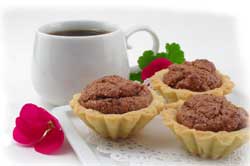 Beautiful
to look at and even better to eat, these little tartlets have
a delicate crust featuring a hint of orange zest. The filling
is a thick blend of a classic pairing -- bittersweet chocolate
and roasted hazelnuts. The assembly of these tiny tarts was
accomplished easily and the results were picture perfect and
delightfully tasting. Beautiful
to look at and even better to eat, these little tartlets have
a delicate crust featuring a hint of orange zest. The filling
is a thick blend of a classic pairing -- bittersweet chocolate
and roasted hazelnuts. The assembly of these tiny tarts was
accomplished easily and the results were picture perfect and
delightfully tasting.
Click here to view the full,
illustrated recipe.
Click here for a
printable
version of the recipe.
Cinnamon-Sour
Cream Cupcakes
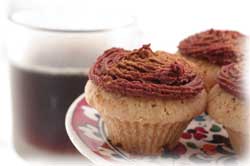 Moist
beyond belief, these diminutive cakes offered the comfort
flavor of cinnamon with just the right sweetness - reminiscent
of our favorite sour cream coffeecake. The cinnamon-flavored
chocolate ganache completed the moment. (The sturdy,
small-sized silicone cups used to bake these cupcakes were
perfect in this application). Moist
beyond belief, these diminutive cakes offered the comfort
flavor of cinnamon with just the right sweetness - reminiscent
of our favorite sour cream coffeecake. The cinnamon-flavored
chocolate ganache completed the moment. (The sturdy,
small-sized silicone cups used to bake these cupcakes were
perfect in this application).
Click here to view the full,
illustrated recipe.
Click here for a
printable
version of the recipe.
Chocolate-Espresso
Pots de Crème
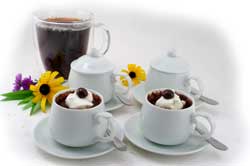 It
had been some time since we'd used our little pots de crème
set. Finding this recipe inspired us to find our special
lidded cups and experiment with this recipe. The results did
not disappoint! Neither mousse, nor custard, the
chocolate-espresso flavor caused swooning all around the table
to the point of embarrassment. You'll enjoy and be satisfied
with these dainty, but potent pleasures. It
had been some time since we'd used our little pots de crème
set. Finding this recipe inspired us to find our special
lidded cups and experiment with this recipe. The results did
not disappoint! Neither mousse, nor custard, the
chocolate-espresso flavor caused swooning all around the table
to the point of embarrassment. You'll enjoy and be satisfied
with these dainty, but potent pleasures.
Click here to view the full,
illustrated recipe.
Click here for a
printable
version of the
recipe.
| |
Make a
great cup of coffee, and take a few extra minutes to relax and
enjoy it thoroughly!
|
|
| |