"Curry Cuisine"
October 22,
2009 - Vol 1, Issue 17
| |
|
|
|
|
Curry
Cuisine
|
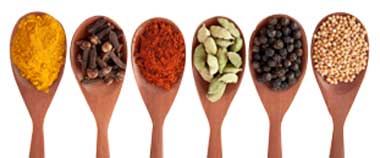
Mention
"curry" and our mouths begin to salivate. We inhale
deeply in anticipation of the rich aromas that will
permeate the kitchen as the curry develops its layers on
the stove. Either mild or hot, curries are a pillar of
Indian culinary traditions. As our palates "go global"
in search of the exciting and novel, curry flavors
satisfy both culinary curiosity and gustatory
satisfaction. In this issue we open the door to just a
few basics of Indian cooking techniques, ingredients,
and flavors that we think will pique your interest to
learn more. We begin with some basic answers about
curry, followed by some essential techniques. We finish
with a unique cookbook that removes the "it's too
complicated" barrier that often accompanies forays into
ethnic cooking explorations. The featured book, 5
Spices, 50 Dishes, focuses on the essence of
Indian flavors by utilizing accessible ingredients and
methods; it's an excellent primer for any Westerner
desiring a global flair, or merely fabulously tasting
good
food!
|
| October Wine of the
Month |

|
Saturdays at Cucina
Fresca!
|
UPCOMING
events at Cucina Fresca:
Saturday,
October 24th
Wusthof
Knife Day 10 am - 3pm
Kick off our annual
holiday Wusthof knife sale with our exclusive Boning
Knife Bonanza! Be the first to take advantage of
great deals on Wusthof cutlery with additional savings
on all Wusthof boning knives.
FREE
Kitchen Knife Sharpening 10am - 3
pm, any brand of kitchen knives welcome and feel
free to drop knives off in advance. 
Saturday,
October 31st
Pumpkin
Carving Contest
and Costume
Contest
Entries due at 11 am, prizes given for
multiple age groups. Call for details.
Haunted
Downtown Business Tour
Tour by local
historian, Jan Petersen; begins at 2pm at Cucina
Fresca. |
E-News Drawing
|
If you
receive our newsletter, you will be entered into a
drawing each month for a great prize for your
kitchen. Check here each month to see if you have
won, if so, come in to collect your
prize!
September's
winner: Dominique
Homan
Dominique won a cookbook. Congrats Dominique,
come by anytime to pick up your
prize! | | |
|
Food Bank Benefit
Results
|
We were
THRILLED with the turnout to our Julia Child inspired F.I.S.H.
Food Bank Benefit Event. Thank you to everyone who
participated! 160 people attended, we collected over
600 pounds
of food, and earned $400
for the food bank. Here are the results of the raffle
drawings. Come in anytime to pick up your prize!
Food Bank Benefit - Raffle Prize
Winners
|
Bosch Cooler Pak-
Jody Micheletti
Seafood Stock
- Carmen Cousins
Measuring
Spoons - Stacey
Sawyer
Measuring Spoons - Jo
Sherwood
Measuring Spoons -
Melissa Mahlberg
Measuring
Spoons - Doneete Guisti
Measuring Spoons - Rachel
Black
Blackberry Merlot Wine
Reduction - Barb Campbell
Chef
Choice Knife Sharpener - Tom
Cariker
Red Wine Sauce - Susan
Beattles
White Wine Sauce -
Kevein Laxalt
Blue Paring
Knife - Jan Walsh
Brown
Teapot - Delene Volkert
Dijon
3.5 Qt. Dutch Oven - Karleen
Bundy
Beaujolais Wine - Karen
Hoem
Beaujolais Wine - Billie
Crawford
Chantal Baking Dish
- Jennifer Tobin |
Capresso 10-cup Coffee
Maker - Karen Winchell
King's
Road Tray - Myrna
Penaflor
King's Road 4 Dessert
Plates - Jody Barnhart
King's
Road 4 Dessert Plates - Micky
Tolbert
Julia Child Inspired
Basket - Jeannie
Gillins
Coffee Mug with Coffee
- Jan King
Coffee Mug with
Coffee - Debbie
Almaguer
Mandarin Orange Bath/Body
Set - Marva Santina
What 2
Wear Gift Certificate - Lisa
Frazier
Single Serving Wine -
Sarah Sweetwater
Wine Cooler -
Dana Brodsho
Wooden Wine Shelf
- Vicki Jeppsen
Patio Umbrella
- Sandy Canady
Cowboy Joe Coffee
Bucket - Brooke Gerber
13" x
10" Sheet Pan - Molly
Popp
Fagor 10.5" Square Grill
- Susan Wharton
| | |
| Stumped Us Contest
|
October's
"Stumped Us" Question:
No one
stumped us in September . . . can you believe
it? We
can't!
September's
"Stumped Us" results: "What is
this?"Correct
answer....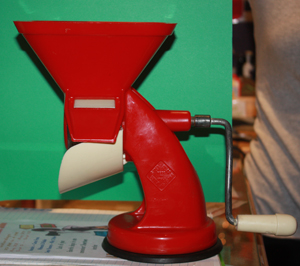 This is a
type of food mill; it will separate seeds and skin from
tomatoes, cooked apples or soaked dry chilies; sending
the skin and seeds to one side and the pulp to the other
leaving a nice smooth paste free of skin and seeds. I have
used one of these for tomato sauce and also to prepare chilies
for chorizos. This is a
type of food mill; it will separate seeds and skin from
tomatoes, cooked apples or soaked dry chilies; sending
the skin and seeds to one side and the pulp to the other
leaving a nice smooth paste free of skin and seeds. I have
used one of these for tomato sauce and also to prepare chilies
for chorizos.
September entry
winner.... Martha
Torrealday
Thank you
for your answer, Martha! Come in anytime to pick up your
prize!
|
Indian
Cookery
|
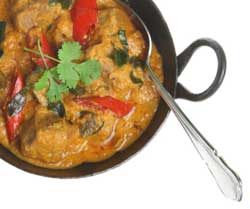 India
is a big country with many regional specialties as in our own
country, and certainly many more than one can grasp in a brief
overview. The specialties arise from the land and climate, and
take advantage of the food that flourishes best in each area.
Further, India's rich history as a melting pot of many peoples
and migrations has greatly influenced its cuisine over the
centuries along with its multiple ethnic and religious
traditions. India
is a big country with many regional specialties as in our own
country, and certainly many more than one can grasp in a brief
overview. The specialties arise from the land and climate, and
take advantage of the food that flourishes best in each area.
Further, India's rich history as a melting pot of many peoples
and migrations has greatly influenced its cuisine over the
centuries along with its multiple ethnic and religious
traditions.
A very broad categorization of Indian
cuisine might start with a delineation of Northern, Southern,
Eastern and Western Indian food traditions - (apologies to our
Indian friends for this simplistic explanation). Within each
region are distinct cuisines: Andhra, Bangladeshi, Bengali,
Gujarati, Karnataka, Malayali, Nepalese, Oriyas, Pashtun,
Punjabi, Sindhi, Sri Lankan, Tamil, Telugu, and on and on. As
spices of the Far East headed to Europe and the New World
centuries ago, the return trip brought tomatoes, potatoes,
squash and chiles to the Indian subcontinent turning them into
culinary staples for Indian kitchens. Old and new together
have created today's unique and pleasing fusion of
flavors.
What is curry? Just one
category of Indian recipes, "curry" is actually a generic term
most easily translated as "sauce" or "gravy." From that broad
definition, the specifics explode into an array of pleasures.
To our initial frustration, there is no single list of spices
or ingredients that define "curry." Curry can refer to the
spiced sauce, or to an entire dish made with a spiced sauce.
Resolution on the definition is best reached by understanding
"curry" in its broadest sense - "a spiced dish with southern
Asian origins." To confuse matters a bit more, curry is also a
plant whose leaves are often used in fresh form. Curry leaves
may be part of a curry dish, but are not responsible for the
classic taste of curries.
What is curry powder? - Curry
powder is a spice blend that attempts to shortcut the
assemblage of spices for a curry dish. Spice purveyors mix
their own blends of curry powders. Again, there is no one list
of ingredients or proper proportions comprising curry powder.
There are certain themes across the unique blends that almost
always include: turmeric, cumin, coriander, and fenugreek,
then perhaps proprietary amounts of garlic, cloves, fennel
seed, ginger, cinnamon, clove, mustard seed, cardamom, mace,
nutmeg, black pepper, red pepper, or any number of other
spices. A curry powder is handy, but obfuscates the breadth of
flavors possible in making curry dishes from individual spices
according to the needs of the specific recipe.
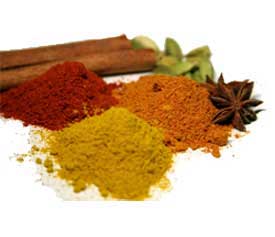 What is garam masala? A
literal translation of garam
masala is "hot mixture," where "hot" refers to an
intensity of taste, rather than heat as produced by a chile.
There are hundreds of garam
masala mixtures, each unique to the cook or family
tradition. A garam
masala mix of spices varies regionally, but might
include peppercorns, cardamom, nutmeg, cinnamon, and clove.
Garam masala is
usually added at the end of cooking to maximize the flavors.
Unlike curry spice blends, garam masala does not
commonly feature turmeric, coriander, fenugreek, or mustard
seed to the extent that curry powder does. Garam masala has distinct
uses in both its roasted and unroasted forms. What is garam masala? A
literal translation of garam
masala is "hot mixture," where "hot" refers to an
intensity of taste, rather than heat as produced by a chile.
There are hundreds of garam
masala mixtures, each unique to the cook or family
tradition. A garam
masala mix of spices varies regionally, but might
include peppercorns, cardamom, nutmeg, cinnamon, and clove.
Garam masala is
usually added at the end of cooking to maximize the flavors.
Unlike curry spice blends, garam masala does not
commonly feature turmeric, coriander, fenugreek, or mustard
seed to the extent that curry powder does. Garam masala has distinct
uses in both its roasted and unroasted forms.
In
addition to key spices, flavor-filled fresh herbs and
vegetables underpin many curry recipes, especially onion,
garlic, ginger and fresh chiles. The spices and aromatics
combined with oils, coconut milk, or vegetable liquids form
the curry sauce that deliciously coats vegetables, legumes,
meats, or
poultry.
|
Curry
Techniques
|
Most
Indian cookery is accomplished on the stovetop with very
little use of the oven. It holds many similarities to wok
cookery in that regard. The techniques of Indian cooking focus
on the layering of flavors and the optimization of each
ingredient. This is most obvious with the preparation of
spices:
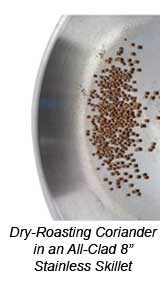 Dry-roasting
of Spices - Many Indian recipes call for the
roasting of spices. Like nuts, many whole seed spices
such as coriander, cumin, fenugreek, and others, benefit from
roasting; the flavors are brought forth and the golden toast
transforms and deepens the inherent flavors. To dry roast
spices, use a small, heavy-bottomed skillet. Heat the pan over
medium high heat. Add the seeds and stir frequently to
achieve even browning. The color of the seeds will deepen and
exude their aroma. If you "over-roast" the spices (a.k.a.
"burn") throw out that batch and start over! Dry-roasting
of Spices - Many Indian recipes call for the
roasting of spices. Like nuts, many whole seed spices
such as coriander, cumin, fenugreek, and others, benefit from
roasting; the flavors are brought forth and the golden toast
transforms and deepens the inherent flavors. To dry roast
spices, use a small, heavy-bottomed skillet. Heat the pan over
medium high heat. Add the seeds and stir frequently to
achieve even browning. The color of the seeds will deepen and
exude their aroma. If you "over-roast" the spices (a.k.a.
"burn") throw out that batch and start over!
Oil-roasting of Spices - Some
spices respond to hot oil with a special blooming of their
flavors, especially coriander, cumin, fenugreek, and
peppercorns. This process of oil-roasting is known as tadka or
tarka.
Heat a high temperature-tolerant oil such as canola or peanut
oil in a high quality skillet. 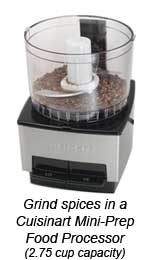 Test
the heat of the oil with a drop of water. When the droplet
sizzles and skips, add the seeds. They too will sizzle and
spatter as they quickly roast. (A splatter screen is very
useful at this moment!) Watch very carefully as the seeds will
brown quickly. Remove the pan from heat and transfer the seeds
to a small plate lined with a paper towel. Once cooled, grind
the spices and proceed with your recipe. Test
the heat of the oil with a drop of water. When the droplet
sizzles and skips, add the seeds. They too will sizzle and
spatter as they quickly roast. (A splatter screen is very
useful at this moment!) Watch very carefully as the seeds will
brown quickly. Remove the pan from heat and transfer the seeds
to a small plate lined with a paper towel. Once cooled, grind
the spices and proceed with your recipe.
Grinding Spices - As with all
spices, buy small quantities that will be used within a
relatively short time period. Store them in a dark, dry
location in your kitchen. Whole spices hold their flavor
longer and with greater potency than ground or powdered
spices. In Indian cooking, whole spices are frequently
preferred for the added flavor yielded in the roasting step.
Whole spices are roasted then ground just as they are needed
in the recipe. Spices may be ground with a mini food
processor, mortar and pestle, a coffee grinder, or a
mechanical spice grinder.
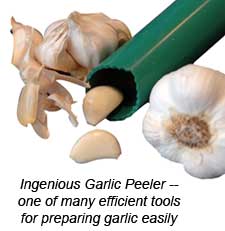
Aromatic Roots - Onion, Garlic,
Ginger - Many, many Indian dishes begin with a diced
onion quickly followed by a paste of garlic and ginger.
- Onion
Dicing - a sharp knife and cutting board are tried
and true, but you might like to experiment with other onion
tools that dice whole onions with one motion.
- Garlic
Prep - With the too-simple-to-believe garlic peeler
and twisting garlic mincer, preparing larger quantities of
garlic is easy and quick.
- Ginger
- Use a ginger grater or a microplane to zest peeled ginger
into a pulp while leaving behind the stringy
fibers.
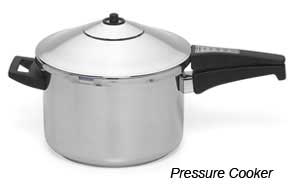 Pressure-cooking
for Legumes and Meats - Modern day Indian cooking
often deploys a pressure cooker to make quick work of stewing
meats and cooking dried legumes. Unlike your mother's pressure
cooker, today's pots are safe and a true time saver. The two
hours it previously took to soak and cook lentils or split
peas now consumes a total of 15 minutes with the help of a
pressure cooker. You'll quickly find that your pressure cooker
is your new favorite pot -- Indian dishes are but one use for
this re-engineered time
saver. Pressure-cooking
for Legumes and Meats - Modern day Indian cooking
often deploys a pressure cooker to make quick work of stewing
meats and cooking dried legumes. Unlike your mother's pressure
cooker, today's pots are safe and a true time saver. The two
hours it previously took to soak and cook lentils or split
peas now consumes a total of 15 minutes with the help of a
pressure cooker. You'll quickly find that your pressure cooker
is your new favorite pot -- Indian dishes are but one use for
this re-engineered time
saver.
|
Curry
Companions
|
Integrating a curry dish into
your menu can be accomplished as an eclectic event, or as part
of a themed meal with traditional accompaniments.
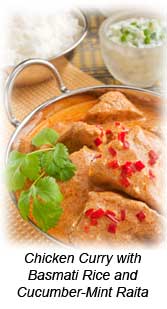 Curry over Rice - A classic
presentation of a curry dish is where the sauce is ladled over
a bed of rice. Basmati
rice is the choice for Indian dishes. Basmati rice is a
long-grained rice with a wonderful fragrance when cooking and
a distinctive, nutty flavor when eaten. Available in both
white and brown forms, basmati rice cooks up as separate,
individual grains. Rice may be steamed on the stovetop or in a
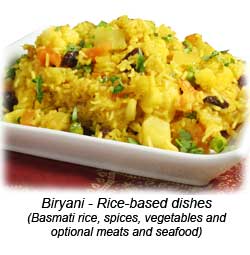
rice cooker. Biryani,
a whole category of spiced, rice-based Indian dishes, goes
well with curry dishes and is another topic to explore as you
try your hand at Indian cooking. Curry over Rice - A classic
presentation of a curry dish is where the sauce is ladled over
a bed of rice. Basmati
rice is the choice for Indian dishes. Basmati rice is a
long-grained rice with a wonderful fragrance when cooking and
a distinctive, nutty flavor when eaten. Available in both
white and brown forms, basmati rice cooks up as separate,
individual grains. Rice may be steamed on the stovetop or in a
rice cooker. Biryani,
a whole category of spiced, rice-based Indian dishes, goes
well with curry dishes and is another topic to explore as you
try your hand at Indian cooking.
Indian Breads - Reliant
primarily on stovetop cooking, Indian breads such as chapatti,
poori,
naan, and
roti, are
cooked on griddles and skillets in quick flatbread fashion.
Torn portions of the bread are used to scoop up the curry.
You'll love experimenting with Indian breads along with
investigating curries.
 Raita (raithas)
- Hot, spicy dishes call for relief occasionally. Chilled
Indian raitas
offer a respite with their yogurt-based dressing. Yogurt,
plain and unsweetened, is a staple of Indian cuisine. Finely
diced cucumbers, onions and other vegetables are added to the
yogurt along with, of course, a few spices. Raita (raithas)
- Hot, spicy dishes call for relief occasionally. Chilled
Indian raitas
offer a respite with their yogurt-based dressing. Yogurt,
plain and unsweetened, is a staple of Indian cuisine. Finely
diced cucumbers, onions and other vegetables are added to the
yogurt along with, of course, a few spices.
Chutneys/Pickles - Among our
favorite components of an Indian meal are chutneys and
pickles. Chutneys - loosely akin to salsas - might be for
dipping or drizzling. They are an essential side dish and
complement to an Indian meal. Indian pickles, another side
dish, can be made of any number of fruits or vegetables
marinated in oil, lemon juice, and spices.
|
Cucina Fresca's Indian Cooking
Tips
|
Tip #1: If you're
seeking to incorporate more plant-based menus in your diet,
Indian cuisine is a natural source of inspiration.
It's
reported that less than 30% of Indians are regular meat
eaters. You'll find many delicious recipes that will enhance
and expand your enjoyment of all kinds of fruits and
vegetables with Indian cooking.
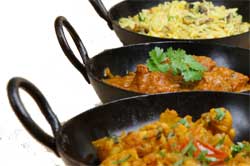 Tip #2: Shop at health
food/natural food stores or ethnic food aisles for some of the
ingredients required in more complicated Indian recipes. But
don't let unfamiliar ingredients hinder your explorations! As
noted in the cookbook reviewed below, many delicious Indian
flavors and great dishes are available with commonly available
ingredients. Tip #2: Shop at health
food/natural food stores or ethnic food aisles for some of the
ingredients required in more complicated Indian recipes. But
don't let unfamiliar ingredients hinder your explorations! As
noted in the cookbook reviewed below, many delicious Indian
flavors and great dishes are available with commonly available
ingredients.
Tip
#3: Ghee is a
common ingredient in Indian cooking and easily available in
jarred form. Ghee is
butter that has been clarified and "toasted," and has a very
concentrated butter flavor. To make your own ghee, melt butter at a
medium temperature until foaming occurs and the white milk
solids separate from the oil. Skim away
the foam. Allow the
butter to continue heating until the white 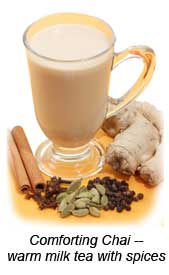 milk
solids turn a golden brown; monitor carefully during this
stage. The
process steams away any water present in the butter. Strain
away the browned particles reserving the clear oil. Ghee may be stored at room
temperature for up to six months and in the refrigerator for
up to a year. Use as you would any flavorful oil, not just in
Indian cooking. milk
solids turn a golden brown; monitor carefully during this
stage. The
process steams away any water present in the butter. Strain
away the browned particles reserving the clear oil. Ghee may be stored at room
temperature for up to six months and in the refrigerator for
up to a year. Use as you would any flavorful oil, not just in
Indian cooking.
Tip #4: Curry is not
restricted to Indian dishes, Thai curries and Vietnamese
curries share the same "spiced sauce" definition, but with
their own regional twist. Thai curries often begin with curry
pastes based on red, green, or yellow chiles and developed
with unique blends of spices and herbs. Vietnamese curries are
thinner in consistency than most Indian curries.
Tip #5: Enjoy Indian spice
flavors with a warm chai. A
mix of sweetened milk and tea is steeped with spices,
(cinnamon, cardamom, cloves and other variations). Many find
drinking chai to be a
very soothing, relaxing experience with positive health
effects.
|
Q &
A's
|
 Q: What is coconut milk? Q: What is coconut milk?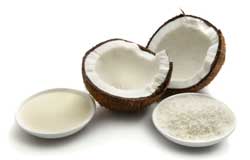
A:
Coconut milk is the liquid contained in the pulp
of a coconut. Once opened, the white portion of the coconut is
grated with a coconut grater, or the "white meat" chunks are
removed and processed to a pulp in a food processor. The pulp
is squeezed dry with the juices - the coconut milk - saved.
The water in the center of a coconut is known as coconut water
and may be used in cooking, but is not the milk and not very
flavorful. Coconut milk is also available in most supermarkets
along with other ethnic foods. It's important to distinguish
canned coconut milk from canned crème de coconut which is
sweetened and not suitable for most curry recipes.
Q: What is
vindaloo?
A: A vindaloo is a common Indian
entrée typically with some red chile fire power. Traditional
vindaloos are made with pork and stem from Portuguese
traditions. Modern vindaloos may replace pork with chicken,
beef, or lamb, and often include potatoes. A type of curry, a
vindaloo has a vinegar component along with a fiery spice
mixture. The meat in a vindaloo is frequently marinated in the
spice mixture for extra flavor enhancement.
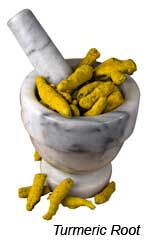 Q: What is
turmeric? Q: What is
turmeric?
A: Turmeric is a common Indian spice
made from a rhizome (root stem) and is related to ginger. The
roots are boiled, dried, and powdered. India produces and
consumes the majority of the turmeric crop. Turmeric is
responsible for the intense yellow color of most curries and
is a common thread across the many curry variations. Take care
when using turmeric as it easily stains clothing, countertops,
and porous utensils a lovely yellow color. The yellow of the
stain is dissolvable with alcohol or oil. The ultra-violet
component of sunlight will also help to remove stains from
clothing.
Q: What
are pulses?
A: Pulses are a common Indian term
for legumes of all types. With the heavy emphasis on
vegetarian eating in Indian, pulses are an important
nutritional component of the diet. Pulses include red lentils,
brown lentils, yellow and green split peas, chickpeas and
beans of all types. Preparations of pulses are often termed
"dals," or
"daals." |
Cookbook
Review
|
5
Spices, 50 Dishes, Simple Indian Recipes using Five Common
Spices by Ruta Kahate. Photography by Susie Cushner.
Copyright 2007. Published by Chronicle Books, San Francisco,
CA.
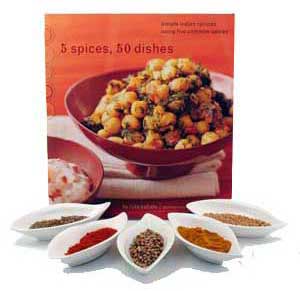 A
perfect introduction to Indian cookery for the layperson! With
the angle of using only five common spices, much of the
intimidation of Indian cuisine is taken away. We're no longer
put off by unfamiliar spices and trips to specialty markets in
search of ingredients. Rather, by assembling and adapting
recipes with commonly available spices and ingredients, the
novice is enabled in the basics of this cuisine. The result of
these introductory lessons is a collection of easy, tasteful
dishes, and a curiosity and confidence to take the next steps
in developing a competence in this marvelous cuisine. Ms.
Kahate presents her instructions in a logical manner without
being overwhelming. She groups her recipes in logical groups:
Vegetables, Dals, Beef and Lamb, Chicken and Eggs, Seafood,
Salads and Raitas, Rice and Bread, Sweets, and a standalone
chapter on "A Perfect Cup of Chai." You'll enjoy your culinary
travels to the other side of the world from the comfort of
your own
kitchen! A
perfect introduction to Indian cookery for the layperson! With
the angle of using only five common spices, much of the
intimidation of Indian cuisine is taken away. We're no longer
put off by unfamiliar spices and trips to specialty markets in
search of ingredients. Rather, by assembling and adapting
recipes with commonly available spices and ingredients, the
novice is enabled in the basics of this cuisine. The result of
these introductory lessons is a collection of easy, tasteful
dishes, and a curiosity and confidence to take the next steps
in developing a competence in this marvelous cuisine. Ms.
Kahate presents her instructions in a logical manner without
being overwhelming. She groups her recipes in logical groups:
Vegetables, Dals, Beef and Lamb, Chicken and Eggs, Seafood,
Salads and Raitas, Rice and Bread, Sweets, and a standalone
chapter on "A Perfect Cup of Chai." You'll enjoy your culinary
travels to the other side of the world from the comfort of
your own
kitchen!
|
Recipes for Three Easy Indian
Dishes
|
Recipes excerpted from 5
Spices, 50 Dishes, Simple Indian Recipes using Five Common
Spices by Ruta Kahate. Copyright 2007. Published by
Chronicle Books, San Francisco, CA. Reprinted with permission
of the publisher. All rights
reserved.
Steamed
Cauliflower with a Spicy Tomato Sauce
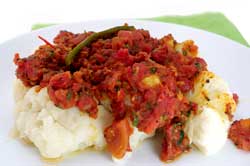 Quick
and easy, this incredibly flavorful sauce came together while
the cauliflower steamed. Using classic spice roasting
techniques, the kitchen fragrances abounded. The flavor layers
built on one another with the addition of garlic, ginger, and
crushed tomatoes. The result was a beautiful presentation and
the tastiest cauliflower we've ever
had! Quick
and easy, this incredibly flavorful sauce came together while
the cauliflower steamed. Using classic spice roasting
techniques, the kitchen fragrances abounded. The flavor layers
built on one another with the addition of garlic, ginger, and
crushed tomatoes. The result was a beautiful presentation and
the tastiest cauliflower we've ever
had!
Click here to view the
full, illustrated recipe.
Click here for a
printable
version of the
recipe.
Everyday
Yellow Dal
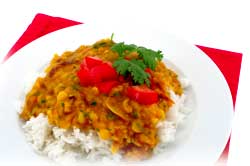 High
protein, inexpensive and marvelously delicious, this yellow
dal deserves to be a regular in your repertoire! Spices are
bloomed in hot oil, and a savory mixture created with the
addition of plenty of onions and garlic. Traditional flavors
are showcased well in this satisfying mélange of color and
taste. Next time we plan to try our pressure cooker so that
the soaking step is eliminated and the cooking time cut to
one-third the time. High
protein, inexpensive and marvelously delicious, this yellow
dal deserves to be a regular in your repertoire! Spices are
bloomed in hot oil, and a savory mixture created with the
addition of plenty of onions and garlic. Traditional flavors
are showcased well in this satisfying mélange of color and
taste. Next time we plan to try our pressure cooker so that
the soaking step is eliminated and the cooking time cut to
one-third the time.
Click here to view the
full, illustrated recipe.
Click here for a
printable
version of the
recipe.
Goan
Shrimp Curry with Eggplant
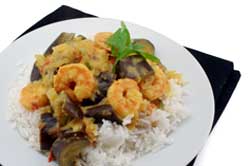 The
featured spices rearranged for this curry were enhanced with
the addition of coconut milk. This recipe has its roots in the
coastal Goa region of western India where seafood dishes are
the natural cuisine. Once again, the tantalizing flavors
dazzled our taste buds and more than satisfied our hunger.
With a one skillet preparation the dish came together in less
than one-half hour. This recipe would be equally good with any
number of vegetables. Another keeper for the quick supper
repertoire! The
featured spices rearranged for this curry were enhanced with
the addition of coconut milk. This recipe has its roots in the
coastal Goa region of western India where seafood dishes are
the natural cuisine. Once again, the tantalizing flavors
dazzled our taste buds and more than satisfied our hunger.
With a one skillet preparation the dish came together in less
than one-half hour. This recipe would be equally good with any
number of vegetables. Another keeper for the quick supper
repertoire!
.
Click here to view the
full, illustrated recipe.
Click here for a
printable
version of the
recipe.
| |
Go global
in your kitchen -- it's worth the
trip!
|
|
| |