"Sweet Holidays"
December 3,
2009 - Vol 1, Issue 20
| |
|
| Farmer's Market
|
|
2010
DBA
Farmer's Market The Elko DBA is
working on an annual Farmer's Market to start in July of
2010. If you interested in volunteering, becoming a
vendor, or would just like general information, email
Amber at: elkofarmersmarket
@yahoo.com
|
| Feed a Family
|
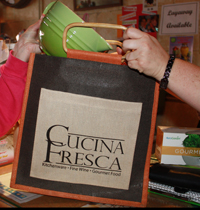
Bring a
Bag
and Feed a Family.
Each time you make a
purchase and bring your own bag, we will drop a dime in
a jar on our counter. All dimes collected from the jar
will be donated to the F.I.S.H. Food bank to feed
Northeastern Nevada families in need.
| |
|
Sweets for the
Sweet!
|
 "While visions of sugarplums danced
in their heads. . . ." This phrase, from the
famous poem "Twas the Night Before Christmas," swirls in
our mind as the winter holiday season gathers momentum
around us. We also find ourselves humming "Dance of the
Sugarplum Fairy" from Tchaikovsky's The
Nutcracker. But what is a sugarplum? And, more
importantly, where can we find some? This issue is all
about holiday sweets - candy making at its seasonal
best! Learn some of the science behind sugar's
transformation and some key tips on making candy. Gifts
of candy from your own kitchen are unique and special in
these days of "off the shelf" and "carry-out." We'll
help you get started with three recipes - homemade
marshmallows, old-fashioned
taffy, and delicious,
healthy sugarplums! Sharing your homemade candy
will be a great way to say Happy
Holidays! "While visions of sugarplums danced
in their heads. . . ." This phrase, from the
famous poem "Twas the Night Before Christmas," swirls in
our mind as the winter holiday season gathers momentum
around us. We also find ourselves humming "Dance of the
Sugarplum Fairy" from Tchaikovsky's The
Nutcracker. But what is a sugarplum? And, more
importantly, where can we find some? This issue is all
about holiday sweets - candy making at its seasonal
best! Learn some of the science behind sugar's
transformation and some key tips on making candy. Gifts
of candy from your own kitchen are unique and special in
these days of "off the shelf" and "carry-out." We'll
help you get started with three recipes - homemade
marshmallows, old-fashioned
taffy, and delicious,
healthy sugarplums! Sharing your homemade candy
will be a great way to say Happy
Holidays!
|
Current Holiday Specials
at Cucina Fresca
|
Take advantage of our
in-store specials and mail-in-rebates for many of our
name-brand lines of cookware, cutlery, and
appliances. During the holiday season, we are
featuring incredible deals on  select items from: select items from:
- Wusthof
- Cuisinart
- Emeril Cookware
- Waring Pro
- KitchenAid
- LeCreuset.
|
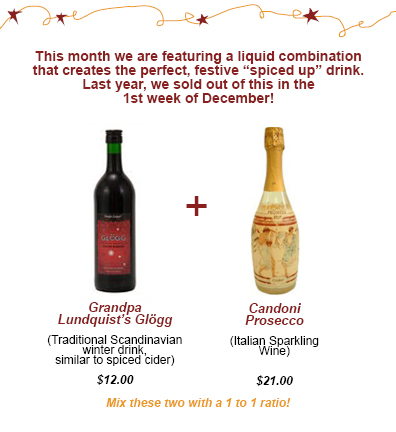
| December Wine of the
Month |
|
Cucina Fresca's Online
Holiday Shopping Options
|
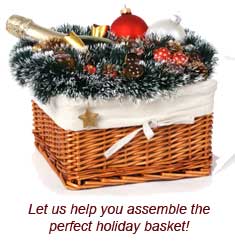
View
our Holiday Gift Basket
Brochure! |
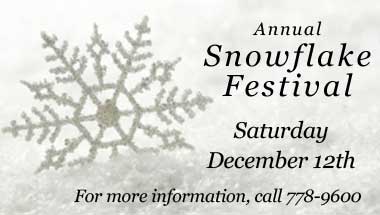
Upcoming Downtown
Business Association Event
|
|
E-News Drawing
|
If you
receive our newsletter, you will be entered into a
drawing each month for a great prize for your
kitchen. Check here each month to see if you have
won, if so, come in to collect your prize!
November's
winner: Carol Sims
Congrats, Carol, come by anytime to
pick up your
prize!
| | |
|
Offering
Gifts
|
 Giving a gift can be such a joy! There's
special karma that goes on during the process of gift giving.
The intended recipient comes to mind, their enjoyments and
interests roll around as the possibilities of delighting them
with a gift solidify. What an honor it is to have friends and
family to gladden with a gift. It really is the thought that
counts! Giving a gift can be such a joy! There's
special karma that goes on during the process of gift giving.
The intended recipient comes to mind, their enjoyments and
interests roll around as the possibilities of delighting them
with a gift solidify. What an honor it is to have friends and
family to gladden with a gift. It really is the thought that
counts!
Everyone
Eats - Of course, we think we're the perfect store for
everyone on your list - after all, everyone needs to eat, and
we're all about fulfilling that basic need in some way! Trends
show that more and more of us are cooking and eating at home.
Sometimes it's for economizing purposes, or for healthier food
choices, or a revived hobby. Regardless, the kitchen is
experiencing a renaissance!
 Offer Tools for New Skills -
"Feeding" cooking skills, novice or experienced, with some
inspirational gear is right in style! Sometimes it's that
unique piece of equipment that inspires a new skill or
specialty. Other times, it's about having appropriate gear
needed for achieving good results easily. Offer Tools for New Skills -
"Feeding" cooking skills, novice or experienced, with some
inspirational gear is right in style! Sometimes it's that
unique piece of equipment that inspires a new skill or
specialty. Other times, it's about having appropriate gear
needed for achieving good results easily.
Gifts of Experience - We find
that offering the gift of experience is always a well-received
gift. A reservation and gift certificate to one of our cooking
classes is a unique and always appropriate gift. It's the
perfect way to spend a lovely winter evening and some quality
relaxing time after the holidays.
Specialty Foods - And, if
your intended is not an experienced or emerging cook, you'll
find we have a host of food gift choices that will delight and
satisfy. Our selection of gourmet food items make great
stocking stuffers, or together form a delicious basket of
goodies. We'd be pleased to help you choose just the right
combination of items that are sure to delight.
Gift Registry - Our gift
registry is not just for weddings, it's for anyone
with a wish list. If you'd like to drop some hints to your
Santa, we'd be happy to be the go-between! We recommend
noting a number of items that allows the giver to choose -
this keeps the element of surprise alive!
 Gift Certificates - Our gift
certificates are a perfect solution for everyone - every age,
every interest, and every palate. Gift Certificates - Our gift
certificates are a perfect solution for everyone - every age,
every interest, and every palate.
Free Gift Wrapping - To
simplify your life, and to complete your shopping in one
swoop, we offer gift wrapping for free. We'll prepare your
choice and dress it up just right! You'll be done with
your holiday gift shopping in just one trip to our
store!
|
Becoming
Candy
|
Sugar is
pure fuel. We're genetically programmed to like "sweet"
because it quickly enters our body providing immediate
carbohydrates for our brain functions and muscle movements.
Understanding some fundamentals about sugar will greatly aid
your comfort level with candy making. Here are some basics to
get you started:
 Sugar Chemistry - Just a
tiny bit of chemistry helps to explain candy. Sugar is
sucrose,12 carbon atoms, 22 hydrogen, and 11 oxygen atoms,
arranged in a crystalline, compound structure of two simpler
molecules, fructose and glucose. Sucrose molecules at room
temperature want to lock together to form crystals. Depending
on the type of candy being made, this urge to link up and
crystallize is good as with fudge or fondants, and bad when
making lollipops, taffy or caramels. Sugar Chemistry - Just a
tiny bit of chemistry helps to explain candy. Sugar is
sucrose,12 carbon atoms, 22 hydrogen, and 11 oxygen atoms,
arranged in a crystalline, compound structure of two simpler
molecules, fructose and glucose. Sucrose molecules at room
temperature want to lock together to form crystals. Depending
on the type of candy being made, this urge to link up and
crystallize is good as with fudge or fondants, and bad when
making lollipops, taffy or caramels.
Dissolving Sugar - In candy
making, sugar is dissolved in water. The water dissolves the
crystals into more individual molecules. There is a point
where additional sugar in a defined amount of water will no
longer dissolve. This is known as the saturation
point. But, heat changes the saturation point. As the
water and sugar mixture warms, more sugar can be dissolved.
This is known as supersaturation
- the magical key to candy making!
Preventing Crystals - The
sugar water heated into a supersaturated state desperately
wants to "lock arms" and crystallize; the candy makers' task
is to interfere with that urge. Crystallization can be slowed
or prevented in one of three ways:
 (1) Tip the ratio - Many
candy recipes call for adding corn syrup which is primarily
glucose. Having more glucose molecules hanging around changes
the original ratio of one fructose molecule and one glucose
molecule needed to make the crystal-loving sucrose molecule.
By crowding the field with extra glucose, the formed sucrose
molecules have a more difficult time finding each other and
joining into crystals.(2) Add some
butter - Some candy recipes feature butter which also
serves to muddle in the sugar water mixture preventing it from
crystallizing. Hard brittles and toffee use butter to
interrupt crystallization, and to add flavor and a texture
that easily cracks in the hand and mouth.(3) Change the
pH - The inclusion of an acidic component breaks the
sucrose bonds between the fructose and glucose molecules and
prevents them from reforming. The result is a liquid sugar
form known as invert sugar. Common acidic ingredients in candy
making include lemon juice or cream of
tartar. (1) Tip the ratio - Many
candy recipes call for adding corn syrup which is primarily
glucose. Having more glucose molecules hanging around changes
the original ratio of one fructose molecule and one glucose
molecule needed to make the crystal-loving sucrose molecule.
By crowding the field with extra glucose, the formed sucrose
molecules have a more difficult time finding each other and
joining into crystals.(2) Add some
butter - Some candy recipes feature butter which also
serves to muddle in the sugar water mixture preventing it from
crystallizing. Hard brittles and toffee use butter to
interrupt crystallization, and to add flavor and a texture
that easily cracks in the hand and mouth.(3) Change the
pH - The inclusion of an acidic component breaks the
sucrose bonds between the fructose and glucose molecules and
prevents them from reforming. The result is a liquid sugar
form known as invert sugar. Common acidic ingredients in candy
making include lemon juice or cream of
tartar.
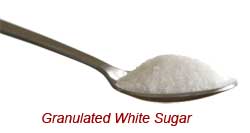
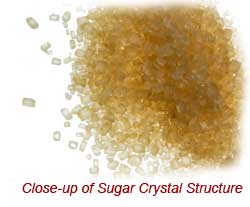
 Granulated
Sugar - this is regular white table sugar, the kind
that most frequently comes to mind. The sugar crystals are
somewhat irregular cubes. It does not need to be sifted or
packed when measuring, simply poured or weighed. Granulated
Sugar - this is regular white table sugar, the kind
that most frequently comes to mind. The sugar crystals are
somewhat irregular cubes. It does not need to be sifted or
packed when measuring, simply poured or weighed.
- Superfine
Sugar - this is regular white table sugar but crushed
to a finer particle size. Alternatively termed "bar sugar"
or "caster sugar," its small size allows it to dissolve very
quickly.
- Confectioner's
Sugar - this sugar is white sugar ground into a
powder, hence the alternate name, "powdered sugar." Many
powdered sugars contain cornstarch to prevent clumping and
caking. This form of sugar dissolves nearly instantly.
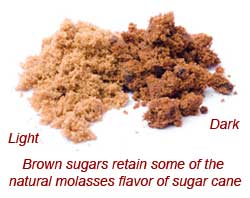
- Brown
Sugar - this type of sugar retains some of the
natural brown molasses resulting from processing the sugar
cane. Dark brown sugar contains more residual molasses than
light brown sugar. Use dark brown sugar where the stronger
flavor matches well with spices as in gingerbread. Use light
brown sugar where the more delicate taste is complementary
and does not compete with the other flavors.
- Raw
Sugar - this form of sugar typically comes from
sugarcane sources and also has some of the natural brown
molasses components remaining from processing. The residual
molasses gives raw sugar its amber color and slight molasses
taste.
 Types of raw sugar include demerara
sugar, Muscovado
sugar, Barbados
sugar, and Turbinado
sugar. Types of raw sugar include demerara
sugar, Muscovado
sugar, Barbados
sugar, and Turbinado
sugar.
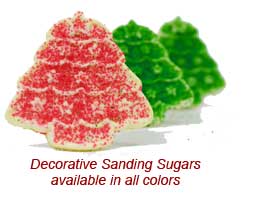
- Decorative or
Sanding Sugar - these sugars are coarse, large
crystals often colored in liquid form and allowed to
crystallize. The large crystals keep the sugar from
dissolving when heated or in contact with moisture making
them perfect for topping cookies, muffins and other baked
goods.
|
Catching the Magical
Moment
|
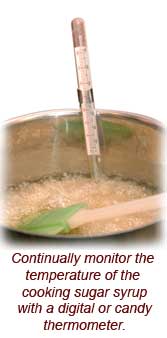 Sugar is the primary component of candy,
but that sugar can take several forms and yield different
characteristics based on how it's handled in the kitchen. As a
sugar solution is heated, the water evaporates changing the
concentration of sugar. Determining exactly when a sugar
solution is prime for the next step is the magic of candy
making. Sugar is the primary component of candy,
but that sugar can take several forms and yield different
characteristics based on how it's handled in the kitchen. As a
sugar solution is heated, the water evaporates changing the
concentration of sugar. Determining exactly when a sugar
solution is prime for the next step is the magic of candy
making.
Temperature,
Temperature, Temperature - Sugar changes internal
structure when heated to very specific heat levels. The
changes may not be obvious at the time the solution reaches a
particular temperature, but will clearly affect the final
cooled product. A traditional glass candy thermometer may be
used to monitor the bubbling sugar solution. Or, for ease and
accuracy use a digital thermometer to track
progress.
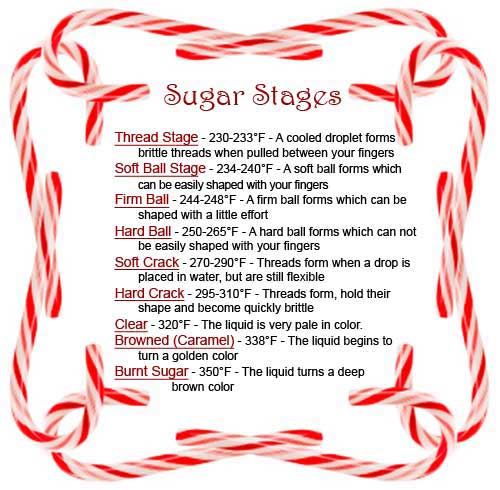
Assess
Texture - A test of the sugar's progress can be made by
cooling droplets of the sugar solution in cold water and
noting its characteristics. The longer the boiling, the more
water that evaporates leaving a denser sugar liquid able to
crystallize to greater and greater degrees when cooled. The
following nine categories are standard definitions when
cooking sugar:
A Couple of Cautions: At each
of these stages, the syrup is hotter than boiling water and
can cause burns if not careful. It may take some time for the
sugar syrup to reach 320°F, but it will reach the higher
temperatures very quickly after that point.
|
Cucina Fresca's Candy Making
Tips
|
Tip #1: If there
ever was an occasion for mise
en place, it's when making candy. Timing is often
critical; having adequate working space cleared and the right
equipment at hand before beginning is crucial. Wash, dry, and
prep any pans or molds as the first step.
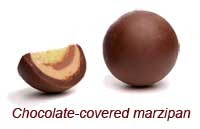 Tip #2: For a very quick gift
from your kitchen, make chocolate-covered anything! Cover or
partially dip pretzels, dried fruit, candied citrus peel,
mini-shortbread cookies, marzipan, or even peanut butter
sandwiched between two crackers. Tip #2: For a very quick gift
from your kitchen, make chocolate-covered anything! Cover or
partially dip pretzels, dried fruit, candied citrus peel,
mini-shortbread cookies, marzipan, or even peanut butter
sandwiched between two crackers.
Tip #3: When taking the
temperature of a liquid in a saucepan, the position of the
thermometer makes a critical difference. Make sure the tip of
the thermometer is at least one inch from the side of the
saucepan, and at half the height of the liquid. Do not allow
the thermometer to touch the bottom,  it will register too hot; if too close to
the pan's sides it may register too cool. it will register too hot; if too close to
the pan's sides it may register too cool.
Tip #4: The cooling and final
handling of sugar syrups can be greatly affected by the room
temperature. If too cold, the candy may cool and harden more
quickly than the time it takes to pull or cut. Similarly, if
the candy calls for warm handling, as in taffy, make separate
single batches instead of doubling the recipe.
Tip #5: When making candy,
measuring the ingredients accurately - there's some serious
kitchen chemistry going on where preciseness will pay off in
excellent results.
|
Q &
A's
|
 Q: What ever happened to sugar
cubes? Q: What ever happened to sugar
cubes?
A: Sugar cubes, or "lumps," used to be
the standard on tables everywhere; 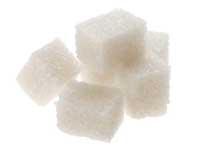 they've been replaced with
individual serving packets. You can make your own sugar cubes
or molds by taking granulated sugar and adding a very small
amount of water, (1 T. for each cup of sugar), and packing the
mixture, (that now resembles moist beach sand), into miniature
decorative molds and letting them air dry until hardened. Add
a drop of food coloring as part of the water amount if
desired. they've been replaced with
individual serving packets. You can make your own sugar cubes
or molds by taking granulated sugar and adding a very small
amount of water, (1 T. for each cup of sugar), and packing the
mixture, (that now resembles moist beach sand), into miniature
decorative molds and letting them air dry until hardened. Add
a drop of food coloring as part of the water amount if
desired.
Q: Often times you'll read a
recipe that encourages you to wash the sides of the saucepan
with a brush dipped in water. Why?
A: The brush and water
dissolve any crystals that may have formed on the rim of the
pan. This prevents these crystals from becoming seed crystals,
or platforms for beginning crystallization throughout the
mixture.
Q: What
is stevia?
A: Stevia is a South
American shrub whose leaves have a natural sweetness. The
sweetness of stevia registers on our palates as a very
concentrated sensation which means very little is needed to
sweeten our foods.
Q: What's the best way to
store my homemade candies?
A: The proper solution
will depend on the type of candy. In general, fresh candy
likes to be kept in a dry environment. 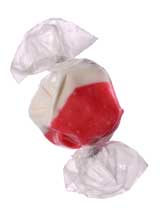 Sticky candies, like caramels and
taffy, are best individually wrapped in wax paper wrappers.
Less sticky candies can be wrapped in foil squares. Fluted
paper or foil cups hold individual pieces neatly. Sticky candies, like caramels and
taffy, are best individually wrapped in wax paper wrappers.
Less sticky candies can be wrapped in foil squares. Fluted
paper or foil cups hold individual pieces neatly.
Q: If a recipe calls for one
cup of granulated sugar, can I substitute an equal amount of
superfine sugar or powdered sugar?
A: It depends on the
recipe and the sugar's role in the recipe. The volume of each
type of sugar varies in the yielded quantity of sweetness. For
example, one cup of granulated sugar equals 1-3/4 cup powdered
sugar. For candy making it's best to stick with the specified
form and quantity of the sugar
listed.
|
Cookbook
Review
|
A
Baker's Field Guide to Holiday Candy & Confections, Sweet Treats All Year
Long by Dede Wilson. Copyright 2005. Published
by Harvard Common Press, Boston, MA.
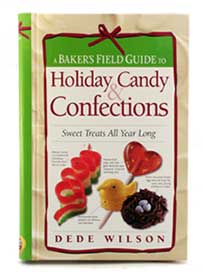 If you're intrigued with candy
making, this is the perfect cookbook for getting started and
also for expanding your skills. This catalog of recipes
introduces all of the basic candy making techniques ranging
from soft nougats and fudge, to hard, glittery lollipops. With
the theme of holidays, the offerings span New Year's,
Valentine's Day, Purim, Easter, Halloween, Hanukkah, Christmas
and fourteen other annual occasions. The recipes build on
classic candy favorites, ethnic traditions, and some new,
unique ideas. Each recipe is tagged with indicators noting the
ease of the recipe, whether it's suitable for kids, the time
involved, if it stores and mails well, and a host of other
insights. The instructions and annotations are complete
without being complicated. The result is an enabled cook made
comfortable with candy making techniques. We started our
education with the three recipes below which now has us
empowered to try some more of our favorite candies - Ribbon
candy, Turkish delight, Peppermint Patties, Chocolate-covered
Pralines, Panforte di Siena, Marzipan, Cherry Lollipops,
Divinity, Butter Mints . . .
. If you're intrigued with candy
making, this is the perfect cookbook for getting started and
also for expanding your skills. This catalog of recipes
introduces all of the basic candy making techniques ranging
from soft nougats and fudge, to hard, glittery lollipops. With
the theme of holidays, the offerings span New Year's,
Valentine's Day, Purim, Easter, Halloween, Hanukkah, Christmas
and fourteen other annual occasions. The recipes build on
classic candy favorites, ethnic traditions, and some new,
unique ideas. Each recipe is tagged with indicators noting the
ease of the recipe, whether it's suitable for kids, the time
involved, if it stores and mails well, and a host of other
insights. The instructions and annotations are complete
without being complicated. The result is an enabled cook made
comfortable with candy making techniques. We started our
education with the three recipes below which now has us
empowered to try some more of our favorite candies - Ribbon
candy, Turkish delight, Peppermint Patties, Chocolate-covered
Pralines, Panforte di Siena, Marzipan, Cherry Lollipops,
Divinity, Butter Mints . . .
.
|
Three Candy
Recipes
|
Recipes excerpted from A
Baker's Field Guide to Holiday Candy & Confections
by Dede Wilson. Copyright 2005. Published by Harvard Common
Press, Boston, MA. Reprinted with permission of the publisher.
All rights reserved.
Star-Shaped
Marshmallows
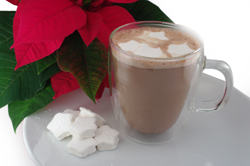
Homemade
marshmallows are so
different
than poofy
grocery
store versions, that
one or the
other should have a different name! Making these
marshmallows was deceptively easy. The basic recipe calls for
vanilla, but we can easily see a peppermint version being
equally delicious in our cocoa or out of hand. Customized
variations are easily accomplished with different cookie
cutter shapes,
colored topping sugars, or partial dipping
in chocolate.
Click here for
to view the full,
illustrated recipe.
Click here for a
printable
version of the recipe.
Saltwater
Taffy
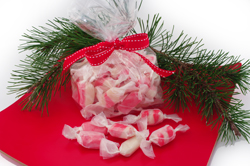
We had to
choose this recipe just for the childhood memories it evoked.
A taffy pull is a great social activity because it takes a few
extra hands to pull and work the taffy before it cools. The
stretching incorporates air and helps to give the taffy its
chewy texture. If your kids or grandkids have never
experienced a taffy pull, it's time to introduce them to this
old-fashioned fun!
Click here for
to view the full,
illustrated recipe.
Click here for a
printable
version of the recipe.
Sugarplums
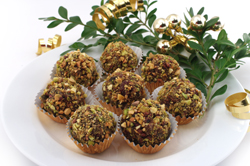
Contrary to its name, these
sugarplums don't contain any sugar, but get their sweetness
from natural dried fruits. A variety of fruits and nuts are
chopped finely in a food processor, formed into balls, then
rolled in nuts or coconut. They are delicious and a healthy
sweet when made with orange juice, or more decadent when made
with rum!
Click here for
to view the full,
illustrated recipe.
Click here for a
printable
version of the
recipe.
| |
Sweet
dreams and holiday wishes from our kitchen to
yours!
|
|
| |