What's the
Difference?
|
|
The role of spice
in globalization began around 2000 B.C.E. Middle
Eastern cultures established and controlled land routes from Europe
to the Far East destinations rich in spices. This monopoly on land-based supply routes
inspired early sea explorations, and eventually
the discovery of the New World by Christopher Columbus.
He who controlled the
supply and distribution of spices, and all that went with it,
controlled the world's wealth. and eventually
the discovery of the New World by Christopher Columbus.
He who controlled the
supply and distribution of spices, and all that went with it,
controlled the world's wealth.
The word "spice" is
commonly used to describe both herbs and spices. The American Spice Trade
Association kindly recognizes
this, and defines spices as "any dried plant product used primarily
for seasoning purposes." Strictly speaking,
however, spices differ from herbs as follows:
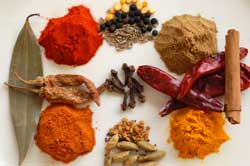
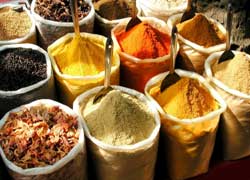
Spices - aromatic flavorings, found in the bark,
seeds, roots, fruit, and stems of plants.
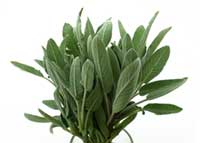
Herbs - aromatics from the leafy portion of a
plant.
 Without
refrigeration, cultures first used spices as a meat preservative and
to make the meat more palatable by masking undesirable flavors.
Spices found additional roles as ingredients in perfumes, medicines,
and even as a form of currency; peppercorns were once known to be as
valuable as gold. Today, even precious spices are
an accessible commodity, but still bring excitement to the
adventurous palate. Without
refrigeration, cultures first used spices as a meat preservative and
to make the meat more palatable by masking undesirable flavors.
Spices found additional roles as ingredients in perfumes, medicines,
and even as a form of currency; peppercorns were once known to be as
valuable as gold. Today, even precious spices are
an accessible commodity, but still bring excitement to the
adventurous palate.
With spices so
easily accessible, quality becomes an important factor to
consider. As with many things in life, it's
location, location, location. Every plant has a
favorite climate, and favorable conditions produce a thriving plant
and the best spice. The monsoon rains of Calicut
produce the finest peppercorns. The Spice Islands
of southern Indonesia yield the best cloves. Top
quality nutmeg and mace originate from Indonesia, and premium
saffron comes from Grecian soils. High quality
herbs and spices grown in their favored location may cost more, but
the return on the investment, in the form of first-class flavor and
shelf life, is high!
 The
wonderfully unique flavors of herbs and spices emanate from organic
compounds called terpenes. These essential oils
are made up of specific flavor notes that give each spice their
familiar aroma and taste. Applying the right
spices with the right foods, in the right quantity, at the right
time, turns cooking into an art form. The
culinary elite constantly probe new combinations that extend their
repertoire and offer cutting edge excitement to tastebuds. The
wonderfully unique flavors of herbs and spices emanate from organic
compounds called terpenes. These essential oils
are made up of specific flavor notes that give each spice their
familiar aroma and taste. Applying the right
spices with the right foods, in the right quantity, at the right
time, turns cooking into an art form. The
culinary elite constantly probe new combinations that extend their
repertoire and offer cutting edge excitement to tastebuds.
McCormick &
Co., working with well-known culinary professionals, generated a
"Flavor Forecast for
2007" including these enticing
combinations that span the globe:
Clove &
Green Apple- Crisp,
refreshing, and warm, this healthful pair is an ideal accent to
light flavors and foods. This pairing is
typically found in African, Asian, and Indian cuisine.
Crystallized
Ginger & Salted Pistachio- The palate-pleasing combination of salty
and sweet goes upscale with this pairing, frequently found in
cuisines of North Africa, the Mediterranean, and Asia.
Thyme &
Tangerine- When thyme and
tangerine come together, the result is, at once, sweet and
savory. This combination blends well with
Caribbean, Mediterranean, and Middle Eastern flavors.
 Cumin
& Apricot- Cumin and
apricot are a perfect example of the yin/yang nature of flavor
pairings. Cumin
& Apricot- Cumin and
apricot are a perfect example of the yin/yang nature of flavor
pairings.
Tellicherry
Black Pepper & Berry-
The distinct flavor of black pepper becomes twice as nice when
paired with berry.
Toasted Mustard
& Fennel Seeds- When
mustard and fennel seeds join forces, the result is a mighty punch
of flavor and texture.
Sea Salt &
Smoked Tea- This chic
coupling is the next evolution of the classic salt and smoke
combination.
Wasabi &
Maple- The ultimate in
sweet heat, watch out when wasabi and maple team up!
Lavender &
Honey- Lavender, a
flowering herb related to mint, and honey, liquid gold created from
any number of flowers - are culinary treasures.
Caramelized
Garlic & Riesling Vinegar- The two add a deeper, more refined flavor
to foods, ushering in new trends in taste.
("Flavor Forecast for
2007"
reprinted with permission from McCormick &
Co.) |
Using Herbs &
Spices
|
|
Herbs and spices
transform a meal from mundane to exotic, and transport us across the
globe without having to pack a thing. The use of
herbs and spices should compliment and extend the natural flavor of
a dish's key ingredients, never overwhelm.
Kitchen
Essentials is pleased to offer Frontier Herbs &
Spices from Norway, Iowa.
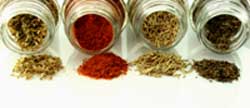 Proper Dry
Storage - Providing the
proper storage for your cache of spices will insure consistent
flavors and maintain their quality. The ideal
condition for your spices is a cool, dry, dark environment. Without
sunlight and heat, spices retain the strength of their flavors and
lengthen their shelf life. When cooking, take
care to open the spice container away from any steaming pots on the
stove. Moisture may cause clumping and deterioration of the
flavors. Proper Dry
Storage - Providing the
proper storage for your cache of spices will insure consistent
flavors and maintain their quality. The ideal
condition for your spices is a cool, dry, dark environment. Without
sunlight and heat, spices retain the strength of their flavors and
lengthen their shelf life. When cooking, take
care to open the spice container away from any steaming pots on the
stove. Moisture may cause clumping and deterioration of the
flavors.
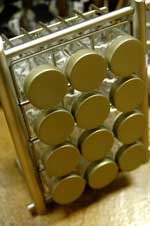 Organization - We've all ended up with three containers
of oregano, but no basil in the middle of preparing an Italian
menu. A good system for organizing spices allows
for an efficient inventory before shopping, and facilitates finding
the right spice quickly when cooking. Organizers
come in many different shapes and materials, from magnetic
containers and spinning carousels to drawer
dividers. Organization - We've all ended up with three containers
of oregano, but no basil in the middle of preparing an Italian
menu. A good system for organizing spices allows
for an efficient inventory before shopping, and facilitates finding
the right spice quickly when cooking. Organizers
come in many different shapes and materials, from magnetic
containers and spinning carousels to drawer
dividers.
Fresh
Storage - Fresh herbs can
be stored in the refrigerator for up to 10 days.
Wash and pat dry the fresh sprigs, wrap loosely in a paper
towel and place in a plastic bag. Alternatively,
place the bunch of herbs in a glass of water, and cover the top with
a loose plastic bag. Store herbs in the warmer locations of the
refrigerator as many of the tender leaves, (especially basil), are
susceptible to colder temperatures.
Freezing - Fresh herbs may be frozen for extended
storage. Wash the herbs well, remove the stems.
Pack the leaves in an ice cube tray with a slight amount of
water. Alternatively, freeze leaves in a single layer. Once frozen,
store cubes or frozen leaves in a zippered plastic bag.
Chopping -- Fresh herbs may be minced or cut into
strips with a chiffonade technique. A good chef's
knife will make quick work of this step. Kitchen
shears are handy for a coarser cut. Chop or chiffonade herbs
immediately before using for optimum flavor.
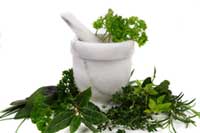 Grinding - A protective barrier surrounding many
whole seed spices extends their shelf life to 2-3 years.
Whole spices may be crushed manually with a mortar and
pestle, or a mechanical spice grinder. A coffee
grinder or a small food processor are also perfect for the
task. Grinding - A protective barrier surrounding many
whole seed spices extends their shelf life to 2-3 years.
Whole spices may be crushed manually with a mortar and
pestle, or a mechanical spice grinder. A coffee
grinder or a small food processor are also perfect for the
task.
Toasting -- Some spices can be toasted or dry-roasted to
heighten the flavor and bloom the aroma.
Heat-inspired spices include cumin, sesame seeds, fennel
seeds, poppy seeds, coriander, and mustard seeds.
Place seeds in a heavy, dry skillet over medium
heat. Stir or shake the pan frequently until
fragrant - a mere 1-3 minutes.
Shelf
Life - Ground spices lose
their potency quickly due to the large surface area
exposed. Use both ground spices and dried herbs
within a year.
|
Type |
Recommended Shelf
Life |
|
Ground
spice |
6 month-1
year |
|
Whole spice
(seeds) |
2-3
year |
|
Dried
herbs |
6 month -1
year |
|
Fresh
herbs |
Up to 10 days
in fridge |
|
Frozen
herbs |
1
year | |
Fresh Herbs
|
|
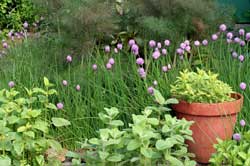 Fresh
herbs differ from dried herbs in many ways. Dried
herbs concentrate many of their flavors, but other plant qualities
are lost in the drying process. A general
rule-of-thumb is to use dried herbs at one-third the volume of a
fresh herb. If the dried herb is further processed into a ground
form, consider using one-quarter the volume. Fresh
herbs differ from dried herbs in many ways. Dried
herbs concentrate many of their flavors, but other plant qualities
are lost in the drying process. A general
rule-of-thumb is to use dried herbs at one-third the volume of a
fresh herb. If the dried herb is further processed into a ground
form, consider using one-quarter the volume.
Fresh herbs are
renowned for, well, a fresh flavor. Access to
fresh herbs is sometimes difficult; a do-it-yourself solution is in
order. Growing fresh herbs offers convenience and
a ready supply of some favorites year-round.
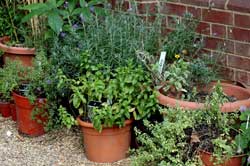
Herbs can be grown indoors or outdoors depending on the
season. Many plants will do well in either
condition, though indoor herbs tend to be generally less productive.
Take the following guidelines into consideration:
Outdoor
Growing
Light - Most herbs need 6-8 hours of sunlight to
produce the maximum amount of the oils responsible for their
signature flavor and aroma. Herbs will grow in
partial shade, but the growth and quality will be less and slower
than plants grown in full sunlight.
Soil - Herbs prefer a neutral soil with adequate
drainage. 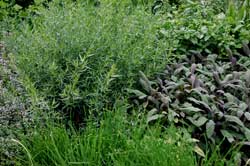 Herbs do not like
"wet feet," that is, their roots require a moist, but well-drained
environment. A good garden soil rich in organic matter and minimal
clay will work well. If the soil is too heavy,
work in some sand and/or compost. Various mints with their woody
roots will withstand moist environments better than most herbal
plants. Herbs do not like
"wet feet," that is, their roots require a moist, but well-drained
environment. A good garden soil rich in organic matter and minimal
clay will work well. If the soil is too heavy,
work in some sand and/or compost. Various mints with their woody
roots will withstand moist environments better than most herbal
plants.
Water - Provide enough moisture, (if Mother
Nature does not), to keep the soil moist but not saturated. Excess
water can cause root rot and other scourges detrimental to plant
growth.
Harvest - Herbs should be harvested in mid-morning
when the leaves are most flavorful and the amounts of aromatic oils
are at their highest. Harvesting continually and
consistently throughout the growing season will encourage ongoing
plant growth and ready access to the preferred new leaves of the
plant.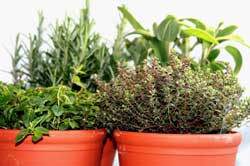
Indoor
Growing
Light - Getting enough sunlight during wintertime
will be the biggest challenge since the herbs still require their
daily 6-8 hours of light. During the winter,
plants may be placed in a south or west-facing window.
However, on very cold days, make sure their window position
is still warm enough. Growing lights supplement
natural sunlight during low light months.
Soil - A mixture of two parts potting soil to
one part coarse sand, and one part perlite will provide a good
substrate for indoor growth. Choose a pot large
enough for some healthy growth and one that provides for adequate
drainage. A larger pot will retain moisture for a
longer period of time in the dry, indoor climates of
winter.
 Water - Water as needed to keep the soil moist
without overwatering. Water - Water as needed to keep the soil moist
without overwatering.
Harvest - Similar to an outdoor environment, a
mid-morning harvest will supply herbs with the most
flavor.
There are great
growing kits available that supply seed, soil, and growing
lights. Check out the Aero Garden made especially
for the culinary gardener. |
| Plan Ahead Tip |
 Tip
#1:
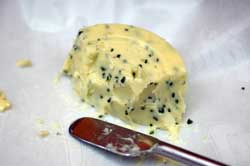
Prepare a "compound butter" and enjoy
wonderful herbal flavors for up to a month. A
compound butter is comprised of butter whipped with other
ingredients, such as a fresh herb, chopped shallot and a little
wine. The butter mix may be molded into
individual shapes, rolled into a log for thin slicing in the future,
or placed in a utility container. Mix one
tablespoon of herbs with one-quarter pound of butter.
Use on grilled meats, warm bread, or steamed
vegetables. Invent your own combinations of
compound butter, or try one of these
suggestions: (1) basil, shallots, and lemon juice, (2)
parsley and garlic, (3) chives,
black pepper, parsley and your favorite bleu
cheese. Tip
#1:
Prepare a "compound butter" and enjoy
wonderful herbal flavors for up to a month. A
compound butter is comprised of butter whipped with other
ingredients, such as a fresh herb, chopped shallot and a little
wine. The butter mix may be molded into
individual shapes, rolled into a log for thin slicing in the future,
or placed in a utility container. Mix one
tablespoon of herbs with one-quarter pound of butter.
Use on grilled meats, warm bread, or steamed
vegetables. Invent your own combinations of
compound butter, or try one of these
suggestions: (1) basil, shallots, and lemon juice, (2)
parsley and garlic, (3) chives,
black pepper, parsley and your favorite bleu
cheese.
 Tip
#2:
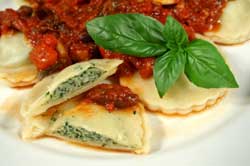
Reserve a few stems of whatever fresh herb you
are cooking with for garnishing the finished dish.
The herbal garnish may take the form of chopped herbs
sprinkled over soup, rice, or pasta, a chiffonade of basil on a
salad or pasta, or the classic sprig of mint on any dessert or
fruity drink. The splash of green color goes a
long way toward feeding our eyes and
anticipation. Tip
#2:
Reserve a few stems of whatever fresh herb you
are cooking with for garnishing the finished dish.
The herbal garnish may take the form of chopped herbs
sprinkled over soup, rice, or pasta, a chiffonade of basil on a
salad or pasta, or the classic sprig of mint on any dessert or
fruity drink. The splash of green color goes a
long way toward feeding our eyes and
anticipation.
|
Q
& A's
|
|

Q. I love having fresh mint
available in the kitchen, but it has taken over my garden. Is there
something I can do?
A.
Find a large
shrub-sized plastic garden pot, 12-14 inches tall, and remove the
bottom of the pot with a pair of garden shears.
Dig a hole as deep as the pot; line the hole with the
bottomless pot with the rim an inch above dirt level.
Plant the mint inside the buried
pot. 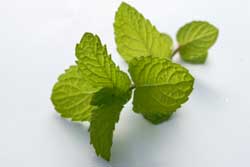 The aggressive
roots that lie near the ground's surface will be contained in this
makeshift fortress, yet water will be allowed to drain. The aggressive
roots that lie near the ground's surface will be contained in this
makeshift fortress, yet water will be allowed to drain.
Q:
How do I know if a
spice is fresh?
A: When spices are first opened write the date
on the container so the freshness can be tracked easily.
Spices will not "go bad"
(as in rot), but they will lose their flavor and
potency. A change in color or a decrease in the
aroma may indicate age. To check the aroma, rub some of the spice
between your fingers; a spice should greet you with an immediate,
full fragrance.
Q. What is a bouquet
garni?
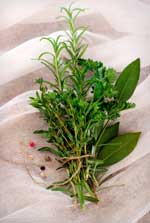 A. Bouquet garni is
the French term given to a bundle of fresh herbs, typically thyme, parsley, and bay
leaf. The
bundle is tied together with a string or placed in a small
cheesecloth bag. The herbs are used to flavor
stews, stocks, and soups. When the cooking is
complete, the bundle is easily removed from the finished dish prior
to serving. A. Bouquet garni is
the French term given to a bundle of fresh herbs, typically thyme, parsley, and bay
leaf. The
bundle is tied together with a string or placed in a small
cheesecloth bag. The herbs are used to flavor
stews, stocks, and soups. When the cooking is
complete, the bundle is easily removed from the finished dish prior
to serving.
Q:
If I use my coffee
grinder to grind spices, how do I clean it?
A:
Place a
few tablespoons of sugar, or white rice in the grinder and process.
The pulverized sugar or rice will absorb any oils and dust remaining
from the grinding of spices. Depending on how often you use whole
spices, keep a separate coffee grinder solely for spices. It is
important to note that allspice and cloves contain an oil called
eugenol that can damage plastic parts in machines; crush these
spices manually.
|
| Recipe |
|
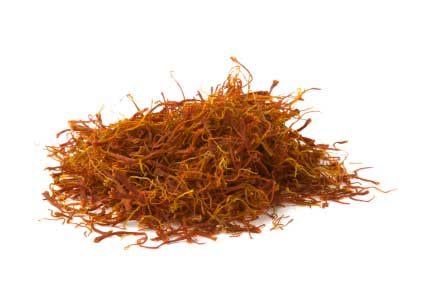 Saffron
is gold in the spice cabinet, not just because of its price, but for
the wonderful, unique flavor that it imparts to a dish.
Saffron is the stigma (top of a flower's pistil) from a
specific species of crocus flowers. Each flower
contains only three stigmas, also called saffron threads. Saffron
must be collected by hand in Mediterranean countries during a
two-week flowering period in the fall. The stigmas from 75,000
crocuses make about one pound of saffron.
Fortunately, a little saffron goes a long way making it
occasionally affordable and always delectable. Saffron
is gold in the spice cabinet, not just because of its price, but for
the wonderful, unique flavor that it imparts to a dish.
Saffron is the stigma (top of a flower's pistil) from a
specific species of crocus flowers. Each flower
contains only three stigmas, also called saffron threads. Saffron
must be collected by hand in Mediterranean countries during a
two-week flowering period in the fall. The stigmas from 75,000
crocuses make about one pound of saffron.
Fortunately, a little saffron goes a long way making it
occasionally affordable and always delectable.
Saffron is featured
in paella, a classic rice dish cooked with seafood, chicken, and
vegetables. Paella is cooked in one pan, from
which it gets its name, the paella pan. It is
wide and shallow, typically 13 to 14 inches across with two looped
handles on either side. The saffron imparts a
distinctive flavor and a strong golden color to the
paella. Some paella recipes substitute tumeric
for the golden color, but nothing will replicate the saffron flavor
except saffron.
Add a pitcher of
sangria and your meal will be perfect!
(Click here for a
printable version of the
recipe - PDF format).
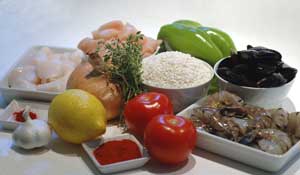 Spanish
Paella Spanish
Paella
1/4 cup olive
oil
3 chicken breasts, cut into large cubes
1/2 tsp.
salt
1/2 tsp. black pepper
1 large Spanish onion, medium
dice
1 green pepper, medium dice
4 cloves garlic, minced
2
tsp. Spanish paprika
1 T. fresh thyme (or 1 tsp. dried
thyme)
1 pound fresh shrimp, peeled and deveined
9 sea
scallops, (or 1 pound bay scallops)
2 cups Arborio rice
1 cup
tomatoes, finely chopped
5
cups chicken broth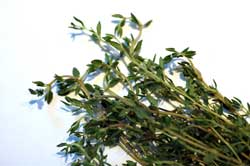
1/2 tsp.
saffron threads
1 cup baby
peas
1/2 cup roasted red peppers, cut into strips
12 clams in
shell (or 18 mussels)
1/4 cup parsley, chopped
1 lemon, cut
into wedges
2 scallions, cut in a thin diagonal
(1) Have all
ingredients measured and readied before cooking - mise en
place!
(2) Heat 3 tbsp
oil in large skillet on medium high heat.
(3) Add chicken pieces
and fry 3 to 4 minutes per side until golden.
(4) Remove from
skillet and season with salt and pepper.
(5) Add onions and
peppers to skillet.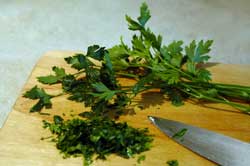
(6) Sauté 2
minutes.
(7) Stir in garlic, paprika and thyme.
(8) Sauté 1 minute and add shrimp.
(9)
Sauté until shrimp just turn pink.
(10) Remove from
skillet.
(11) Add 1 Tbsp oil if needed.
(12) Sprinkle rice
into pan.
(13) Sauté,
stirring frequently 2 to 3 minutes or until coated with oil.
(14)
Stir in tomatoes.
(15) Combine stock and saffron and stir into
rice mixture.
(16) Bring to
boil.
(17) Boil for about 2
minutes,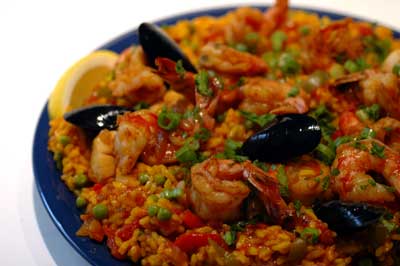 reduce heat to
medium. reduce heat to
medium.
(18) Return chicken
to the pan, pushing down into rice.
(19) Cook uncovered for 15
minutes.
(20) Stock should
be bubbling.
Stir rice, add shrimp, scallops, peas, red peppers
and clams/mussels.
(21) Cook for 10 minutes longer.
(22)
Remove from heat and cover for 10 minutes.
(23) To serve,
sprinkle with parsley and garnish with lemon wedges and green
onions.
Adapted from RecipeZaar, Copyright 2007. Reprinted
with
permission. | |




 LIVESTRONG is a well-known campaign
initiated by famous bike racer, Lance Armstrong. He has used the
notireity gained in the biking world and as a cancer survivor to
advance the causes fighting cancer. The bright yellow of LIVESTRONG,
echos the bright yellow shirt worn by the winning cyclist in
the Tour de France. Proceeds from the sale of the LIVESTRONG mugs go
towards cancer research and therapies.
LIVESTRONG is a well-known campaign
initiated by famous bike racer, Lance Armstrong. He has used the
notireity gained in the biking world and as a cancer survivor to
advance the causes fighting cancer. The bright yellow of LIVESTRONG,
echos the bright yellow shirt worn by the winning cyclist in
the Tour de France. Proceeds from the sale of the LIVESTRONG mugs go
towards cancer research and therapies.