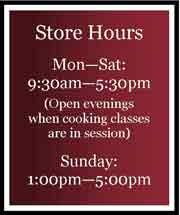
Store
Hours
|
 |
KA on
WTTV
|
| Just in case
you missed our latest TV segments on Ch. 7/WTVW, you
can still access the recipes at our website.
|
Bring a
Bag
|
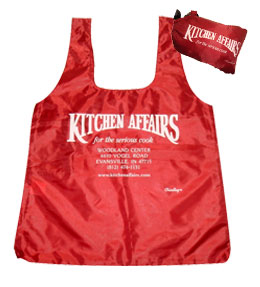 BRING A
BAG, SAVE A TREE,FEED A
FAMILY!Over $850 was raised
in 2009! Thank You! BRING A
BAG, SAVE A TREE,FEED A
FAMILY!Over $850 was raised
in 2009! Thank You!
Each time you make a
purchase and don't need a bag, or provide your own, we will donate
ten cents to the Tri-State Food Bank. If you don't need a bag, watch
us drop a dime in the jar on the counter. We thank you, and the
Tri-State's neediest families thank you,
too. ALL DONATIONS IN OUR JAR
WILL GO TO
THE TRI-STATE FOOD
BANK! | |
|
Good
Morning!
|
"Breakfast is
the most important meal of the day!" These words, from hundreds of
mothers everywhere, linger in our minds. "Breaking the fast" is one
of our most favorite mealtimes. After eight or so hours, food tastes
particularly good! The range of possibilities extends from simple to
complex. In this issue, we focus on some of our favorite breakfast
breads that are perfect any time of day. 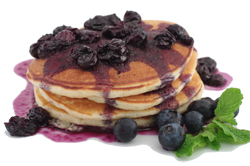 If it's been awhile since you've had fresh
waffles or homemade pancakes, you'll be delighted to become
reacquainted with these pleasures. This edition focuses on just a
few of the breakfast bread options available and delves into the
secrets for mixing up all kinds of yummy quick breads. We finish
with some great recipes for waffles, pancakes, and morning muffins.
It's just the tip of the iceberg as far as breakfast possibilities
go, but not a bad place to start for rediscovering fresh, homemade
breakfasts! If it's been awhile since you've had fresh
waffles or homemade pancakes, you'll be delighted to become
reacquainted with these pleasures. This edition focuses on just a
few of the breakfast bread options available and delves into the
secrets for mixing up all kinds of yummy quick breads. We finish
with some great recipes for waffles, pancakes, and morning muffins.
It's just the tip of the iceberg as far as breakfast possibilities
go, but not a bad place to start for rediscovering fresh, homemade
breakfasts!
|
Cooking
Classes
|
 The class schedule for January, February, and
March is available NOW! The class schedule for January, February, and
March is available NOW!
Consider a Valentine's gift for both
of you -- take a cooking class together! It's a fun evening of good
food and good company!
Check out our website to see the
entire Class Schedule and
complete class descriptions later this month!
Thursday, Jan. 21 - 6:30 p.m. - Hearty Winter Soups
with
Nicki Leathem. $35
Saturday, Jan. 23 - 9:30 a.m. - Over-the-Top Valentine Baking
with Deena Stovall. $55
Sunday, Jan. 24 - 1:30 p.m. -
Hunker-Down Home
Co oking with Deena Stovall.
$50 oking with Deena Stovall.
$50
Monday, Jan. 25 - 6:30 p.m. -
A Shaker Supper Menu
with Stephen Lee. $48
Wednesday, Jan. 27 - 6:30 p.m. - Making Molded Cookies with
Connie Meisinger. $42
Thursday, Jan. 28 - 6:30 p.m. -
Hot Wok, & Easy!
with Shelly Sackett. $45
Saturday, Jan. 30 - 10:00 a.m. - Kids Make Soups 'N'
Stews
with Peg Neireiter.
$40
Sunday,
Jan. 31 - 2:00 p.m. - New Food Processor Tips &
Tricks with Mary Rezek. $40

Tuesday, Feb. 2 - 6:30 p.m. - Chocolate Entrees
with Aimee
Blume. $48
Thursday, Feb. 4 - 6:30 p.m. - Our Family's Favorites
with Shelly Sackett. $45
Saturday, Feb. 6 - 10:00 a.m. - Decorating Cookies for
Valentine's with Cathy Webb. $40
Sunday, Feb. 7 - 2:00 p.m. - Little Guys' Valentine's Day
Party with Peg Neireiter. $40
| |
The Quick in Quick
Bread!
|
Many breakfast
breads fall into the category of bread known as "quick breads."
Unlike yeast-based breads that take time for the yeast to work its
magic, quick breads produce immediate results. 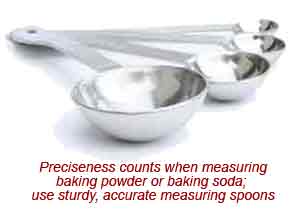 The chemistry behind quick breads is
interesting, and a basic understanding of what's going on will help
produce excellent outcomes every time. The chemistry behind quick breads is
interesting, and a basic understanding of what's going on will help
produce excellent outcomes every time.
At its most basic
level, bread is grain flour restructured around air bubbles.
Creating, growing, and capturing air bubbles is the magic of making
any bread. For yeast-based breads, the yeast "breathes" out carbon
dioxide as it multiplies in sitting dough. In contrast, quick breads
rely on a natural, immediate chemical reaction from baking soda
and/or baking powder to produce carbon dioxide. In either case, the
carbon dioxide expands the bubbles already present from the mixing
process. Both liquid and heat can activate these substances into
producing carbon dioxide gas. The expanded bubbles are captured as
the dough is baked and as the flour's proteins harden around the
little air pockets.
Baking
Soda - Baking soda is sodium bicarbonate. When in contact
with liquid and heated, it dissolves into carbon dioxide gas and
sodium carbonate. The carbon dioxide expands air bubbles already
present in the batter, while the sodium carbonate remains behind as
a slightly alkaline substance that is neutralized by any acidic
ingredient in the batter such as sour cream, buttermilk, or citrus
juice, etc.
 Baking
Powder - Baking powder is a combination of baking soda, some
type of powdered acid, and cornstarch. In one teaspoon of baking
powder, there is only 1/4 teaspoon of baking soda. The baking soda
produces carbon dioxide gas while the acidic component neutralizes
the remaining sodium carbonate. The cornstarch keeps the powders
mixed and dry. The acidic component of baking powder is matched in
strength to the amount of baking soda present so that the end result
is neutral to the batter. The acidic component is also responsible
for when and how quickly baking powder acts once in contact with
liquid. Fast-acting baking powder produces gas immediately upon
contact with liquid. Slow-acting baking powder inspires the release
of gas only when heated. Double-acting baking powder has two
different acidic components that do both. Baking
Powder - Baking powder is a combination of baking soda, some
type of powdered acid, and cornstarch. In one teaspoon of baking
powder, there is only 1/4 teaspoon of baking soda. The baking soda
produces carbon dioxide gas while the acidic component neutralizes
the remaining sodium carbonate. The cornstarch keeps the powders
mixed and dry. The acidic component of baking powder is matched in
strength to the amount of baking soda present so that the end result
is neutral to the batter. The acidic component is also responsible
for when and how quickly baking powder acts once in contact with
liquid. Fast-acting baking powder produces gas immediately upon
contact with liquid. Slow-acting baking powder inspires the release
of gas only when heated. Double-acting baking powder has two
different acidic components that do both.
Why it's important to not over mix
- Bubbles, the essential texture component of bread, are introduced
as the batter is made. Most quick breads call for a minimal amount
of mixing; this is to preserve the air bubbles in the batter.
Neither baking soda nor baking powder create bubbles, they only
expand existing bubbles. 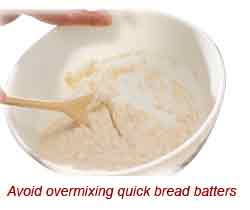 Too much stirring removes air from the
batter and can create a flat product. Instead of additional
stirring, some recipes call for the batter to set 5 minutes so that
the dry ingredients can absorb the liquid. Too much stirring removes air from the
batter and can create a flat product. Instead of additional
stirring, some recipes call for the batter to set 5 minutes so that
the dry ingredients can absorb the liquid.
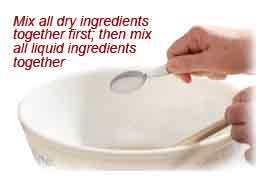
Why it's important to mix dry and liquid
ingredients separately - In order to stir the batter as
little as possible, mix all of the dry ingredients of the recipe
together allowing the baking soda and/or baking powder to be evenly
dispersed. Similarly, mix all of the liquids together separately.
This allows for minimal stirring once the liquids are added to the
dry ingredients.
The potency of baking soda and baking powder
diminishes over time. Store baking soda and baking powder in a cool,
dry cupboard. Check expiration dates on containers when purchasing,
and note the date of opening on the container. Generally, use these
products within six months from
opening. |
Waffles &
Pancakes
|
|
We love our friends' tradition of waffles every Sunday morning!
It's something to look forward to, is deceptively easy to make, and
is a delicious way to enjoy a weekend morning. And, in our minds,
pancakes and sausage make the perfect quick supper that everyone
enjoys! There are just a few tricks to becoming comfortable with
making griddle and iron breads - we'll share them with you and have
you an expert in no time!
Waffles - Let's face it,
the little pockets in waffles are a bit of genius; they hold perfect
amounts of syrup and toppings while the delicate crust provides
extra delicious golden brown flavor. To make excellent waffles,
follow the tips below!
Choosing a Waffle Iron -
Waffles aren't waffles without the grid of ridges and valleys. It
takes a special cooking iron - a waffle iron - to get these molded
results. Waffle irons come in many shapes and sizes and produce
varying results. Here are some tips for choosing a great waffle
iron:
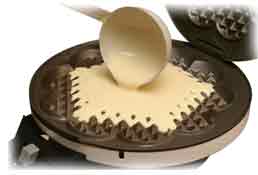 Select a non-stick surface; it makes
removing fresh waffles effortless and clean up easy. Select a non-stick surface; it makes
removing fresh waffles effortless and clean up easy.
- Choose a size that fits your need; there are many compact
waffle irons available that make cupboard storage very doable.
- Note cord management strategies; a place to wind and secure
the cord makes set-up and storage easy.
- Select a model that has fine controls for heat management;
many models have the nice feature of a "ready" light when properly
heated and when the waffle is done.
- Check the style of handles and ensure that they stay cool to
the touch.
Making Waffles - Follow
the quick bread batter techniques noted above for making the waffle
mix. Follow these steps for great waffles every time:
-
Place the waffle iron on a level surface with safe cord
arrangements.
-
Preheat the waffle iron in a closed position until very
hot.
-
Use the exact amount of batter prescribed for your specific
iron. This will adequately fill the griddle, yet not cause an
overflowing mess. 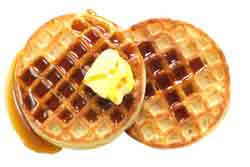 -
Set the level of doneness desired and allow the iron to do
its work; avoid the temptation to peek at the progress. The
perfect waffle is evenly golden -- not too light, not too
dark.
-
Serve waffles as soon as possible - nothing beats the
freshness! If you must, keep waffles warm in a 200ºF oven, covered
loosely, while the second and third batch cook.
-
When finished, allow the waffle iron to cool in an open
position; it will cool more quickly.
Pancakes - A stack of
pancakes, steaming hot, evokes many childhood memories for us! A pat
of butter and a drizzle of syrup complete the picture!
Choosing a Pancake
Griddle - Pancakes do not require a special iron like
waffles, but may be made on the stovetop or on a flat griddle of any
type. Consider the following when choosing a pancake-making
surface:
-
Choose a pan with a non-stick surface for easy management and
great results.
-
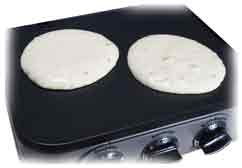 A cast-iron skillet is great for making
pancakes because it recovers its heat quickly after confronted
with cool batter. Make sure it is seasoned well. Add oil to the
pan as it heats removing any excess oil with a paper
towel. -
A stovetop griddle allows for making multiple pancakes at a
time. Choose a stovetop griddle that conducts heat very
efficiently so that there are no hot or cool spots, but only even
heat.
-
A griddle appliance is very useful for pancakes; choose a
griddle whose coils are positioned for even heating across the
griddle, and where the temperature is easily controlled and
responsive.
Making Pancakes - Follow
the quick bread batter techniques noted above for making the pancake
mix. You'll have great pancakes every time with these tips:
If using a griddle, place it on a level surface with safe cord
arrangements.
-
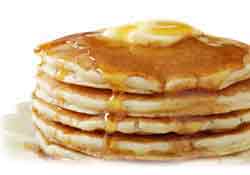 Preheat the skillet or griddle until
hot. -
Test the heat of the pan with a mini-test pancake. Place a
dollop of pancake batter on the hot surface. Adjust the heat
accordingly.
-
Turn the pancake when bubbles float to the top and pop on the
surface of the batter. Turn pancakes only once. The time required
for cooking a pancake will vary based on the nature and thickness
of the batter.
-
If the surface of the pancake is splotchy white and brown,
this may be due to excess oil on the cooking surface; wipe the
surface with a paper towel to absorb any excess oil and cook the
next cake.
-
Serve pancakes fresh from the griddle! As noted above, if you
must keep pancakes warm while additional cakes are cooking, keep
them warm in a 200ºF oven covered loosely with a square of
foil.
|
Marvelous
Muffins
|
Muffins are
favorite breakfast breads that also fall into the quick bread
category. The flavor and add-in options for muffins are nearly
endless! As easy as muffins are to make, excellent results are often
elusive. Based on the same quick bread chemistry as waffles and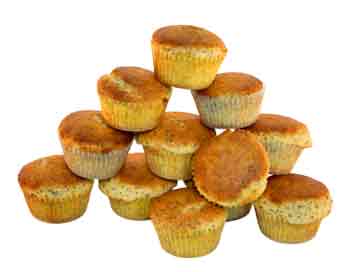 pancakes, use the tips above and the tricks
below to make marvelous muffins every time! pancakes, use the tips above and the tricks
below to make marvelous muffins every time!
There are two
things to get right when making muffins:
Proper Mixing - Mix dry ingredients
together, the wet ingredients together, then combine the two. Stir
by hand only enough to incorporate the wet and dry together. The
most common error when making muffins is to over mix the batter. The
dry ingredients should just be wet. The batter will be lumpy -
that's ok - avoid the urge to make a smooth batter.
Optimal Oven Temperatures - When
baking, the outside of the muffin is set immediately, while the
inside continues to bake. The batter's bubbles expand during baking
and push the center of the muffin upwards since there is no other
place to go. Muffins generally require a hot oven - 375ºF-400ºF - to
bake properly. Too hot, or too cool, and the results will be less
than perfect.
If you're having problems baking great
muffins, the shape of a baked muffin will reveal clues as to what is
going right and what might be wrong. The ideal muffin has a nicely
domed top, an even, coarse crumb and is done on the inside without
being overdone on the outside.
Sunken/Flat
Muffin - not mixed enough, too low an oven temperature, too
large a muffin cup, or too much, or too little, baking powder or
baking soda.
Pointed Peak
Muffin - results from over-mixing, or too hot an
oven
Perfect
Muffin - mixed just until batter is moistened; oven is the
perfect hotness; batter contains just the right amount of
leavener.
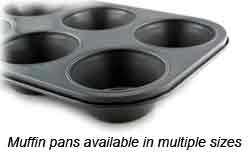
Muffin Pans
- The muffin pan you use will determine any required
adjustments to the recipe. Still use a hot oven, but adjust the
baking time. The smaller the muffin, the shorter the baking
time.
 Mini-Muffin
Pans - these cute little minis hold about 1/8 cup, or 2 T. of
batter and will take about 6+/- minutes less to bake than a standard
size muffin. Mini-Muffin
Pans - these cute little minis hold about 1/8 cup, or 2 T. of
batter and will take about 6+/- minutes less to bake than a standard
size muffin.
Standard Muffin
Pans - these pans hold about 1/2 cup of batter per muffin.
Unless specified otherwise, most muffin recipes assume a standard
muffin size.
Jumbo Muffin
Pans - these pans can hold up to 1 cup of batter and will
take 10+/- minutes longer to
bake.
|
Smart Breakfast Bread
Tips
|
Tip #1: Freeze extra waffles for
your own toaster version of breakfast on the go - they are
incredibly less expensive than boxed, pre-frozen waffle choices.
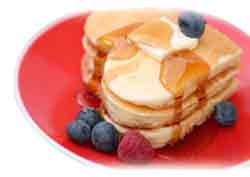 Tip #2: Make pancakes fun by
pouring the batter into special shapes; creatively experiment with
your pouring technique or use special pancake
shape-makers. Tip #2: Make pancakes fun by
pouring the batter into special shapes; creatively experiment with
your pouring technique or use special pancake
shape-makers.
Tip #3:
Use a small sticky note to jot down your favorite pancake or
waffle ingredients and basic instructions. Post the note on the
inside of a cupboard. Quick access to this information will get you
started easily and enjoying your favorite breakfast bread more
often.
Tip #4: Make
your own pancake or waffle mix by combining all dry ingredients
together and storing in a jar, canister, or a zippered plastic bag.
Note the wet ingredients and the ratio of wet to dry on the outside
of the container with a taped note card, or a strip of masking
tape.
Tip #5: For a
fluffier pancake or waffle, separate the egg, beat the egg whites
until stiff, then fold them into the batter as the last step. The
result is a different, lighter texture.
Tip #6: Get familiar with your
waffle iron and what happens to the batter as you close the iron. If
the batter is pushed forward from the hinge, adjust the placement of
the batter accordingly.
Tip
#7: Experiment with basic pancake and waffle batters with the
simple addition of cinnamon, or vanilla, or even a drop of almond
flavoring.
Tip
#8: When brushing butter or oil onto the surface of a
griddle or waffle iron, we strongly recommend a silicone basting
brush. The bristles won't melt or pull out, to leave a sticky mess
or "hairs" in your food. We carry them in a range of sizes, from
mini for brushing butter on muffin tops to barbeque, with long
handles, and several sizes and styles in between.
Tip #9: Use your waffle iron
to make French toast. The grid imprint makes things a bit more
interesting and holds syrup nicely! Try making a grilled cheese
sandwich in your waffle iron or any thin panini-style
sandwich.
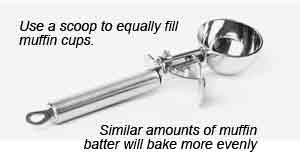 Tip
#10: Use a batter scoop to evenly place muffin batter into
the baking cups. This will help to ensure same-sized muffins and
even baking. Tip
#10: Use a batter scoop to evenly place muffin batter into
the baking cups. This will help to ensure same-sized muffins and
even baking.
Tip #11:
Mix muffins and place the batter in individually lined cups. Freeze
well. Once frozen, store the "nearly ready" muffins in a zippered
plastic bag. When ready to bake, place the frozen units in the
muffin tin and add 10 extra minutes to the baking
time.
|
Mike's
Corner
|
The British
isles and America are about the only countries that make a big
distinction between "breakfast foods" and foods eaten at other
times. Throughout Asia and Latin America the same foods are eaten in
the morning, at noon, and at night, interchangeably. Maybe that's
why Mike's favorite breakfast is an aged Cheddar and onion omelet,
topped with chile con carne and diced jalapenos . . . (When I was in
college, I also loved sourdough pancakes topped with chile, cheese
and onions. If you haven't tried it, don't knock it!)
When
you travel overseas, plan on big breakfasts. In Israel, for example,
you'll have a choice of 4 or 5 fish dishes, all served cold, a
variety of cheeses and great breads of all kinds, and several
vegetable and fruit salads, too. When we were in Spain, it was
cheeses, sausages, fruits, breads, olives and pickled vegetables.
Notice that each one includes breads; the carbohydrates release
their sugar slowly to keep your energy level even throughout the
day. Every breakfast should include grains of some kind, either in
cereal or in breads.
One of my favorite muffins is one that
was taught in one of our first cooking classes in the store by
"Frenchie" Gerbig. I've frozen these, tightly wrapped in plastic,
then grabbed a couple and thrown them into a pocket as I headed out
the door to go hunting, fishing or hiking. They're really nutritious
and filling, too. Your kids will love them for breakfast, in their
lunch boxes or as an after-school snack.
PINEHURST
CAKES (Makes 18 muffins)
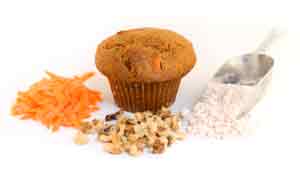
2 cups all-purpose flour
1¼ cups
sugar
2 teaspoons ground cinnamon
1/2 teaspoon salt
1 cup
corn oil
2 teaspoons pure vanilla extract
2 cups grated
carrots
3 eggs
1 cup apples, peeled and grated
1/2 cup
raisins
1/2 cup chopped pecans, walnuts, or almonds
1/2 cup
shredded coconut
Preheat the oven to 350 F. Grease or
oil 18 regular-sized muffin or cupcake tins.
Combine the
flour, sugar, cinnamon, salt, oil, vanilla and eggs in a large mixer
and mix until well-blended. Fold in the carrots, apples, raisins,
nuts and coconut. Pour into the greased muffin tins, filling them
about 2/3rds to 3/4ths full. Bake in the preheated oven for 15
minutes, or until a cake tester inserted in the center comes out
clean. Serve hot or cold. Will keep, refrigerated, in an air-tight
container up to 1 week. May be frozen. OK to microwave on
medium-power to defrost. Great for a grab-and-go
breakfast.
Click here for a printable version of
the recipe (PDF
Format).
|
Q &
A's
|
 Q: What is a Belgian waffle, and how
does it differ from a plain, old waffle? Q: What is a Belgian waffle, and how
does it differ from a plain, old waffle?
A: A Belgian waffle is
generally denser and deeper than a traditional American waffle. The
"valleys" are deeper and the overall height taller. A Belgian
variant known as a Brussels waffle is made with a yeast batter and
produces a light and fluffy waffle. Another Belgian-style, a Liege
waffle features pieces of sugar in the batter that transform into
caramelized goodness when baked.
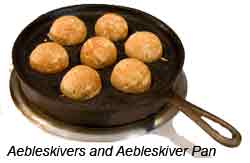 Q: What is an aebleskiver? Q: What is an aebleskiver?
A: An
aebleskiver (translated as "apple slices") is a specialized Danish
pancake. Aebleskivers require a special pan with deep, rounded
wells. The wells hold a batter, which puffs up nicely making a
rounded ball. The aebleskiver is turned with two sticks to brown the
topside. We like to fill the aebleskiver with a fruit filling. These
are a great treat - plan to make a lot of them for your breakfast
crew!
Q: What should I do
with leftover batter?
A: Any leftover waffle or
pancake batter can be kept in the refrigerator in an airtight
container for 1-2 days. Stir the batter before using to offset any
separation that may have happened during storage.
Q: My pancakes and waffles are tough
and chewy; what's wrong?
A: Most likely, your iron or
griddle is not hot enough. Try increasing the heat slightly until
the desired result is achieved. If the griddle or iron is not
recovering its heat between cakes, it may be time for a new
appliance; a good griddle or waffle iron should efficiently and
quickly manage a consistently hot
temperature. |
Cookbook
Review
|
The Big Book
of Breakfast by Maryana Vollstedt. Copyright 2003. Published
by Chronicle Books LLC, San Francisco, CA.
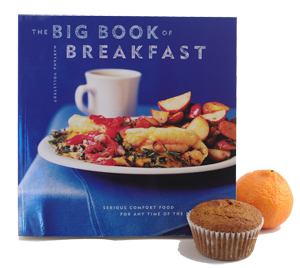 The subtitle of this book says it all -
"Serious Comfort Food for any Time of Day." This well-designed
cookbook covers all manner of breakfasts and breakfast foods. The
recipes are presented simply, yet thoroughly, in eighteen different
chapters focused on different breakfast categories. The recipes span
a broad range of breakfast options ranging from eggs, casseroles,
skillets, pancakes, waffles, crepes, meats, potatoes, breakfast
fruits, and so much more! We appreciated the inclusion of classic
breakfast recipes presented alongside many creative variations. This
book will be an inspiration for a "breakfast for one," or for a
full-fledged brunch for dozens. What a great way to say 'Good
Morning!' on any day, or at any time of
day! The subtitle of this book says it all -
"Serious Comfort Food for any Time of Day." This well-designed
cookbook covers all manner of breakfasts and breakfast foods. The
recipes are presented simply, yet thoroughly, in eighteen different
chapters focused on different breakfast categories. The recipes span
a broad range of breakfast options ranging from eggs, casseroles,
skillets, pancakes, waffles, crepes, meats, potatoes, breakfast
fruits, and so much more! We appreciated the inclusion of classic
breakfast recipes presented alongside many creative variations. This
book will be an inspiration for a "breakfast for one," or for a
full-fledged brunch for dozens. What a great way to say 'Good
Morning!' on any day, or at any time of
day!
|
Recipes for Breakfast
Breads
|
Recipes excerpted from The Big Book
of Breakfast by Maryana Vollstedt. Copyright 2003. Published
by Chronicle Books LLC, San Francisco, CA. Reprinted with the
permission of the publisher. All rights
reserved.
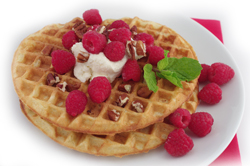 Buttermilk Waffles with Sweetened Cream
Cheese Buttermilk Waffles with Sweetened Cream
Cheese
We love our waffle iron and the
scrumptious waffles it makes! This recipe is a classic. The
buttermilk lends just a hint of tanginess to the finished result.
And, the sweetened, whipped cream cheese with berries were the
perfect visual and gustatory topping to this beautiful breakfast
treat! We can't say "Mmmmm..." enough!
Click here to view the full, illustrated
recipe.
Click here for a printable version of the
recipe. (PDF format)
Sour Cream Pancakes with Blueberry-Maple
Syrup
These pancakes are exactly what pancakes
should be - light, perfectly puffed and, oh, so delicious! The
generous dollop of sour cream in the batter is the secret to their
luscious moistness. The fresh blueberries steeped in genuine maple
syrup were a simple discovery that topped our stack beautifully and
tasted wonderfully.
Click here to view the full, illustrated
recipe.
Click here for a printable version of the
recipe. (PDF format)
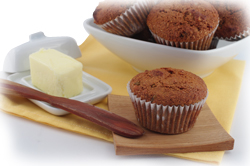 Real Bran Muffins Real Bran Muffins
Full of
flavor and moistness, these bran muffins rated five stars on our
list of muffin favorites! The best thing about these muffins is the
do-ahead nature of the batter. Mix it up and bake as desired.
Alternatively, bake the whole batch, cool, wrap individually, and
freeze. They are a great, satisfying answer to those "grab-and-go"
mornings!
Click here to view the full, illustrated
recipe.
Click here for a printable version of the
recipe. (PDF
format)
| |